

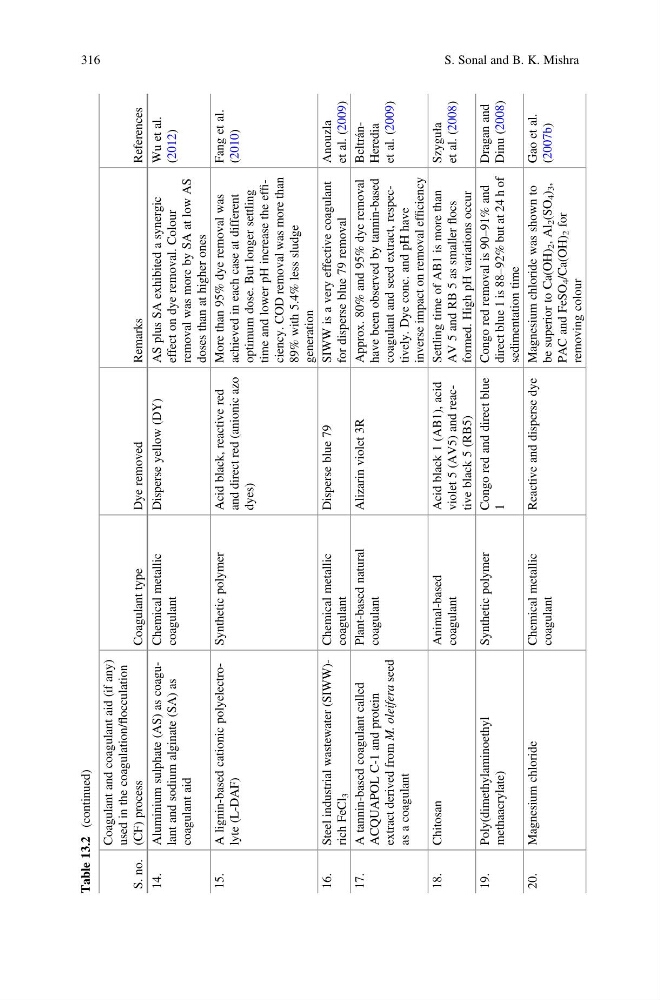
Table 13.2
(continued)
S. no.
Coagulant and coagulant aid (if any)
used in the coagulation/flocculation
(CF) process
Coagulant type
Dye removed
Remarks
References
14.
Aluminium sulphate (AS) as coagulant and sodium alginate (SA) as
coagulant aid
Chemical metallic
coagulant
Disperse yellow (DY)
AS plus SA exhibited a synergic
effect on dye removal. Colour
removal was more by SA at low AS
doses than at higher ones
Wu et al.
(2012)
15.
A lignin-based cationic polyelectrolyte (L-DAF)
Synthetic polymer
Acid black, reactive red
and direct red (anionic azo
dyes)
More than 95% dye removal was
achieved in each case at different
optimum dose. But longer settling
time and lower pH increase the efficiency. COD removal was more than
89% with 5.4% less sludge
generation
Fang et al.
(2010)
16.
Steel industrial wastewater (SIWW)rich FeCl
3
Chemical metallic
coagulant
Disperse blue 79
SIWW is a very effective coagulant
for disperse blue 79 removal
Anouzla
et al. (2009)
17.
A tannin-based coagulant called
ACQUAPOL C-1 and protein
extract derived from M. oleifera
seed
as a coagulant
Plant-based natural
coagulant
Alizarin violet 3R
Approx. 80% and 95% dye removal
have been observed by tannin-based
coagulant and seed extract, respectively. Dye conc. and pH have
inverse impact on removal efficiency
BeltránHeredia
et al. (2009)
18.
Chitosan
Animal-based
coagulant
Acid black 1 (AB1), acid
violet 5 (AV5) and reactive black 5 (RB5)
Settling time of AB1 is more than
AV 5 and RB 5 as smaller
flocs
formed. High pH variations occur
Szyguła
et al. (2008)
19.
Poly(dimethylaminoethyl
methaacrylate)
Synthetic polymer
Congo red and direct blue
1
Congo red removal is 90–91% and
direct blue 1 is 88–92% but at 24 h of
sedimentation time
Dragan and
Dinu (2008)
20.
Magnesium chloride
Chemical metallic
coagulant
Reactive and disperse dye Magnesium chloride was shown to
be superior to Ca(OH)
2 , Al
2 (SO
4 )
3 ,
PAC and FeSO
4 /Ca(OH)
2 for
removing colour
Gao et al.
(2007b)
316
S. Sonal and B. K. Mishra
(continued)
S. no.
Coagulant and coagulant aid (if any)
used in the coagulation/flocculation
(CF) process
Coagulant type
Dye removed
Remarks
References
14.
Aluminium sulphate (AS) as coagulant and sodium alginate (SA) as
coagulant aid
Chemical metallic
coagulant
Disperse yellow (DY)
AS plus SA exhibited a synergic
effect on dye removal. Colour
removal was more by SA at low AS
doses than at higher ones
Wu et al.
(2012)
15.
A lignin-based cationic polyelectrolyte (L-DAF)
Synthetic polymer
Acid black, reactive red
and direct red (anionic azo
dyes)
More than 95% dye removal was
achieved in each case at different
optimum dose. But longer settling
time and lower pH increase the efficiency. COD removal was more than
89% with 5.4% less sludge
generation
Fang et al.
(2010)
16.
Steel industrial wastewater (SIWW)rich FeCl
3
Chemical metallic
coagulant
Disperse blue 79
SIWW is a very effective coagulant
for disperse blue 79 removal
Anouzla
et al. (2009)
17.
A tannin-based coagulant called
ACQUAPOL C-1 and protein
extract derived from M. oleifera
seed
as a coagulant
Plant-based natural
coagulant
Alizarin violet 3R
Approx. 80% and 95% dye removal
have been observed by tannin-based
coagulant and seed extract, respectively. Dye conc. and pH have
inverse impact on removal efficiency
BeltránHeredia
et al. (2009)
18.
Chitosan
Animal-based
coagulant
Acid black 1 (AB1), acid
violet 5 (AV5) and reactive black 5 (RB5)
Settling time of AB1 is more than
AV 5 and RB 5 as smaller
flocs
formed. High pH variations occur
Szyguła
et al. (2008)
19.
Poly(dimethylaminoethyl
methaacrylate)
Synthetic polymer
Congo red and direct blue
1
Congo red removal is 90–91% and
direct blue 1 is 88–92% but at 24 h of
sedimentation time
Dragan and
Dinu (2008)
20.
Magnesium chloride
Chemical metallic
coagulant
Reactive and disperse dye Magnesium chloride was shown to
be superior to Ca(OH)
2 , Al
2 (SO
4 )
3 ,
PAC and FeSO
4 /Ca(OH)
2 for
removing colour
Gao et al.
(2007b)
316
S. Sonal and B. K. Mishra