

They concluded that with the implementation of advanced technology, the rate of
emission becomes reduced that directly affects the global warming potential.
Hossain et al. (2017) also concluded that both off-site sorting and direct landfilling
had shown a significant impact on the environment. Similarly, Landi et al. (2018)
discussed the LCA technique to measure the reusing of textile fibers that directly
benefit the environment. They maturely studied the textile material characterization
in order to determine the technical feasibility to obtain a clean and compact fiber for
further reuse instead of landfilling of the fiber. Horodytska et al. (2018) discussed
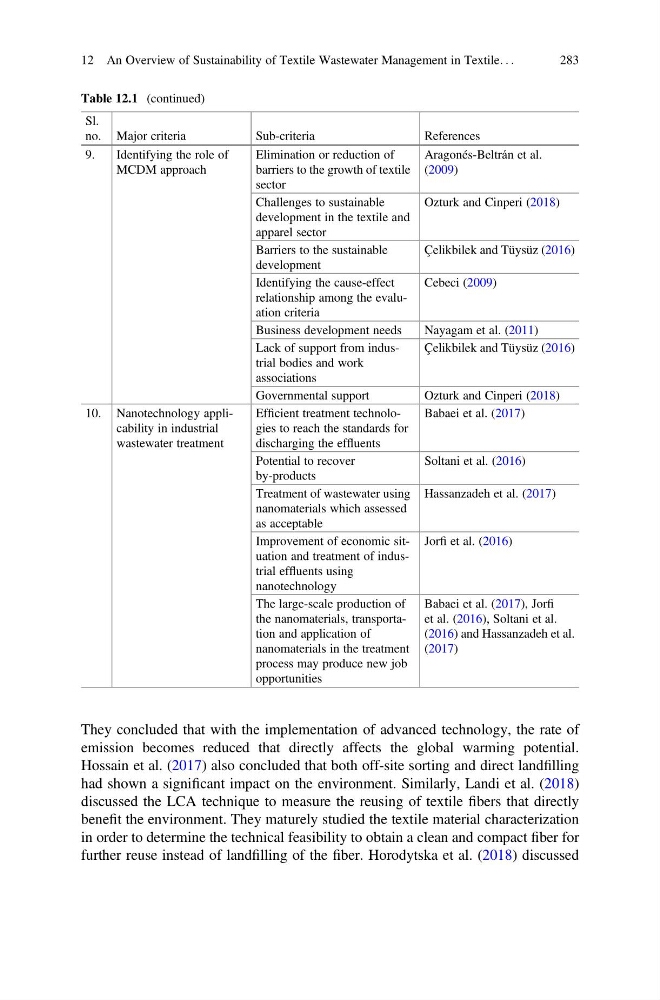
Table 12.1 (continued)
Sl.
no. Major criteria
Sub-criteria
References
9.
Identifying the role of
MCDM approach
Elimination or reduction of
barriers to the growth of textile
sector
Aragonés-Beltrán et al.
(2009)
Challenges to sustainable
development in the textile and
apparel sector
Ozturk and Cinperi (2018)
Barriers to the sustainable
development
Çelikbilek and Tüysüz (2016)
Identifying the cause-effect
relationship among the evaluation criteria
Cebeci (2009)
Business development needs
Nayagam et al. (2011)
Lack of support from industrial bodies and work
associations
Çelikbilek and Tüysüz (2016)
Governmental support
Ozturk and Cinperi (2018)
10. Nanotechnology applicability in industrial
wastewater treatment
Efficient treatment technologies to reach the standards for
discharging the effluents
Babaei et al. (2017)
Potential to recover
by-products
Soltani et al. (2016)
Treatment of wastewater using
nanomaterials which assessed
as acceptable
Hassanzadeh et al. (2017)
Improvement of economic situation and treatment of industrial effluents using
nanotechnology
Jorfi et al. (2016)
The large-scale production of
the nanomaterials, transportation and application of
nanomaterials in the treatment
process may produce new job
opportunities
Babaei et al. (2017), Jorfi
et al. (2016), Soltani et al.
(2016) and Hassanzadeh et al.
(2017)
12 An Overview of Sustainability of Textile Wastewater Management in Textile. . .
283
emission becomes reduced that directly affects the global warming potential.
Hossain et al. (2017) also concluded that both off-site sorting and direct landfilling
had shown a significant impact on the environment. Similarly, Landi et al. (2018)
discussed the LCA technique to measure the reusing of textile fibers that directly
benefit the environment. They maturely studied the textile material characterization
in order to determine the technical feasibility to obtain a clean and compact fiber for
further reuse instead of landfilling of the fiber. Horodytska et al. (2018) discussed
Table 12.1 (continued)
Sl.
no. Major criteria
Sub-criteria
References
9.
Identifying the role of
MCDM approach
Elimination or reduction of
barriers to the growth of textile
sector
Aragonés-Beltrán et al.
(2009)
Challenges to sustainable
development in the textile and
apparel sector
Ozturk and Cinperi (2018)
Barriers to the sustainable
development
Çelikbilek and Tüysüz (2016)
Identifying the cause-effect
relationship among the evaluation criteria
Cebeci (2009)
Business development needs
Nayagam et al. (2011)
Lack of support from industrial bodies and work
associations
Çelikbilek and Tüysüz (2016)
Governmental support
Ozturk and Cinperi (2018)
10. Nanotechnology applicability in industrial
wastewater treatment
Efficient treatment technologies to reach the standards for
discharging the effluents
Babaei et al. (2017)
Potential to recover
by-products
Soltani et al. (2016)
Treatment of wastewater using
nanomaterials which assessed
as acceptable
Hassanzadeh et al. (2017)
Improvement of economic situation and treatment of industrial effluents using
nanotechnology
Jorfi et al. (2016)
The large-scale production of
the nanomaterials, transportation and application of
nanomaterials in the treatment
process may produce new job
opportunities
Babaei et al. (2017), Jorfi
et al. (2016), Soltani et al.
(2016) and Hassanzadeh et al.
(2017)
12 An Overview of Sustainability of Textile Wastewater Management in Textile. . .
283