

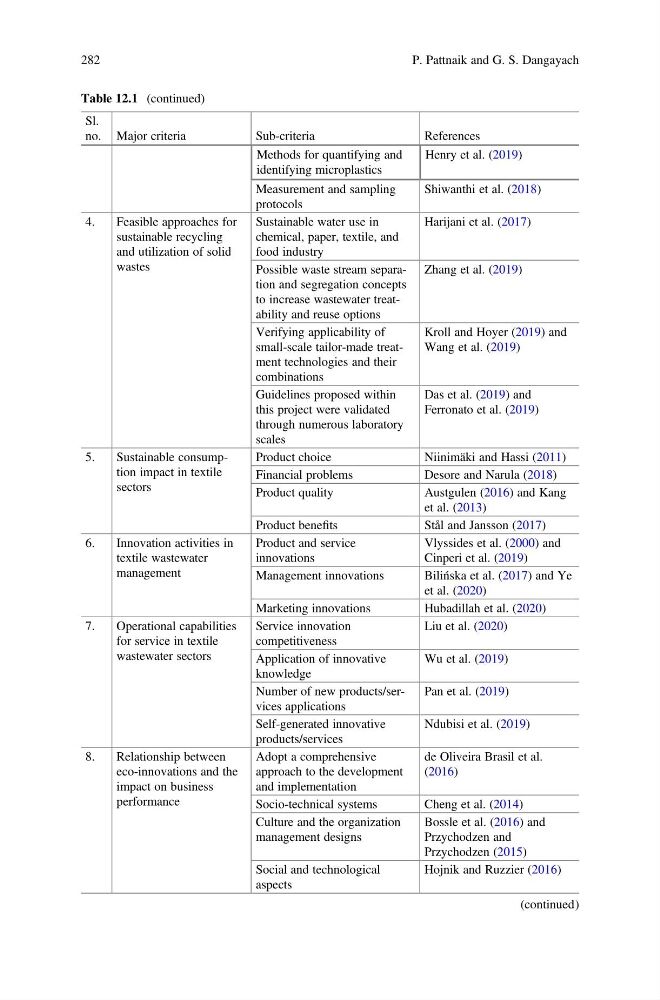
Table 12.1 (continued)
Sl.
no. Major criteria
Sub-criteria
References
Methods for quantifying and
identifying microplastics
Henry et al. (2019)
Measurement and sampling
protocols
Shiwanthi et al. (2018)
4.
Feasible approaches for
sustainable recycling
and utilization of solid
wastes
Sustainable water use in
chemical, paper, textile, and
food industry
Harijani et al. (2017)
Possible waste stream separation and segregation concepts
to increase wastewater treatability and reuse options
Zhang et al. (2019)
Verifying applicability of
small-scale tailor-made treatment technologies and their
combinations
Kroll and Hoyer (2019) and
Wang et al. (2019)
Guidelines proposed within
this project were validated
through numerous laboratory
scales
Das et al. (2019) and
Ferronato et al. (2019)
5.
Sustainable consumption impact in textile
sectors
Product choice
Niinimäki and Hassi (2011)
Financial problems
Desore and Narula (2018)
Product quality
Austgulen (2016) and Kang
et al. (2013)
Product benefits
Stål and Jansson (2017)
6.
Innovation activities in
textile wastewater
management
Product and service
innovations
Vlyssides et al. (2000) and
Cinperi et al. (2019)
Management innovations
Bilińska et al. (2017) and Ye
et al. (2020)
Marketing innovations
Hubadillah et al. (2020)
7.
Operational capabilities
for service in textile
wastewater sectors
Service innovation
competitiveness
Liu et al. (2020)
Application of innovative
knowledge
Wu et al. (2019)
Number of new products/services applications
Pan et al. (2019)
Self-generated innovative
products/services
Ndubisi et al. (2019)
8.
Relationship between
eco-innovations and the
impact on business
performance
Adopt a comprehensive
approach to the development
and implementation
de Oliveira Brasil et al.
(2016)
Socio-technical systems
Cheng et al. (2014)
Culture and the organization
management designs
Bossle et al. (2016) and
Przychodzen and
Przychodzen (2015)
Social and technological
aspects
Hojnik and Ruzzier (2016)
(continued)
282
P. Pattnaik and G. S. Dangayach
Sl.
no. Major criteria
Sub-criteria
References
Methods for quantifying and
identifying microplastics
Henry et al. (2019)
Measurement and sampling
protocols
Shiwanthi et al. (2018)
4.
Feasible approaches for
sustainable recycling
and utilization of solid
wastes
Sustainable water use in
chemical, paper, textile, and
food industry
Harijani et al. (2017)
Possible waste stream separation and segregation concepts
to increase wastewater treatability and reuse options
Zhang et al. (2019)
Verifying applicability of
small-scale tailor-made treatment technologies and their
combinations
Kroll and Hoyer (2019) and
Wang et al. (2019)
Guidelines proposed within
this project were validated
through numerous laboratory
scales
Das et al. (2019) and
Ferronato et al. (2019)
5.
Sustainable consumption impact in textile
sectors
Product choice
Niinimäki and Hassi (2011)
Financial problems
Desore and Narula (2018)
Product quality
Austgulen (2016) and Kang
et al. (2013)
Product benefits
Stål and Jansson (2017)
6.
Innovation activities in
textile wastewater
management
Product and service
innovations
Vlyssides et al. (2000) and
Cinperi et al. (2019)
Management innovations
Bilińska et al. (2017) and Ye
et al. (2020)
Marketing innovations
Hubadillah et al. (2020)
7.
Operational capabilities
for service in textile
wastewater sectors
Service innovation
competitiveness
Liu et al. (2020)
Application of innovative
knowledge
Wu et al. (2019)
Number of new products/services applications
Pan et al. (2019)
Self-generated innovative
products/services
Ndubisi et al. (2019)
8.
Relationship between
eco-innovations and the
impact on business
performance
Adopt a comprehensive
approach to the development
and implementation
de Oliveira Brasil et al.
(2016)
Socio-technical systems
Cheng et al. (2014)
Culture and the organization
management designs
Bossle et al. (2016) and
Przychodzen and
Przychodzen (2015)
Social and technological
aspects
Hojnik and Ruzzier (2016)
(continued)
282
P. Pattnaik and G. S. Dangayach