

7.4.2 Nitrification
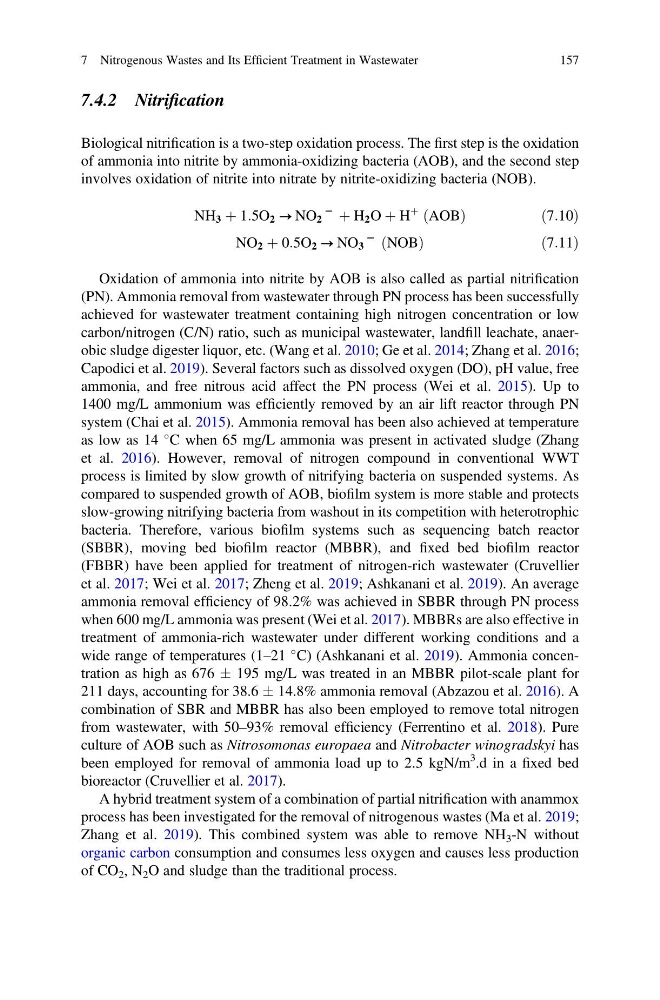
Biological nitrification is a two-step oxidation process. The first step is the oxidation
of ammonia into nitrite by ammonia-oxidizing bacteria (AOB), and the second step
involves oxidation of nitrite into nitrate by nitrite-oxidizing bacteria (NOB).
NH 3 þ 1:5O 2 → NO 2
2
þ H 2 O þ H
þ AOB
ð
Þ
ð7:10Þ
NO 2 þ 0:5O 2 → NO 3
2 NOB
ð
Þ
ð7:11Þ
Oxidation of ammonia into nitrite by AOB is also called as partial nitrification
(PN). Ammonia removal from wastewater through PN process has been successfully
achieved for wastewater treatment containing high nitrogen concentration or low
carbon/nitrogen (C/N) ratio, such as municipal wastewater, landfill leachate, anaerobic sludge digester liquor, etc. (Wang et al. 2010; Ge et al. 2014; Zhang et al. 2016;
Capodici et al. 2019). Several factors such as dissolved oxygen (DO), pH value, free
ammonia, and free nitrous acid affect the PN process (Wei et al. 2015). Up to
1400 mg/L ammonium was efficiently removed by an air lift reactor through PN
system (Chai et al. 2015). Ammonia removal has been also achieved at temperature
as low as 14
C when 65 mg/L ammonia was present in activated sludge (Zhang
et al. 2016). However, removal of nitrogen compound in conventional WWT
process is limited by slow growth of nitrifying bacteria on suspended systems. As
compared to suspended growth of AOB, biofilm system is more stable and protects
slow-growing nitrifying bacteria from washout in its competition with heterotrophic
bacteria. Therefore, various biofilm systems such as sequencing batch reactor
(SBBR), moving bed biofilm reactor (MBBR), and fixed bed biofilm reactor
(FBBR) have been applied for treatment of nitrogen-rich wastewater (Cruvellier
et al. 2017; Wei et al. 2017; Zheng et al. 2019; Ashkanani et al. 2019). An average
ammonia removal efficiency of 98.2% was achieved in SBBR through PN process
when 600 mg/L ammonia was present (Wei et al. 2017). MBBRs are also effective in
treatment of ammonia-rich wastewater under different working conditions and a
wide range of temperatures (1–21
C) (Ashkanani et al. 2019). Ammonia concentration as high as 676 Æ 195 mg/L was treated in an MBBR pilot-scale plant for
211 days, accounting for 38.6 Æ 14.8% ammonia removal (Abzazou et al. 2016). A
combination of SBR and MBBR has also been employed to remove total nitrogen
from wastewater, with 50–93% removal efficiency (Ferrentino et al. 2018). Pure
culture of AOB such as Nitrosomonas europaea and Nitrobacter winogradskyi has
been employed for removal of ammonia load up to 2.5 kgN/m
3 .d in a fixed bed
bioreactor (Cruvellier et al. 2017).
A hybrid treatment system of a combination of partial nitrification with anammox
process has been investigated for the removal of nitrogenous wastes (Ma et al. 2019;
Zhang et al. 2019). This combined system was able to remove NH 3 -N without
organic carbon consumption and consumes less oxygen and causes less production
of CO 2 , N 2 O and sludge than the traditional process.
7 Nitrogenous Wastes and Its Efficient Treatment in Wastewater
157
Biological nitrification is a two-step oxidation process. The first step is the oxidation
of ammonia into nitrite by ammonia-oxidizing bacteria (AOB), and the second step
involves oxidation of nitrite into nitrate by nitrite-oxidizing bacteria (NOB).
NH 3 þ 1:5O 2 → NO 2
2
þ H 2 O þ H
þ AOB
ð
Þ
ð7:10Þ
NO 2 þ 0:5O 2 → NO 3
2 NOB
ð
Þ
ð7:11Þ
Oxidation of ammonia into nitrite by AOB is also called as partial nitrification
(PN). Ammonia removal from wastewater through PN process has been successfully
achieved for wastewater treatment containing high nitrogen concentration or low
carbon/nitrogen (C/N) ratio, such as municipal wastewater, landfill leachate, anaerobic sludge digester liquor, etc. (Wang et al. 2010; Ge et al. 2014; Zhang et al. 2016;
Capodici et al. 2019). Several factors such as dissolved oxygen (DO), pH value, free
ammonia, and free nitrous acid affect the PN process (Wei et al. 2015). Up to
1400 mg/L ammonium was efficiently removed by an air lift reactor through PN
system (Chai et al. 2015). Ammonia removal has been also achieved at temperature
as low as 14
C when 65 mg/L ammonia was present in activated sludge (Zhang
et al. 2016). However, removal of nitrogen compound in conventional WWT
process is limited by slow growth of nitrifying bacteria on suspended systems. As
compared to suspended growth of AOB, biofilm system is more stable and protects
slow-growing nitrifying bacteria from washout in its competition with heterotrophic
bacteria. Therefore, various biofilm systems such as sequencing batch reactor
(SBBR), moving bed biofilm reactor (MBBR), and fixed bed biofilm reactor
(FBBR) have been applied for treatment of nitrogen-rich wastewater (Cruvellier
et al. 2017; Wei et al. 2017; Zheng et al. 2019; Ashkanani et al. 2019). An average
ammonia removal efficiency of 98.2% was achieved in SBBR through PN process
when 600 mg/L ammonia was present (Wei et al. 2017). MBBRs are also effective in
treatment of ammonia-rich wastewater under different working conditions and a
wide range of temperatures (1–21
C) (Ashkanani et al. 2019). Ammonia concentration as high as 676 Æ 195 mg/L was treated in an MBBR pilot-scale plant for
211 days, accounting for 38.6 Æ 14.8% ammonia removal (Abzazou et al. 2016). A
combination of SBR and MBBR has also been employed to remove total nitrogen
from wastewater, with 50–93% removal efficiency (Ferrentino et al. 2018). Pure
culture of AOB such as Nitrosomonas europaea and Nitrobacter winogradskyi has
been employed for removal of ammonia load up to 2.5 kgN/m
3 .d in a fixed bed
bioreactor (Cruvellier et al. 2017).
A hybrid treatment system of a combination of partial nitrification with anammox
process has been investigated for the removal of nitrogenous wastes (Ma et al. 2019;
Zhang et al. 2019). This combined system was able to remove NH 3 -N without
organic carbon consumption and consumes less oxygen and causes less production
of CO 2 , N 2 O and sludge than the traditional process.
7 Nitrogenous Wastes and Its Efficient Treatment in Wastewater
157