

suggested that removal of ammonium-nitrogen was favored in the presence of
sodium chloride and retarded in the absence of sodium chloride (Huang et al. 2018).
7.4 Biological Treatment Processes
7.4.1 Anammox
Anammox is a chemoautotrophic biological process which involves conversion of
ammonium (NH 4
+
) into dinitrogen (N 2 ) gas by anaerobic ammonia-oxidizing bacteria by utilizing nitrite (NO 2
À
) as the electron acceptor, as indicated in Eq. (7.9)
(Qi et al. 2018).
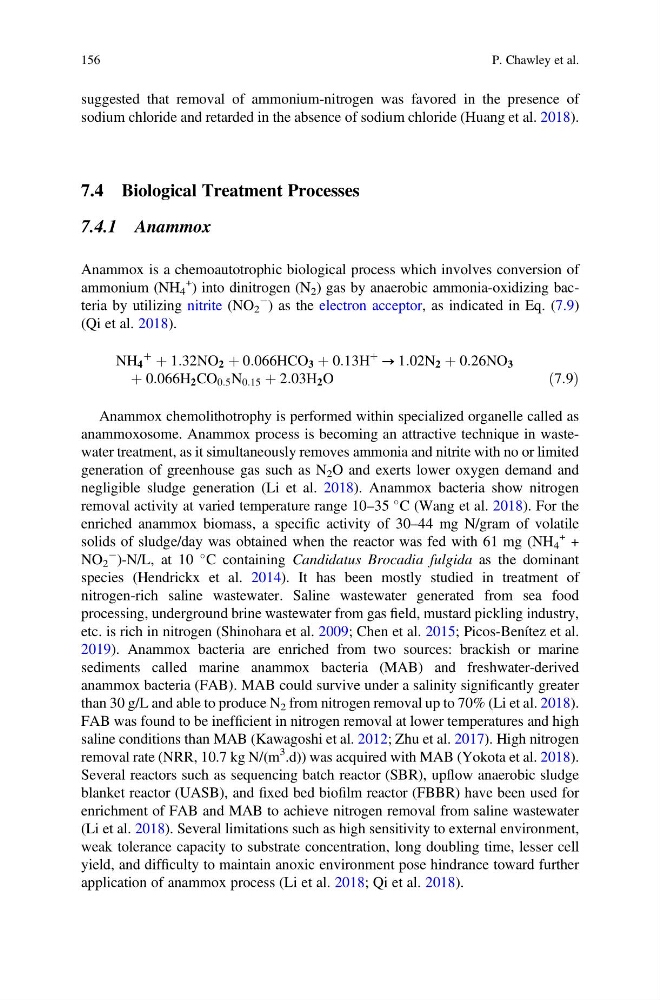
NH 4
þ
þ 1:32NO 2 þ 0:066HCO 3 þ 0:13H
þ
→ 1:02N 2 þ 0:26NO 3
þ 0:066H 2 CO 0:5 N 0:15 þ 2:03H 2 O
ð7:9Þ
Anammox chemolithotrophy is performed within specialized organelle called as
anammoxosome. Anammox process is becoming an attractive technique in wastewater treatment, as it simultaneously removes ammonia and nitrite with no or limited
generation of greenhouse gas such as N 2 O and exerts lower oxygen demand and
negligible sludge generation (Li et al. 2018). Anammox bacteria show nitrogen
removal activity at varied temperature range 10–35
C (Wang et al. 2018). For the
enriched anammox biomass, a specific activity of 30–44 mg N/gram of volatile
solids of sludge/day was obtained when the reactor was fed with 61 mg (NH 4
+ +
NO 2
À )-N/L, at 10
C containing Candidatus Brocadia fulgida as the dominant
species (Hendrickx et al. 2014). It has been mostly studied in treatment of
nitrogen-rich saline wastewater. Saline wastewater generated from sea food
processing, underground brine wastewater from gas field, mustard pickling industry,
etc. is rich in nitrogen (Shinohara et al. 2009; Chen et al. 2015; Picos-Benítez et al.
2019). Anammox bacteria are enriched from two sources: brackish or marine
sediments called marine anammox bacteria (MAB) and freshwater-derived
anammox bacteria (FAB). MAB could survive under a salinity significantly greater
than 30 g/L and able to produce N 2 from nitrogen removal up to 70% (Li et al. 2018).
FAB was found to be inefficient in nitrogen removal at lower temperatures and high
saline conditions than MAB (Kawagoshi et al. 2012; Zhu et al. 2017). High nitrogen
removal rate (NRR, 10.7 kg N/(m
3 .d)) was acquired with MAB (Yokota et al. 2018).
Several reactors such as sequencing batch reactor (SBR), upflow anaerobic sludge
blanket reactor (UASB), and fixed bed biofilm reactor (FBBR) have been used for
enrichment of FAB and MAB to achieve nitrogen removal from saline wastewater
(Li et al. 2018). Several limitations such as high sensitivity to external environment,
weak tolerance capacity to substrate concentration, long doubling time, lesser cell
yield, and difficulty to maintain anoxic environment pose hindrance toward further
application of anammox process (Li et al. 2018; Qi et al. 2018).
156
P. Chawley et al.
sodium chloride and retarded in the absence of sodium chloride (Huang et al. 2018).
7.4 Biological Treatment Processes
7.4.1 Anammox
Anammox is a chemoautotrophic biological process which involves conversion of
ammonium (NH 4
+
) into dinitrogen (N 2 ) gas by anaerobic ammonia-oxidizing bacteria by utilizing nitrite (NO 2
À
) as the electron acceptor, as indicated in Eq. (7.9)
(Qi et al. 2018).
NH 4
þ
þ 1:32NO 2 þ 0:066HCO 3 þ 0:13H
þ
→ 1:02N 2 þ 0:26NO 3
þ 0:066H 2 CO 0:5 N 0:15 þ 2:03H 2 O
ð7:9Þ
Anammox chemolithotrophy is performed within specialized organelle called as
anammoxosome. Anammox process is becoming an attractive technique in wastewater treatment, as it simultaneously removes ammonia and nitrite with no or limited
generation of greenhouse gas such as N 2 O and exerts lower oxygen demand and
negligible sludge generation (Li et al. 2018). Anammox bacteria show nitrogen
removal activity at varied temperature range 10–35
C (Wang et al. 2018). For the
enriched anammox biomass, a specific activity of 30–44 mg N/gram of volatile
solids of sludge/day was obtained when the reactor was fed with 61 mg (NH 4
+ +
NO 2
À )-N/L, at 10
C containing Candidatus Brocadia fulgida as the dominant
species (Hendrickx et al. 2014). It has been mostly studied in treatment of
nitrogen-rich saline wastewater. Saline wastewater generated from sea food
processing, underground brine wastewater from gas field, mustard pickling industry,
etc. is rich in nitrogen (Shinohara et al. 2009; Chen et al. 2015; Picos-Benítez et al.
2019). Anammox bacteria are enriched from two sources: brackish or marine
sediments called marine anammox bacteria (MAB) and freshwater-derived
anammox bacteria (FAB). MAB could survive under a salinity significantly greater
than 30 g/L and able to produce N 2 from nitrogen removal up to 70% (Li et al. 2018).
FAB was found to be inefficient in nitrogen removal at lower temperatures and high
saline conditions than MAB (Kawagoshi et al. 2012; Zhu et al. 2017). High nitrogen
removal rate (NRR, 10.7 kg N/(m
3 .d)) was acquired with MAB (Yokota et al. 2018).
Several reactors such as sequencing batch reactor (SBR), upflow anaerobic sludge
blanket reactor (UASB), and fixed bed biofilm reactor (FBBR) have been used for
enrichment of FAB and MAB to achieve nitrogen removal from saline wastewater
(Li et al. 2018). Several limitations such as high sensitivity to external environment,
weak tolerance capacity to substrate concentration, long doubling time, lesser cell
yield, and difficulty to maintain anoxic environment pose hindrance toward further
application of anammox process (Li et al. 2018; Qi et al. 2018).
156
P. Chawley et al.