

Hence, microbubble-added ozonation process can be employed to treat wastewater
at large scale because this process is fast and suitable and can be used for a wide
range of pH. Lastly, after completion of ozonation, ozone self-decomposes to
oxygen without adding any other pollutant to water.
7.3.2.3 Electrochemical Oxidation
Electrochemical oxidation, also called as anodic oxidation, is a versatile technique to
remove contaminants from industrial wastewater due to its ease in operation, lack of
secondary contaminant generation, and better treatment efficiency (Song et al.
2019). Prime benefits of this technique include the following: (i) no requirement
of extraneous addition of chemicals, (ii) can take place in a simple electrochemical
cell, and (iii) at ambient temperature and pressure conditions. Several recent studies
have reported electrochemical oxidation of model pollutants from synthetic wastewater (Panizza and Cerisola 2008; Lizhang et al. 2016; Cotillas et al. 2018).
Additionally, this technique has been employed to treat real wastewater which
consists of multiple contaminants and complex compounds.
Electrochemical oxidation degrades pollutants either through direct or indirect
oxidation (Garcia-Segura et al. 2018). In case of direct oxidation process, pollutants
oxidize at the surface of electrode through electron transfer mode, while indirect
oxidation involves oxidizing agents such as hydroxyl radicals, produced during
electrolysis. Through electrochemical oxidation process, ammonia can be converted
into other forms of nitrogen either by direct or indirect oxidation as presented in
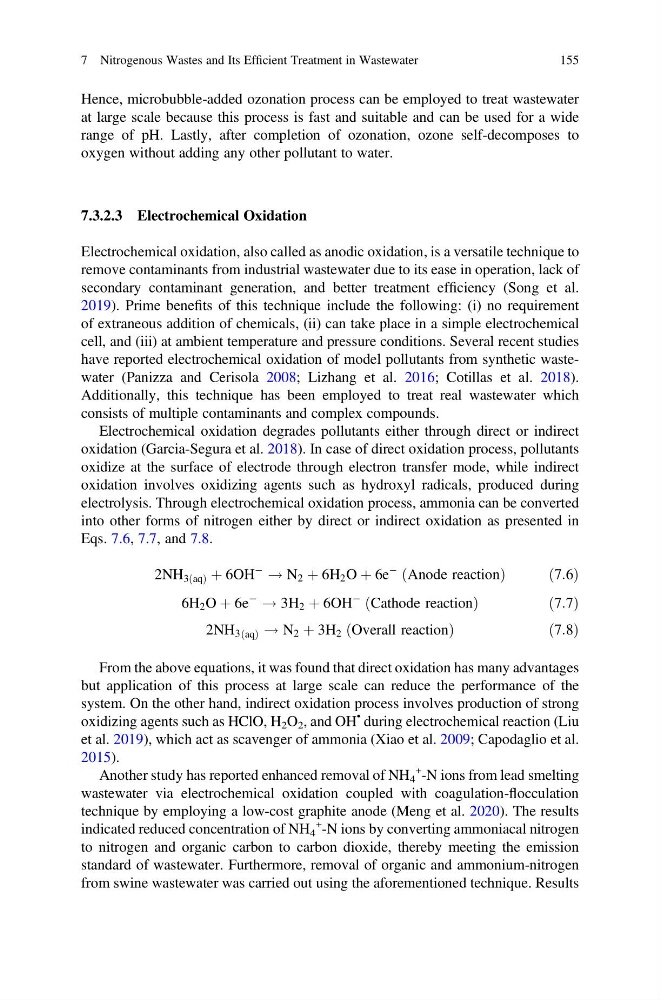
Eqs. 7.6, 7.7, and 7.8.
2NH 3 aq
ð Þ þ 6OH
À
! N 2 þ 6H 2 O þ 6e
À Anode reaction
ð
Þ
ð 7:6Þ
6H 2 O þ 6e
À
! 3H 2 þ 6OH
À Cathode reaction
ð
Þ
ð 7:7Þ
2NH 3 aq
ð Þ ! N 2 þ 3H 2 Overall reaction
ð
Þ
ð 7:8Þ
From the above equations, it was found that direct oxidation has many advantages
but application of this process at large scale can reduce the performance of the
system. On the other hand, indirect oxidation process involves production of strong
oxidizing agents such as HClO, H 2 O 2 , and OH
• during electrochemical reaction (Liu
et al. 2019), which act as scavenger of ammonia (Xiao et al. 2009; Capodaglio et al.
2015).
Another study has reported enhanced removal of NH 4
+
-N ions from lead smelting
wastewater via electrochemical oxidation coupled with coagulation-flocculation
technique by employing a low-cost graphite anode (Meng et al. 2020). The results
indicated reduced concentration of NH 4
+
-N ions by converting ammoniacal nitrogen
to nitrogen and organic carbon to carbon dioxide, thereby meeting the emission
standard of wastewater. Furthermore, removal of organic and ammonium-nitrogen
from swine wastewater was carried out using the aforementioned technique. Results
7 Nitrogenous Wastes and Its Efficient Treatment in Wastewater
155
at large scale because this process is fast and suitable and can be used for a wide
range of pH. Lastly, after completion of ozonation, ozone self-decomposes to
oxygen without adding any other pollutant to water.
7.3.2.3 Electrochemical Oxidation
Electrochemical oxidation, also called as anodic oxidation, is a versatile technique to
remove contaminants from industrial wastewater due to its ease in operation, lack of
secondary contaminant generation, and better treatment efficiency (Song et al.
2019). Prime benefits of this technique include the following: (i) no requirement
of extraneous addition of chemicals, (ii) can take place in a simple electrochemical
cell, and (iii) at ambient temperature and pressure conditions. Several recent studies
have reported electrochemical oxidation of model pollutants from synthetic wastewater (Panizza and Cerisola 2008; Lizhang et al. 2016; Cotillas et al. 2018).
Additionally, this technique has been employed to treat real wastewater which
consists of multiple contaminants and complex compounds.
Electrochemical oxidation degrades pollutants either through direct or indirect
oxidation (Garcia-Segura et al. 2018). In case of direct oxidation process, pollutants
oxidize at the surface of electrode through electron transfer mode, while indirect
oxidation involves oxidizing agents such as hydroxyl radicals, produced during
electrolysis. Through electrochemical oxidation process, ammonia can be converted
into other forms of nitrogen either by direct or indirect oxidation as presented in
Eqs. 7.6, 7.7, and 7.8.
2NH 3 aq
ð Þ þ 6OH
À
! N 2 þ 6H 2 O þ 6e
À Anode reaction
ð
Þ
ð 7:6Þ
6H 2 O þ 6e
À
! 3H 2 þ 6OH
À Cathode reaction
ð
Þ
ð 7:7Þ
2NH 3 aq
ð Þ ! N 2 þ 3H 2 Overall reaction
ð
Þ
ð 7:8Þ
From the above equations, it was found that direct oxidation has many advantages
but application of this process at large scale can reduce the performance of the
system. On the other hand, indirect oxidation process involves production of strong
oxidizing agents such as HClO, H 2 O 2 , and OH
• during electrochemical reaction (Liu
et al. 2019), which act as scavenger of ammonia (Xiao et al. 2009; Capodaglio et al.
2015).
Another study has reported enhanced removal of NH 4
+
-N ions from lead smelting
wastewater via electrochemical oxidation coupled with coagulation-flocculation
technique by employing a low-cost graphite anode (Meng et al. 2020). The results
indicated reduced concentration of NH 4
+
-N ions by converting ammoniacal nitrogen
to nitrogen and organic carbon to carbon dioxide, thereby meeting the emission
standard of wastewater. Furthermore, removal of organic and ammonium-nitrogen
from swine wastewater was carried out using the aforementioned technique. Results
7 Nitrogenous Wastes and Its Efficient Treatment in Wastewater
155