

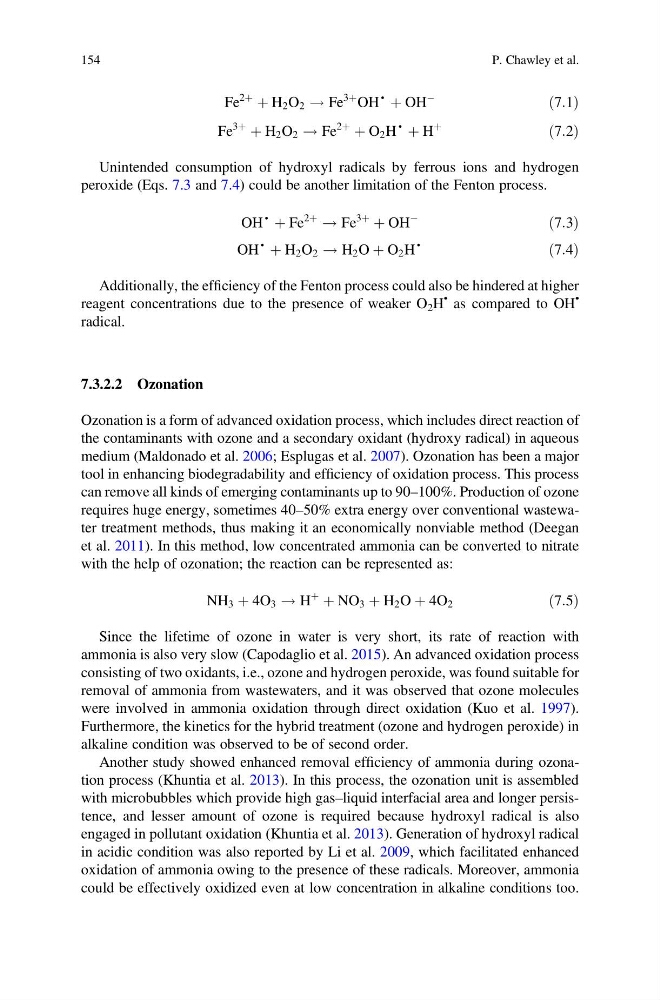
Fe
2þ
þ H 2 O 2 ! Fe
3þ OH
•
þ OH
À
ð7:1Þ
Fe
3þ
þ H 2 O 2 ! Fe
2þ
þ O 2 H
•
þ H
þ
ð7:2Þ
Unintended consumption of hydroxyl radicals by ferrous ions and hydrogen
peroxide (Eqs. 7.3 and 7.4) could be another limitation of the Fenton process.
OH
•
þ Fe
2þ
! Fe
3þ
þ OH
À
ð7:3Þ
OH
•
þ H 2 O 2 ! H 2 O þ O 2 H
•
ð7:4Þ
Additionally, the efficiency of the Fenton process could also be hindered at higher
reagent concentrations due to the presence of weaker O 2 H
• as compared to OH
•
radical.
7.3.2.2 Ozonation
Ozonation is a form of advanced oxidation process, which includes direct reaction of
the contaminants with ozone and a secondary oxidant (hydroxy radical) in aqueous
medium (Maldonado et al. 2006; Esplugas et al. 2007). Ozonation has been a major
tool in enhancing biodegradability and efficiency of oxidation process. This process
can remove all kinds of emerging contaminants up to 90–100%. Production of ozone
requires huge energy, sometimes 40–50% extra energy over conventional wastewater treatment methods, thus making it an economically nonviable method (Deegan
et al. 2011). In this method, low concentrated ammonia can be converted to nitrate
with the help of ozonation; the reaction can be represented as:
NH 3 þ 4O 3 ! H
þ
þ NO 3 þ H 2 O þ 4O 2
ð7:5Þ
Since the lifetime of ozone in water is very short, its rate of reaction with
ammonia is also very slow (Capodaglio et al. 2015). An advanced oxidation process
consisting of two oxidants, i.e., ozone and hydrogen peroxide, was found suitable for
removal of ammonia from wastewaters, and it was observed that ozone molecules
were involved in ammonia oxidation through direct oxidation (Kuo et al. 1997).
Furthermore, the kinetics for the hybrid treatment (ozone and hydrogen peroxide) in
alkaline condition was observed to be of second order.
Another study showed enhanced removal efficiency of ammonia during ozonation process (Khuntia et al. 2013). In this process, the ozonation unit is assembled
with microbubbles which provide high gas–liquid interfacial area and longer persistence, and lesser amount of ozone is required because hydroxyl radical is also
engaged in pollutant oxidation (Khuntia et al. 2013). Generation of hydroxyl radical
in acidic condition was also reported by Li et al. 2009, which facilitated enhanced
oxidation of ammonia owing to the presence of these radicals. Moreover, ammonia
could be effectively oxidized even at low concentration in alkaline conditions too.
154
P. Chawley et al.
2þ
þ H 2 O 2 ! Fe
3þ OH
•
þ OH
À
ð7:1Þ
Fe
3þ
þ H 2 O 2 ! Fe
2þ
þ O 2 H
•
þ H
þ
ð7:2Þ
Unintended consumption of hydroxyl radicals by ferrous ions and hydrogen
peroxide (Eqs. 7.3 and 7.4) could be another limitation of the Fenton process.
OH
•
þ Fe
2þ
! Fe
3þ
þ OH
À
ð7:3Þ
OH
•
þ H 2 O 2 ! H 2 O þ O 2 H
•
ð7:4Þ
Additionally, the efficiency of the Fenton process could also be hindered at higher
reagent concentrations due to the presence of weaker O 2 H
• as compared to OH
•
radical.
7.3.2.2 Ozonation
Ozonation is a form of advanced oxidation process, which includes direct reaction of
the contaminants with ozone and a secondary oxidant (hydroxy radical) in aqueous
medium (Maldonado et al. 2006; Esplugas et al. 2007). Ozonation has been a major
tool in enhancing biodegradability and efficiency of oxidation process. This process
can remove all kinds of emerging contaminants up to 90–100%. Production of ozone
requires huge energy, sometimes 40–50% extra energy over conventional wastewater treatment methods, thus making it an economically nonviable method (Deegan
et al. 2011). In this method, low concentrated ammonia can be converted to nitrate
with the help of ozonation; the reaction can be represented as:
NH 3 þ 4O 3 ! H
þ
þ NO 3 þ H 2 O þ 4O 2
ð7:5Þ
Since the lifetime of ozone in water is very short, its rate of reaction with
ammonia is also very slow (Capodaglio et al. 2015). An advanced oxidation process
consisting of two oxidants, i.e., ozone and hydrogen peroxide, was found suitable for
removal of ammonia from wastewaters, and it was observed that ozone molecules
were involved in ammonia oxidation through direct oxidation (Kuo et al. 1997).
Furthermore, the kinetics for the hybrid treatment (ozone and hydrogen peroxide) in
alkaline condition was observed to be of second order.
Another study showed enhanced removal efficiency of ammonia during ozonation process (Khuntia et al. 2013). In this process, the ozonation unit is assembled
with microbubbles which provide high gas–liquid interfacial area and longer persistence, and lesser amount of ozone is required because hydroxyl radical is also
engaged in pollutant oxidation (Khuntia et al. 2013). Generation of hydroxyl radical
in acidic condition was also reported by Li et al. 2009, which facilitated enhanced
oxidation of ammonia owing to the presence of these radicals. Moreover, ammonia
could be effectively oxidized even at low concentration in alkaline conditions too.
154
P. Chawley et al.