

7.4.3 Denitrification
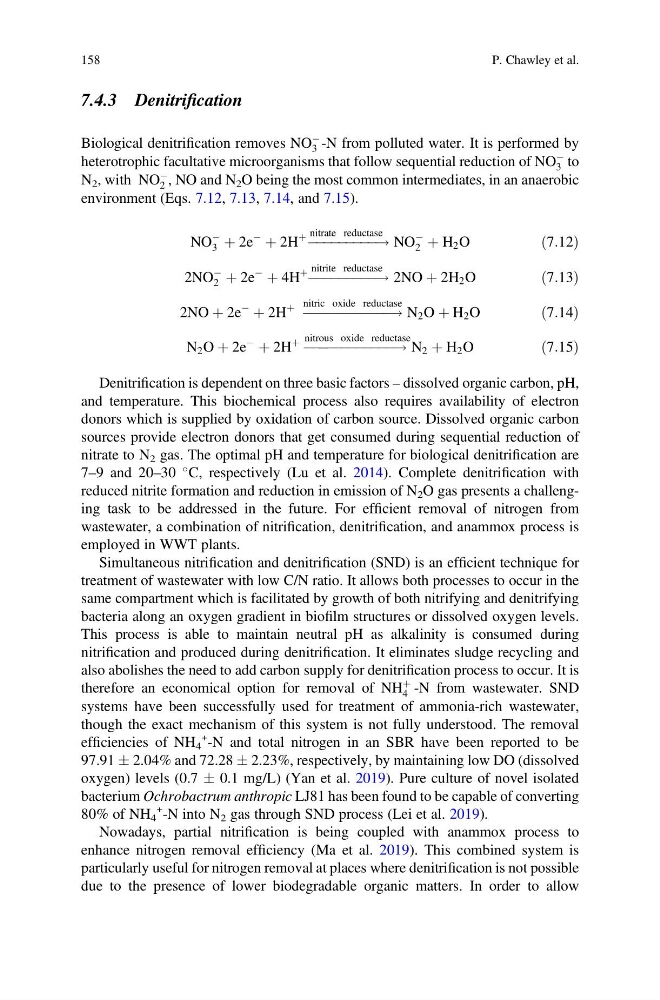
Biological denitrification removes NO
À
3 -N from polluted water. It is performed by
heterotrophic facultative microorganisms that follow sequential reduction of NO
À
3 to
N 2 , with NO
À
2 , NO and N 2 O being the most common intermediates, in an anaerobic
environment (Eqs. 7.12, 7.13, 7.14, and 7.15).
NO
À
3 þ 2e
À
þ 2H
þ nitrate reductase
ÀÀÀÀÀÀÀÀÀ! NO
À
2 þ H 2 O
ð7:12Þ
2NO
À
2 þ 2e
À
þ 4H
þ nitrite reductase
ÀÀÀÀÀÀÀÀÀ! 2NO þ 2H 2 O
ð7:13Þ
2NO þ 2e
À
þ 2H
þ nitric oxide reductase
ÀÀÀÀÀÀÀÀÀÀÀ À! N 2 O þ H 2 O
ð7:14Þ
N 2 O þ 2e
À
þ 2H
þ nitrous oxide reductase
À
ÀÀÀÀÀÀÀÀÀÀÀÀ! N 2 þ H 2 O
ð7:15Þ
Denitrification is dependent on three basic factors – dissolved organic carbon, pH,
and temperature. This biochemical process also requires availability of electron
donors which is supplied by oxidation of carbon source. Dissolved organic carbon
sources provide electron donors that get consumed during sequential reduction of
nitrate to N 2 gas. The optimal pH and temperature for biological denitrification are
7–9 and 20–30
C, respectively (Lu et al. 2014). Complete denitrification with
reduced nitrite formation and reduction in emission of N 2 O gas presents a challenging task to be addressed in the future. For efficient removal of nitrogen from
wastewater, a combination of nitrification, denitrification, and anammox process is
employed in WWT plants.
Simultaneous nitrification and denitrification (SND) is an efficient technique for
treatment of wastewater with low C/N ratio. It allows both processes to occur in the
same compartment which is facilitated by growth of both nitrifying and denitrifying
bacteria along an oxygen gradient in biofilm structures or dissolved oxygen levels.
This process is able to maintain neutral pH as alkalinity is consumed during
nitrification and produced during denitrification. It eliminates sludge recycling and
also abolishes the need to add carbon supply for denitrification process to occur. It is
therefore an economical option for removal of NH
þ
4 -N from wastewater. SND
systems have been successfully used for treatment of ammonia-rich wastewater,
though the exact mechanism of this system is not fully understood. The removal
efficiencies of NH 4
+
-N and total nitrogen in an SBR have been reported to be
97.91 Æ 2.04% and 72.28 Æ 2.23%, respectively, by maintaining low DO (dissolved
oxygen) levels (0.7 Æ 0.1 mg/L) (Yan et al. 2019). Pure culture of novel isolated
bacterium Ochrobactrum anthropic LJ81 has been found to be capable of converting
80% of NH 4
+ -N into N 2 gas through SND process (Lei et al. 2019).
Nowadays, partial nitrification is being coupled with anammox process to
enhance nitrogen removal efficiency (Ma et al. 2019). This combined system is
particularly useful for nitrogen removal at places where denitrification is not possible
due to the presence of lower biodegradable organic matters. In order to allow
158
P. Chawley et al.
Biological denitrification removes NO
À
3 -N from polluted water. It is performed by
heterotrophic facultative microorganisms that follow sequential reduction of NO
À
3 to
N 2 , with NO
À
2 , NO and N 2 O being the most common intermediates, in an anaerobic
environment (Eqs. 7.12, 7.13, 7.14, and 7.15).
NO
À
3 þ 2e
À
þ 2H
þ nitrate reductase
ÀÀÀÀÀÀÀÀÀ! NO
À
2 þ H 2 O
ð7:12Þ
2NO
À
2 þ 2e
À
þ 4H
þ nitrite reductase
ÀÀÀÀÀÀÀÀÀ! 2NO þ 2H 2 O
ð7:13Þ
2NO þ 2e
À
þ 2H
þ nitric oxide reductase
ÀÀÀÀÀÀÀÀÀÀÀ À! N 2 O þ H 2 O
ð7:14Þ
N 2 O þ 2e
À
þ 2H
þ nitrous oxide reductase
À
ÀÀÀÀÀÀÀÀÀÀÀÀ! N 2 þ H 2 O
ð7:15Þ
Denitrification is dependent on three basic factors – dissolved organic carbon, pH,
and temperature. This biochemical process also requires availability of electron
donors which is supplied by oxidation of carbon source. Dissolved organic carbon
sources provide electron donors that get consumed during sequential reduction of
nitrate to N 2 gas. The optimal pH and temperature for biological denitrification are
7–9 and 20–30
C, respectively (Lu et al. 2014). Complete denitrification with
reduced nitrite formation and reduction in emission of N 2 O gas presents a challenging task to be addressed in the future. For efficient removal of nitrogen from
wastewater, a combination of nitrification, denitrification, and anammox process is
employed in WWT plants.
Simultaneous nitrification and denitrification (SND) is an efficient technique for
treatment of wastewater with low C/N ratio. It allows both processes to occur in the
same compartment which is facilitated by growth of both nitrifying and denitrifying
bacteria along an oxygen gradient in biofilm structures or dissolved oxygen levels.
This process is able to maintain neutral pH as alkalinity is consumed during
nitrification and produced during denitrification. It eliminates sludge recycling and
also abolishes the need to add carbon supply for denitrification process to occur. It is
therefore an economical option for removal of NH
þ
4 -N from wastewater. SND
systems have been successfully used for treatment of ammonia-rich wastewater,
though the exact mechanism of this system is not fully understood. The removal
efficiencies of NH 4
+
-N and total nitrogen in an SBR have been reported to be
97.91 Æ 2.04% and 72.28 Æ 2.23%, respectively, by maintaining low DO (dissolved
oxygen) levels (0.7 Æ 0.1 mg/L) (Yan et al. 2019). Pure culture of novel isolated
bacterium Ochrobactrum anthropic LJ81 has been found to be capable of converting
80% of NH 4
+ -N into N 2 gas through SND process (Lei et al. 2019).
Nowadays, partial nitrification is being coupled with anammox process to
enhance nitrogen removal efficiency (Ma et al. 2019). This combined system is
particularly useful for nitrogen removal at places where denitrification is not possible
due to the presence of lower biodegradable organic matters. In order to allow
158
P. Chawley et al.