

196
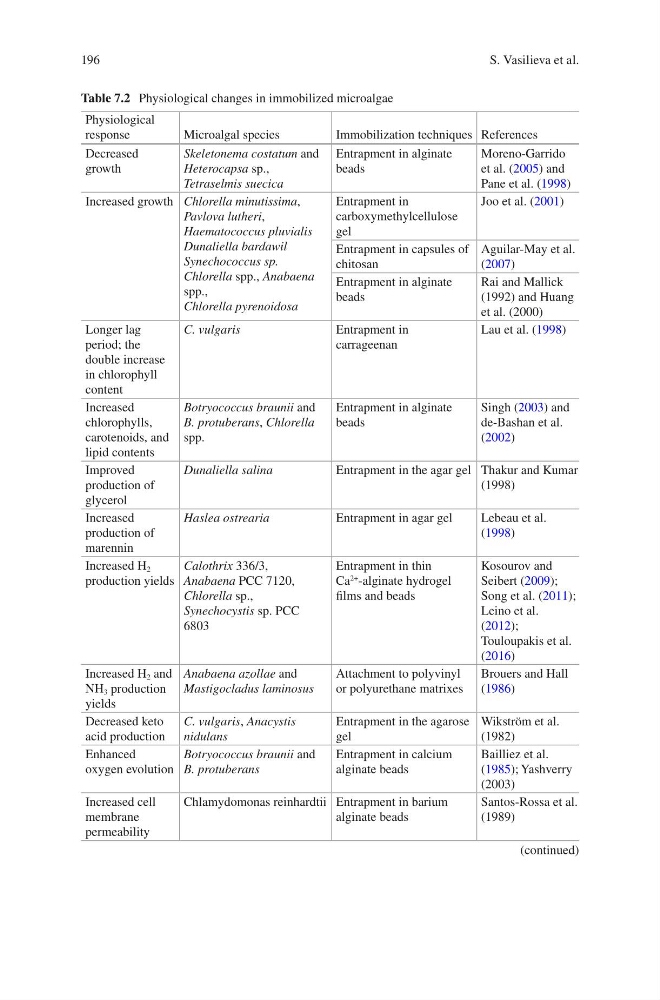
Table 7.2 Physiological changes in immobilized microalgae
Physiological
response
Microalgal species
Immobilization techniques References
Decreased
growth
Skeletonema costatum and
Heterocapsa sp.,
Tetraselmis suecica
Entrapment in alginate
beads
Moreno-Garrido
et al. (2005) and
Pane et al. (1998)
Increased growth Chlorella minutissima,
Pavlova lutheri,
Haematococcus pluvialis
Dunaliella bardawil
Synechococcus sp.
Chlorella spp., Anabaena
spp.,
Chlorella pyrenoidosa
Entrapment in
carboxymethylcellulose
gel
Joo et al. (2001)
Entrapment in capsules of
chitosan
Aguilar-May et al.
(2007)
Entrapment in alginate
beads
Rai and Mallick
(1992) and Huang
et al. (2000)
Longer lag
period; the
double increase
in chlorophyll
content
C. vulgaris
Entrapment in
carrageenan
Lau et al. (1998)
Increased
chlorophylls,
carotenoids, and
lipid contents
Botryococcus braunii and
B. protuberans, Chlorella
spp.
Entrapment in alginate
beads
Singh (2003) and
de-Bashan et al.
(2002)
Improved
production of
glycerol
Dunaliella salina
Entrapment in the agar gel Thakur and Kumar
(1998)
Increased
production of
marennin
Haslea ostrearia
Entrapment in agar gel
Lebeau et al.
(1998)
Increased H 2
production yields
Calothrix 336/3,
Anabaena PCC 7120,
Chlorella sp.,
Synechocystis sp. PCC
6803
Entrapment in thin
Ca
2+
-alginate hydrogel
films and beads
Kosourov and
Seibert (2009);
Song et al. (2011);
Leino et al.
(2012);
Touloupakis et al.
(2016)
Increased H 2 and
NH 3 production
yields
Anabaena azollae and
Mastigocladus laminosus
Attachment to polyvinyl
or polyurethane matrixes
Brouers and Hall
(1986)
Decreased keto
acid production
C. vulgaris, Anacystis
nidulans
Entrapment in the agarose
gel
Wikström et al.
(1982)
Enhanced
oxygen evolution
Botryococcus braunii and
B. protuberans
Entrapment in calcium
alginate beads
Bailliez et al.
(1985); Yashverry
(2003)
Increased cell
membrane
permeability
Chlamydomonas reinhardtii Entrapment in barium
alginate beads
Santos-Rossa et al.
(1989)
(continued)
S. Vasilieva et al.
Table 7.2 Physiological changes in immobilized microalgae
Physiological
response
Microalgal species
Immobilization techniques References
Decreased
growth
Skeletonema costatum and
Heterocapsa sp.,
Tetraselmis suecica
Entrapment in alginate
beads
Moreno-Garrido
et al. (2005) and
Pane et al. (1998)
Increased growth Chlorella minutissima,
Pavlova lutheri,
Haematococcus pluvialis
Dunaliella bardawil
Synechococcus sp.
Chlorella spp., Anabaena
spp.,
Chlorella pyrenoidosa
Entrapment in
carboxymethylcellulose
gel
Joo et al. (2001)
Entrapment in capsules of
chitosan
Aguilar-May et al.
(2007)
Entrapment in alginate
beads
Rai and Mallick
(1992) and Huang
et al. (2000)
Longer lag
period; the
double increase
in chlorophyll
content
C. vulgaris
Entrapment in
carrageenan
Lau et al. (1998)
Increased
chlorophylls,
carotenoids, and
lipid contents
Botryococcus braunii and
B. protuberans, Chlorella
spp.
Entrapment in alginate
beads
Singh (2003) and
de-Bashan et al.
(2002)
Improved
production of
glycerol
Dunaliella salina
Entrapment in the agar gel Thakur and Kumar
(1998)
Increased
production of
marennin
Haslea ostrearia
Entrapment in agar gel
Lebeau et al.
(1998)
Increased H 2
production yields
Calothrix 336/3,
Anabaena PCC 7120,
Chlorella sp.,
Synechocystis sp. PCC
6803
Entrapment in thin
Ca
2+
-alginate hydrogel
films and beads
Kosourov and
Seibert (2009);
Song et al. (2011);
Leino et al.
(2012);
Touloupakis et al.
(2016)
Increased H 2 and
NH 3 production
yields
Anabaena azollae and
Mastigocladus laminosus
Attachment to polyvinyl
or polyurethane matrixes
Brouers and Hall
(1986)
Decreased keto
acid production
C. vulgaris, Anacystis
nidulans
Entrapment in the agarose
gel
Wikström et al.
(1982)
Enhanced
oxygen evolution
Botryococcus braunii and
B. protuberans
Entrapment in calcium
alginate beads
Bailliez et al.
(1985); Yashverry
(2003)
Increased cell
membrane
permeability
Chlamydomonas reinhardtii Entrapment in barium
alginate beads
Santos-Rossa et al.
(1989)
(continued)
S. Vasilieva et al.