

179
indicates the hydrophobicity of the distillation membrane. In general, membrane
wetting can be evaluated by contact angle. Typically, higher contact angle, narrow
pore size, and surface tension maximize liquid entry pressure. It is necessary to
utilize distillation membranes with greater liquid entry pressure (LEP) value (Rácz
et al. 2014). Franken et al. (Franken et al. 1987) have used a mathematical formula
to evaluate LEP value which is based on Cantor-Laplace equation (Franken et al.
1987) (eq. 6.5):
LEP
cos
r
=
−2B L
γ
θ
max
(6.5)
where LEP indicates liquid entry pressure of water in Pa (Pascal), geometric factor
is represented by B that is dimensionless and includes pore irregularities (B = 1 for
assumed cylindrical pores), γL represents the liquid surface tension in N/m (in this
case water at 25 °C, 0.07199 N/m), cos θ represents the contact angle in degree, and
r max indicates the maximal pore (non-closed) radius in meters (m).
Thus, to achieve higher liquid entry pressure (LEP), these following conditions
should be improved:
• The membrane material should be hydrophobic or superhydrophobic in nature.
• The contact angle of the membrane should be higher.
• The membrane pore size should be narrow.
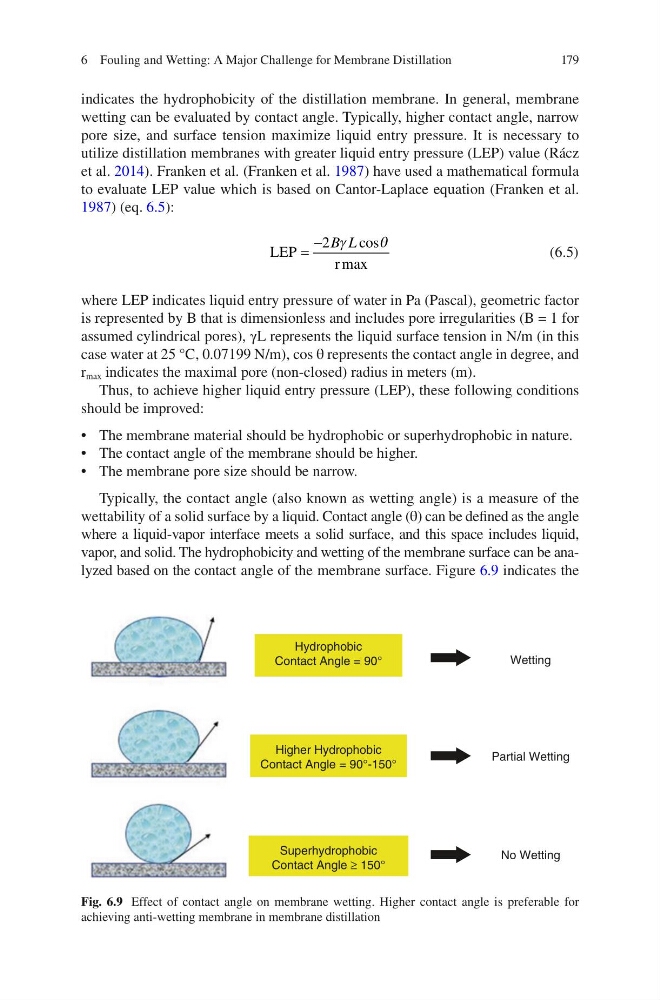
Typically, the contact angle (also known as wetting angle) is a measure of the
wettability of a solid surface by a liquid. Contact angle (θ) can be defined as the angle
where a liquid-vapor interface meets a solid surface, and this space includes liquid,
vapor, and solid. The hydrophobicity and wetting of the membrane surface can be analyzed based on the contact angle of the membrane surface. Figure 6.9 indicates the
Wetting
Partial Wetting
No Wetting
Hydrophobic
Contact Angle = 90°
Higher Hydrophobic
Contact Angle = 90°-150°
Superhydrophobic
Contact Angle ≥ 150°
Fig. 6.9 Effect of contact angle on membrane wetting. Higher contact angle is preferable for
achieving anti-wetting membrane in membrane distillation
6 Fouling and Wetting: A Major Challenge for Membrane Distillation
indicates the hydrophobicity of the distillation membrane. In general, membrane
wetting can be evaluated by contact angle. Typically, higher contact angle, narrow
pore size, and surface tension maximize liquid entry pressure. It is necessary to
utilize distillation membranes with greater liquid entry pressure (LEP) value (Rácz
et al. 2014). Franken et al. (Franken et al. 1987) have used a mathematical formula
to evaluate LEP value which is based on Cantor-Laplace equation (Franken et al.
1987) (eq. 6.5):
LEP
cos
r
=
−2B L
γ
θ
max
(6.5)
where LEP indicates liquid entry pressure of water in Pa (Pascal), geometric factor
is represented by B that is dimensionless and includes pore irregularities (B = 1 for
assumed cylindrical pores), γL represents the liquid surface tension in N/m (in this
case water at 25 °C, 0.07199 N/m), cos θ represents the contact angle in degree, and
r max indicates the maximal pore (non-closed) radius in meters (m).
Thus, to achieve higher liquid entry pressure (LEP), these following conditions
should be improved:
• The membrane material should be hydrophobic or superhydrophobic in nature.
• The contact angle of the membrane should be higher.
• The membrane pore size should be narrow.
Typically, the contact angle (also known as wetting angle) is a measure of the
wettability of a solid surface by a liquid. Contact angle (θ) can be defined as the angle
where a liquid-vapor interface meets a solid surface, and this space includes liquid,
vapor, and solid. The hydrophobicity and wetting of the membrane surface can be analyzed based on the contact angle of the membrane surface. Figure 6.9 indicates the
Wetting
Partial Wetting
No Wetting
Hydrophobic
Contact Angle = 90°
Higher Hydrophobic
Contact Angle = 90°-150°
Superhydrophobic
Contact Angle ≥ 150°
Fig. 6.9 Effect of contact angle on membrane wetting. Higher contact angle is preferable for
achieving anti-wetting membrane in membrane distillation
6 Fouling and Wetting: A Major Challenge for Membrane Distillation