

180
effect of contact angle on membrane wetting. Furthermore, it also shows that when
contact angle is higher than 150°, the chances of membrane wetting are apparently
lesser as compared to the membrane possessing lower contact angle (Khayet
et al. 2006).
Pore Size Distribution
In general, membrane pore size affects the water flux as well as membrane wetting,
so it can be considered as one of the influencing factors of the membrane. Therefore,
the selection of the membrane pore size should be carefully considered. However,
there can be two cases: (a) if the pores were too large, the water easily passed
through the membrane, which creates membrane wetting, and (b) if the membrane
pores were too narrow, the vapor that permeates the membrane will be too less, and
thus, the water flux will reduce. To make sure that the operating temperature and
pressure change could not cause wetting of the membrane, it was recommended that
the membrane pore size must be within the range of 0.1 and 1 μm (Kimura et al.
1987; Laganà et al. 2000).
Membrane Thickness
In general, it is believed that the membrane thickness must be optimized as it may
influence the permeate flux and declined thermal resistance (tend to decrease heat
efficiency or interface temperature difference) as the membrane thickness is getting
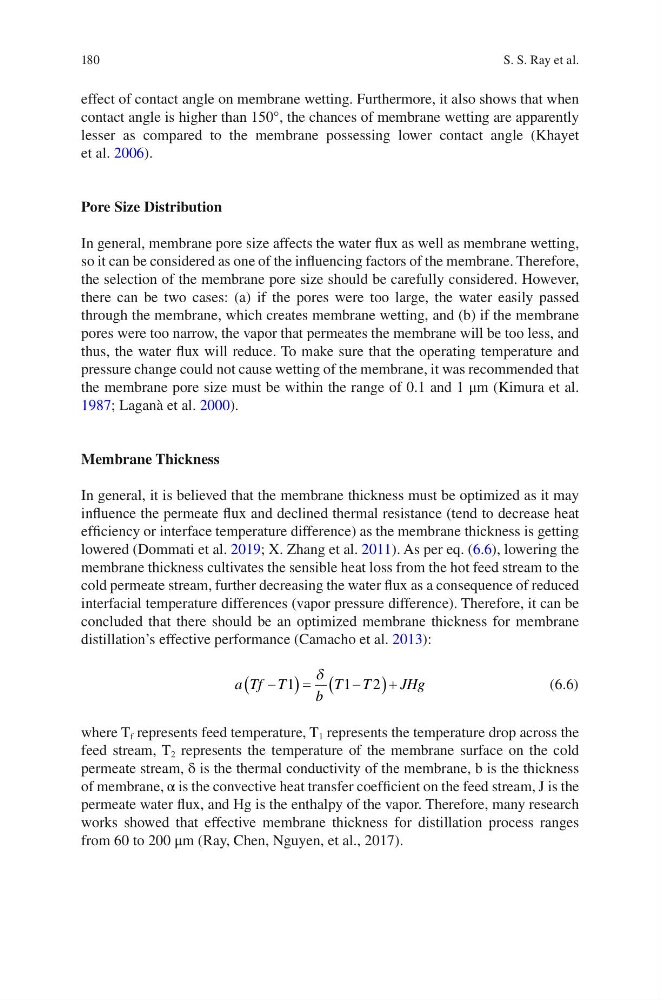
lowered (Dommati et al. 2019; X. Zhang et al. 2011). As per eq. (6.6), lowering the
membrane thickness cultivates the sensible heat loss from the hot feed stream to the
cold permeate stream, further decreasing the water flux as a consequence of reduced
interfacial temperature differences (vapor pressure difference). Therefore, it can be
concluded that there should be an optimized membrane thickness for membrane
distillation’s effective performance (Camacho et al. 2013):
a Tf T
b
T T
JHg
−
(
)=
−
(
)+
1
1 2
δ
(6.6)
where T f represents feed temperature, T 1 represents the temperature drop across the
feed stream, T 2 represents the temperature of the membrane surface on the cold
permeate stream, δ is the thermal conductivity of the membrane, b is the thickness
of membrane, α is the convective heat transfer coefficient on the feed stream, J is the
permeate water flux, and Hg is the enthalpy of the vapor. Therefore, many research
works showed that effective membrane thickness for distillation process ranges
from 60 to 200 μm (Ray, Chen, Nguyen, et al., 2017).
S. S. Ray et al.
effect of contact angle on membrane wetting. Furthermore, it also shows that when
contact angle is higher than 150°, the chances of membrane wetting are apparently
lesser as compared to the membrane possessing lower contact angle (Khayet
et al. 2006).
Pore Size Distribution
In general, membrane pore size affects the water flux as well as membrane wetting,
so it can be considered as one of the influencing factors of the membrane. Therefore,
the selection of the membrane pore size should be carefully considered. However,
there can be two cases: (a) if the pores were too large, the water easily passed
through the membrane, which creates membrane wetting, and (b) if the membrane
pores were too narrow, the vapor that permeates the membrane will be too less, and
thus, the water flux will reduce. To make sure that the operating temperature and
pressure change could not cause wetting of the membrane, it was recommended that
the membrane pore size must be within the range of 0.1 and 1 μm (Kimura et al.
1987; Laganà et al. 2000).
Membrane Thickness
In general, it is believed that the membrane thickness must be optimized as it may
influence the permeate flux and declined thermal resistance (tend to decrease heat
efficiency or interface temperature difference) as the membrane thickness is getting
lowered (Dommati et al. 2019; X. Zhang et al. 2011). As per eq. (6.6), lowering the
membrane thickness cultivates the sensible heat loss from the hot feed stream to the
cold permeate stream, further decreasing the water flux as a consequence of reduced
interfacial temperature differences (vapor pressure difference). Therefore, it can be
concluded that there should be an optimized membrane thickness for membrane
distillation’s effective performance (Camacho et al. 2013):
a Tf T
b
T T
JHg
−
(
)=
−
(
)+
1
1 2
δ
(6.6)
where T f represents feed temperature, T 1 represents the temperature drop across the
feed stream, T 2 represents the temperature of the membrane surface on the cold
permeate stream, δ is the thermal conductivity of the membrane, b is the thickness
of membrane, α is the convective heat transfer coefficient on the feed stream, J is the
permeate water flux, and Hg is the enthalpy of the vapor. Therefore, many research
works showed that effective membrane thickness for distillation process ranges
from 60 to 200 μm (Ray, Chen, Nguyen, et al., 2017).
S. S. Ray et al.