

178
Table 6.5 Criteria of distillation membrane for efficient performance. The basic requirement for
ideal operation based on different properties has been mentioned
Properties
Basic requirement
References
Membrane
thickness
Optimum thickness: Thickness was found to be
inversely proportional to the mass and heat transfer
rate across the membrane
Laganà et al. (2000) and
Smolders and Franken
(1989)
Pore
distribution
Narrow pore size: Water cannot pass through the
membrane pores and leads to wetting. The pore size
of membrane ranges from few nanometers to few
micrometers
Phattaranawik et al.
(2003)
Liquid entry
pressure (LEP)
Higher liquid entry pressure: If liquid entry pressure
is low, this will result in membrane wetting that will
affect the quality of permeate
García-Payo et al.
(2000) and Ray et al.
(2018)
Surface energy Low surface energy: Corresponds to high
hydrophobicity
Bonyadi and Chung
(2007) and Jing Zhang
et al. (2013)
Porosity
Higher porosity: Higher porosity allows more flux
Lawson and Lloyd
(1997)
Replacement of
MD membrane
Fabrication of
superhydrophobic
membrane
Restart for next cycle
Restart for next cycle
If not
If not
If yes
If yes
4 th Approach
3 rd Approach
2 nd Approach
1 st Approach
Chemical
cleaning
Or
Physical
cleaning
Backwash
cleaning
Or
Drying
Long term
operation leads to
Fouling & Wetting
MD Operation
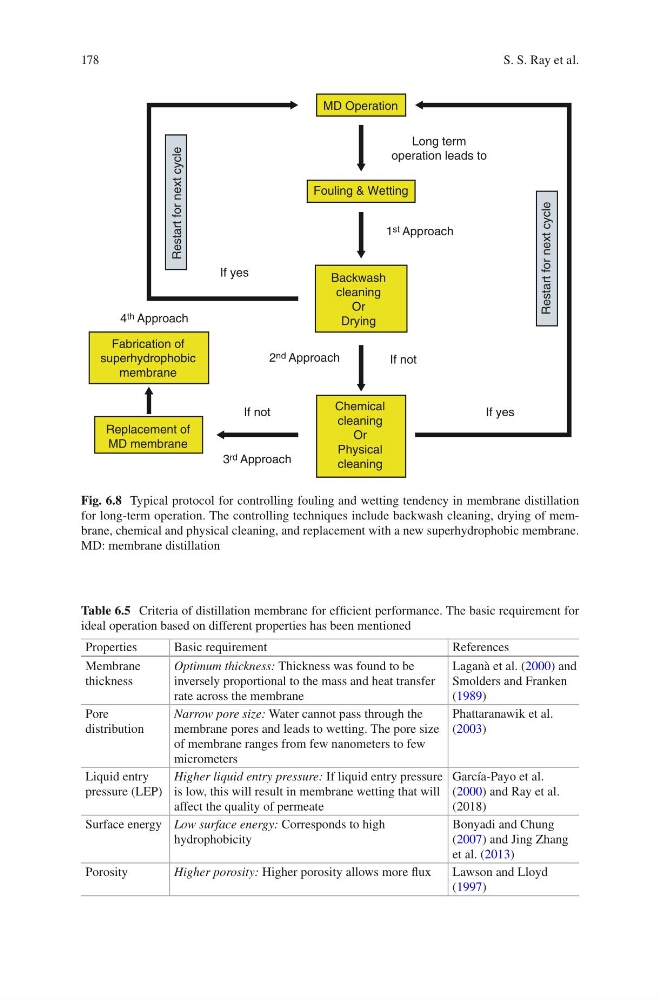
Fig. 6.8 Typical protocol for controlling fouling and wetting tendency in membrane distillation
for long-term operation. The controlling techniques include backwash cleaning, drying of membrane, chemical and physical cleaning, and replacement with a new superhydrophobic membrane.
MD: membrane distillation
S. S. Ray et al.
Table 6.5 Criteria of distillation membrane for efficient performance. The basic requirement for
ideal operation based on different properties has been mentioned
Properties
Basic requirement
References
Membrane
thickness
Optimum thickness: Thickness was found to be
inversely proportional to the mass and heat transfer
rate across the membrane
Laganà et al. (2000) and
Smolders and Franken
(1989)
Pore
distribution
Narrow pore size: Water cannot pass through the
membrane pores and leads to wetting. The pore size
of membrane ranges from few nanometers to few
micrometers
Phattaranawik et al.
(2003)
Liquid entry
pressure (LEP)
Higher liquid entry pressure: If liquid entry pressure
is low, this will result in membrane wetting that will
affect the quality of permeate
García-Payo et al.
(2000) and Ray et al.
(2018)
Surface energy Low surface energy: Corresponds to high
hydrophobicity
Bonyadi and Chung
(2007) and Jing Zhang
et al. (2013)
Porosity
Higher porosity: Higher porosity allows more flux
Lawson and Lloyd
(1997)
Replacement of
MD membrane
Fabrication of
superhydrophobic
membrane
Restart for next cycle
Restart for next cycle
If not
If not
If yes
If yes
4 th Approach
3 rd Approach
2 nd Approach
1 st Approach
Chemical
cleaning
Or
Physical
cleaning
Backwash
cleaning
Or
Drying
Long term
operation leads to
Fouling & Wetting
MD Operation
Fig. 6.8 Typical protocol for controlling fouling and wetting tendency in membrane distillation
for long-term operation. The controlling techniques include backwash cleaning, drying of membrane, chemical and physical cleaning, and replacement with a new superhydrophobic membrane.
MD: membrane distillation
S. S. Ray et al.