

177
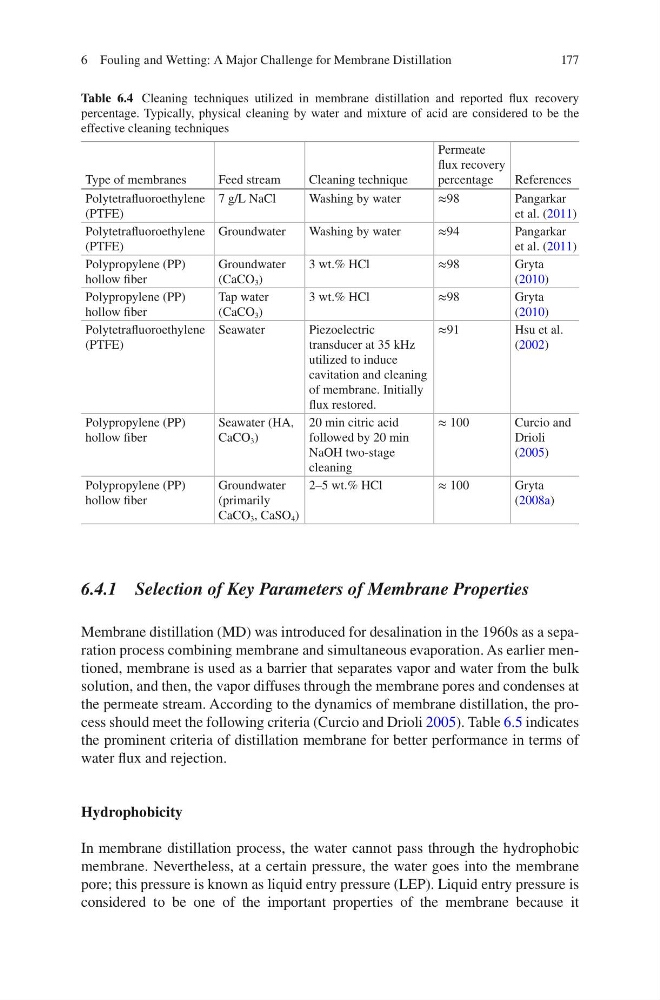
Table 6.4 Cleaning techniques utilized in membrane distillation and reported flux recovery
percentage. Typically, physical cleaning by water and mixture of acid are considered to be the
effective cleaning techniques
Type of membranes
Feed stream
Cleaning technique
Permeate
flux recovery
percentage
References
Polytetrafluoroethylene
(PTFE)
7 g/L NaCl
Washing by water
≈98
Pangarkar
et al. (2011)
Polytetrafluoroethylene
(PTFE)
Groundwater
Washing by water
≈94
Pangarkar
et al. (2011)
Polypropylene (PP)
hollow fiber
Groundwater
(CaCO 3 )
3 wt.% HCl
≈98
Gryta
(2010)
Polypropylene (PP)
hollow fiber
Tap water
(CaCO 3 )
3 wt.% HCl
≈98
Gryta
(2010)
Polytetrafluoroethylene
(PTFE)
Seawater
Piezoelectric
transducer at 35 kHz
utilized to induce
cavitation and cleaning
of membrane. Initially
flux restored.
≈91
Hsu et al.
(2002)
Polypropylene (PP)
hollow fiber
Seawater (HA,
CaCO 3 )
20 min citric acid
followed by 20 min
NaOH two-stage
cleaning
≈ 100
Curcio and
Drioli
(2005)
Polypropylene (PP)
hollow fiber
Groundwater
(primarily
CaCO 3 , CaSO 4 )
2–5 wt.% HCl
≈ 100
Gryta
(2008a)
6.4.1 Selection of Key Parameters of Membrane Properties
Membrane distillation (MD) was introduced for desalination in the 1960s as a separation process combining membrane and simultaneous evaporation. As earlier mentioned, membrane is used as a barrier that separates vapor and water from the bulk
solution, and then, the vapor diffuses through the membrane pores and condenses at
the permeate stream. According to the dynamics of membrane distillation, the process should meet the following criteria (Curcio and Drioli 2005). Table 6.5 indicates
the prominent criteria of distillation membrane for better performance in terms of
water flux and rejection.
Hydrophobicity
In membrane distillation process, the water cannot pass through the hydrophobic
membrane. Nevertheless, at a certain pressure, the water goes into the membrane
pore; this pressure is known as liquid entry pressure (LEP). Liquid entry pressure is
considered to be one of the important properties of the membrane because it
6 Fouling and Wetting: A Major Challenge for Membrane Distillation
Table 6.4 Cleaning techniques utilized in membrane distillation and reported flux recovery
percentage. Typically, physical cleaning by water and mixture of acid are considered to be the
effective cleaning techniques
Type of membranes
Feed stream
Cleaning technique
Permeate
flux recovery
percentage
References
Polytetrafluoroethylene
(PTFE)
7 g/L NaCl
Washing by water
≈98
Pangarkar
et al. (2011)
Polytetrafluoroethylene
(PTFE)
Groundwater
Washing by water
≈94
Pangarkar
et al. (2011)
Polypropylene (PP)
hollow fiber
Groundwater
(CaCO 3 )
3 wt.% HCl
≈98
Gryta
(2010)
Polypropylene (PP)
hollow fiber
Tap water
(CaCO 3 )
3 wt.% HCl
≈98
Gryta
(2010)
Polytetrafluoroethylene
(PTFE)
Seawater
Piezoelectric
transducer at 35 kHz
utilized to induce
cavitation and cleaning
of membrane. Initially
flux restored.
≈91
Hsu et al.
(2002)
Polypropylene (PP)
hollow fiber
Seawater (HA,
CaCO 3 )
20 min citric acid
followed by 20 min
NaOH two-stage
cleaning
≈ 100
Curcio and
Drioli
(2005)
Polypropylene (PP)
hollow fiber
Groundwater
(primarily
CaCO 3 , CaSO 4 )
2–5 wt.% HCl
≈ 100
Gryta
(2008a)
6.4.1 Selection of Key Parameters of Membrane Properties
Membrane distillation (MD) was introduced for desalination in the 1960s as a separation process combining membrane and simultaneous evaporation. As earlier mentioned, membrane is used as a barrier that separates vapor and water from the bulk
solution, and then, the vapor diffuses through the membrane pores and condenses at
the permeate stream. According to the dynamics of membrane distillation, the process should meet the following criteria (Curcio and Drioli 2005). Table 6.5 indicates
the prominent criteria of distillation membrane for better performance in terms of
water flux and rejection.
Hydrophobicity
In membrane distillation process, the water cannot pass through the hydrophobic
membrane. Nevertheless, at a certain pressure, the water goes into the membrane
pore; this pressure is known as liquid entry pressure (LEP). Liquid entry pressure is
considered to be one of the important properties of the membrane because it
6 Fouling and Wetting: A Major Challenge for Membrane Distillation