

176
6.4 Minimization of Fouling and Wetting in Membrane
Distillation Process
Although synthesis of membranes for distillation involves detailing and complexity,
it has emerged as one of the most celebrated methods for water treatment. Over the
recent decades, researchers have shown growing concern for the maintenance of the
membranes and the mitigation methods of fouling, keeping the complexity of synthesis procedure in mind (G. Chen et al. 2013; Ding et al. 2011; Fane and Fell 1987;
Ray et al. 2020). While prevention is the objective that can only be achieved at the
laboratory scale, the reality offers reduction methods that can only be scaled up for
industrial purposes. Some of the most prominent and efficient methods for fouling
control are mentioned below: (a) conventional pre-treatment and (b) nonconventional treatment. Table 6.4 indicates the brief information collected from literature
on the effectiveness of different cleaning techniques for restoring steady water flux.
In general, after a long-term operation of membrane distillation, fouling and wetting
may occur. Usually, backwash technique as well as drying can be effective to control fouling and wetting tendency. Eventually, physical cleaning or chemical cleaning will be required if the pervious technique doesn’t work. In case the membrane
distillation performance was not recovered, then it is recommended to replace the
membrane. Hence, a typical protocol for controlling membrane fouling and wetting
has been illustrated in Fig. 6.8 for better and stable performance.
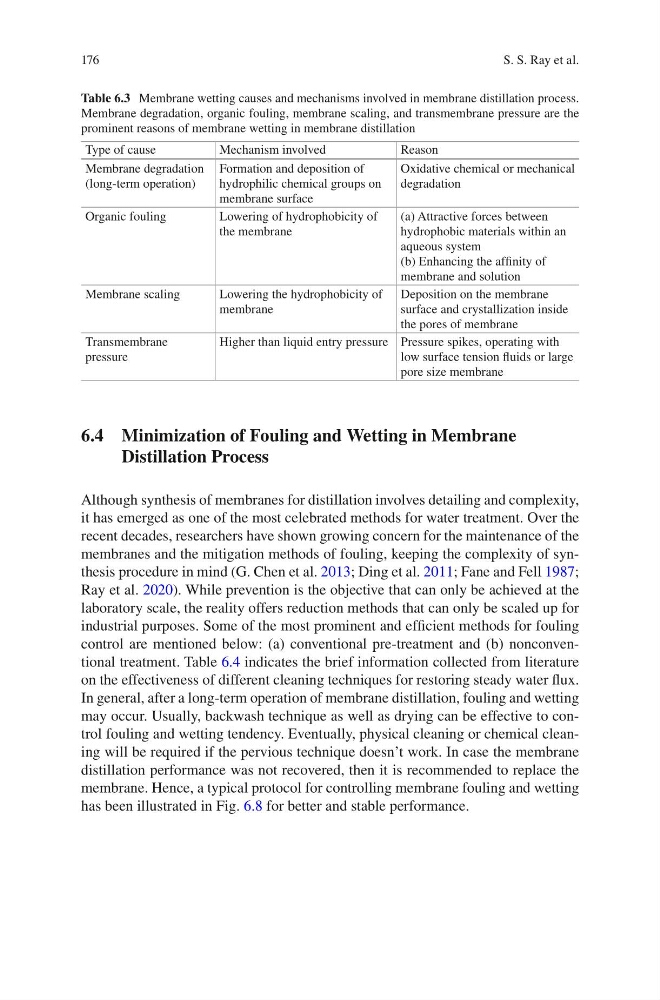
Table 6.3 Membrane wetting causes and mechanisms involved in membrane distillation process.
Membrane degradation, organic fouling, membrane scaling, and transmembrane pressure are the
prominent reasons of membrane wetting in membrane distillation
Type of cause
Mechanism involved
Reason
Membrane degradation
(long-term operation)
Formation and deposition of
hydrophilic chemical groups on
membrane surface
Oxidative chemical or mechanical
degradation
Organic fouling
Lowering of hydrophobicity of
the membrane
(a) Attractive forces between
hydrophobic materials within an
aqueous system
(b) Enhancing the affinity of
membrane and solution
Membrane scaling
Lowering the hydrophobicity of
membrane
Deposition on the membrane
surface and crystallization inside
the pores of membrane
Transmembrane
pressure
Higher than liquid entry pressure Pressure spikes, operating with
low surface tension fluids or large
pore size membrane
S. S. Ray et al.
6.4 Minimization of Fouling and Wetting in Membrane
Distillation Process
Although synthesis of membranes for distillation involves detailing and complexity,
it has emerged as one of the most celebrated methods for water treatment. Over the
recent decades, researchers have shown growing concern for the maintenance of the
membranes and the mitigation methods of fouling, keeping the complexity of synthesis procedure in mind (G. Chen et al. 2013; Ding et al. 2011; Fane and Fell 1987;
Ray et al. 2020). While prevention is the objective that can only be achieved at the
laboratory scale, the reality offers reduction methods that can only be scaled up for
industrial purposes. Some of the most prominent and efficient methods for fouling
control are mentioned below: (a) conventional pre-treatment and (b) nonconventional treatment. Table 6.4 indicates the brief information collected from literature
on the effectiveness of different cleaning techniques for restoring steady water flux.
In general, after a long-term operation of membrane distillation, fouling and wetting
may occur. Usually, backwash technique as well as drying can be effective to control fouling and wetting tendency. Eventually, physical cleaning or chemical cleaning will be required if the pervious technique doesn’t work. In case the membrane
distillation performance was not recovered, then it is recommended to replace the
membrane. Hence, a typical protocol for controlling membrane fouling and wetting
has been illustrated in Fig. 6.8 for better and stable performance.
Table 6.3 Membrane wetting causes and mechanisms involved in membrane distillation process.
Membrane degradation, organic fouling, membrane scaling, and transmembrane pressure are the
prominent reasons of membrane wetting in membrane distillation
Type of cause
Mechanism involved
Reason
Membrane degradation
(long-term operation)
Formation and deposition of
hydrophilic chemical groups on
membrane surface
Oxidative chemical or mechanical
degradation
Organic fouling
Lowering of hydrophobicity of
the membrane
(a) Attractive forces between
hydrophobic materials within an
aqueous system
(b) Enhancing the affinity of
membrane and solution
Membrane scaling
Lowering the hydrophobicity of
membrane
Deposition on the membrane
surface and crystallization inside
the pores of membrane
Transmembrane
pressure
Higher than liquid entry pressure Pressure spikes, operating with
low surface tension fluids or large
pore size membrane
S. S. Ray et al.