

175
membrane pore. Simultaneously, as the feed penetrates more into the pores, partial
wetting occurs and lowers the water flux by limiting the active surface area for mass
transport. Therefore, partial wetting results in deterioration of product quality.
Unfortunately, for long-term operations, almost all the hydrophobic membranes
used in membrane distillation (PTFE, PP, and PVDF) systems get contaminated by
partial wetting. During full wetting, the membrane distillation process no longer
remains as a barrier and leads to a viscous flow of liquid via pores, incapacitating
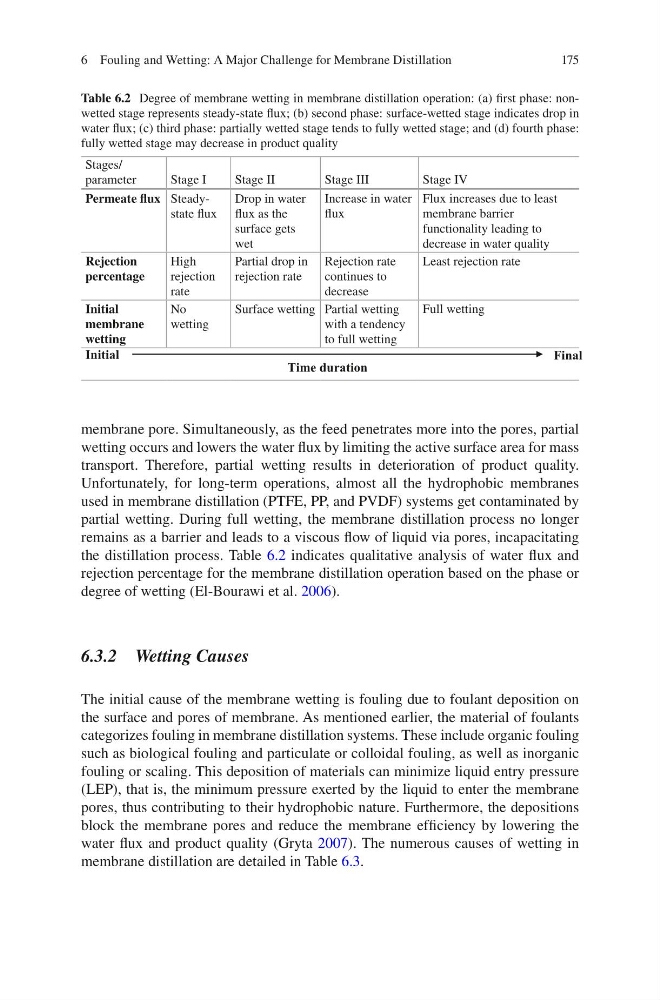
the distillation process. Table 6.2 indicates qualitative analysis of water flux and
rejection percentage for the membrane distillation operation based on the phase or
degree of wetting (El-Bourawi et al. 2006).
6.3.2 Wetting Causes
The initial cause of the membrane wetting is fouling due to foulant deposition on
the surface and pores of membrane. As mentioned earlier, the material of foulants
categorizes fouling in membrane distillation systems. These include organic fouling
such as biological fouling and particulate or colloidal fouling, as well as inorganic
fouling or scaling. This deposition of materials can minimize liquid entry pressure
(LEP), that is, the minimum pressure exerted by the liquid to enter the membrane
pores, thus contributing to their hydrophobic nature. Furthermore, the depositions
block the membrane pores and reduce the membrane efficiency by lowering the
water flux and product quality (Gryta 2007). The numerous causes of wetting in
membrane distillation are detailed in Table 6.3.
Table 6.2 Degree of membrane wetting in membrane distillation operation: (a) first phase: nonwetted stage represents steady-state flux; (b) second phase: surface-wetted stage indicates drop in
water flux; (c) third phase: partially wetted stage tends to fully wetted stage; and (d) fourth phase:
fully wetted stage may decrease in product quality
Stages/
parameter
Stage I
Stage II
Stage III
Stage IV
Permeate flux Steadystate flux
Drop in water
flux as the
surface gets
wet
Increase in water
flux
Flux increases due to least
membrane barrier
functionality leading to
decrease in water quality
Rejection
percentage
High
rejection
rate
Partial drop in
rejection rate
Rejection rate
continues to
decrease
Least rejection rate
Initial
membrane
wetting
No
wetting
Surface wetting Partial wetting
with a tendency
to full wetting
Full wetting
Time duration
Final
Initial
6 Fouling and Wetting: A Major Challenge for Membrane Distillation
membrane pore. Simultaneously, as the feed penetrates more into the pores, partial
wetting occurs and lowers the water flux by limiting the active surface area for mass
transport. Therefore, partial wetting results in deterioration of product quality.
Unfortunately, for long-term operations, almost all the hydrophobic membranes
used in membrane distillation (PTFE, PP, and PVDF) systems get contaminated by
partial wetting. During full wetting, the membrane distillation process no longer
remains as a barrier and leads to a viscous flow of liquid via pores, incapacitating
the distillation process. Table 6.2 indicates qualitative analysis of water flux and
rejection percentage for the membrane distillation operation based on the phase or
degree of wetting (El-Bourawi et al. 2006).
6.3.2 Wetting Causes
The initial cause of the membrane wetting is fouling due to foulant deposition on
the surface and pores of membrane. As mentioned earlier, the material of foulants
categorizes fouling in membrane distillation systems. These include organic fouling
such as biological fouling and particulate or colloidal fouling, as well as inorganic
fouling or scaling. This deposition of materials can minimize liquid entry pressure
(LEP), that is, the minimum pressure exerted by the liquid to enter the membrane
pores, thus contributing to their hydrophobic nature. Furthermore, the depositions
block the membrane pores and reduce the membrane efficiency by lowering the
water flux and product quality (Gryta 2007). The numerous causes of wetting in
membrane distillation are detailed in Table 6.3.
Table 6.2 Degree of membrane wetting in membrane distillation operation: (a) first phase: nonwetted stage represents steady-state flux; (b) second phase: surface-wetted stage indicates drop in
water flux; (c) third phase: partially wetted stage tends to fully wetted stage; and (d) fourth phase:
fully wetted stage may decrease in product quality
Stages/
parameter
Stage I
Stage II
Stage III
Stage IV
Permeate flux Steadystate flux
Drop in water
flux as the
surface gets
wet
Increase in water
flux
Flux increases due to least
membrane barrier
functionality leading to
decrease in water quality
Rejection
percentage
High
rejection
rate
Partial drop in
rejection rate
Rejection rate
continues to
decrease
Least rejection rate
Initial
membrane
wetting
No
wetting
Surface wetting Partial wetting
with a tendency
to full wetting
Full wetting
Time duration
Final
Initial
6 Fouling and Wetting: A Major Challenge for Membrane Distillation