

169
velocity, resulting in higher temperature polarization effects and lowering of permeate flux. Additionally, Gryta et al. noted the pore blockage of adjacent pores as a
surface deposition (partial membrane wetting) (Gryta 2008a). Furthermore, this
additional fouling layer increases the thermal resistance of the surface. External
surface fouling is usually reversible and can be cleaned by physical or chemical
cleaning. To explain the process of cake layer formation, it is very necessary to
describe the contributing forces as well as operation conditions. However, the foulants also have a deciding role for determining the type of fouling to occur. Mostly,
the foulants retained on the membrane and attach themselves on the membrane
surface and contribute to cake layer growth, hereby increasing the resistance over
the surface as R cake , wherein the smaller particulates contribute more to the specific
resistance of a filter cake. The aforementioned relation could be well explained by
mathematical formula given by Blake-Kozeny equation (eq. 6.2) (Broeckmann
et al. 2006; Huisman et al. 1998):
1
9 0
1
2
2
3
K
K cake
k Kozeny
dp
Ccake
p
Ccake
p
∗
= ∗
=
×
∗
( )
−
.
ρ
ρ
(6.2)
STAGE I: Rapid initial decline
STAGE II: Long period of decline
STAGE III: Steady state flux
STAGES OF FLUX DECLINE
STAGES OF FLUX DECLINE
Water flux (LMH)
Time period (h)
(I)
(II)
(III)
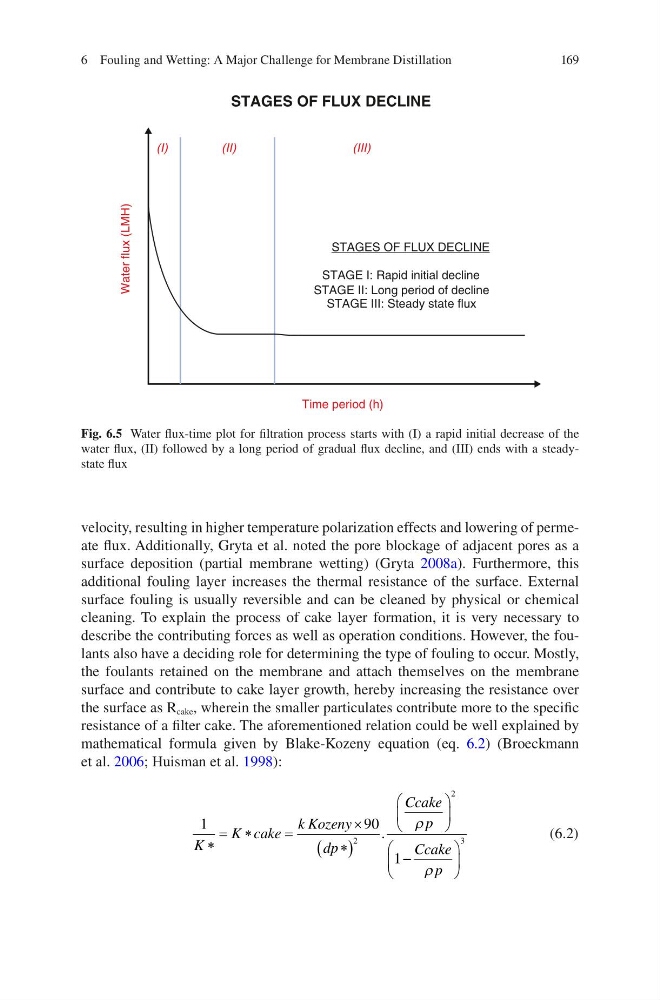
Fig. 6.5 Water flux-time plot for filtration process starts with (I) a rapid initial decrease of the
water flux, (II) followed by a long period of gradual flux decline, and (III) ends with a steadystate flux
6 Fouling and Wetting: A Major Challenge for Membrane Distillation
velocity, resulting in higher temperature polarization effects and lowering of permeate flux. Additionally, Gryta et al. noted the pore blockage of adjacent pores as a
surface deposition (partial membrane wetting) (Gryta 2008a). Furthermore, this
additional fouling layer increases the thermal resistance of the surface. External
surface fouling is usually reversible and can be cleaned by physical or chemical
cleaning. To explain the process of cake layer formation, it is very necessary to
describe the contributing forces as well as operation conditions. However, the foulants also have a deciding role for determining the type of fouling to occur. Mostly,
the foulants retained on the membrane and attach themselves on the membrane
surface and contribute to cake layer growth, hereby increasing the resistance over
the surface as R cake , wherein the smaller particulates contribute more to the specific
resistance of a filter cake. The aforementioned relation could be well explained by
mathematical formula given by Blake-Kozeny equation (eq. 6.2) (Broeckmann
et al. 2006; Huisman et al. 1998):
1
9 0
1
2
2
3
K
K cake
k Kozeny
dp
Ccake
p
Ccake
p
∗
= ∗
=
×
∗
( )
−
.
ρ
ρ
(6.2)
STAGE I: Rapid initial decline
STAGE II: Long period of decline
STAGE III: Steady state flux
STAGES OF FLUX DECLINE
STAGES OF FLUX DECLINE
Water flux (LMH)
Time period (h)
(I)
(II)
(III)
Fig. 6.5 Water flux-time plot for filtration process starts with (I) a rapid initial decrease of the
water flux, (II) followed by a long period of gradual flux decline, and (III) ends with a steadystate flux
6 Fouling and Wetting: A Major Challenge for Membrane Distillation