

168
and was the most contributing mechanism for fouling (Jiang et al. 2005, 2003).
However, increase in cake layer formation was observed with a rise in feed rate.
Later, under the same investigation, the increase in pore blocking with the decrease
in temperature was confirmed. Also, pore blocking is highly dependent on the
type of polymer used for membrane fabrication. Similar to studies by Gryta et al.,
influencing the membrane performance, it was observed that the gas retained in
the membrane pores was a major factor contributing to the fouling internally
(Gryta 2005), commonly observed in highly hydrophobic-polymeric membranes,
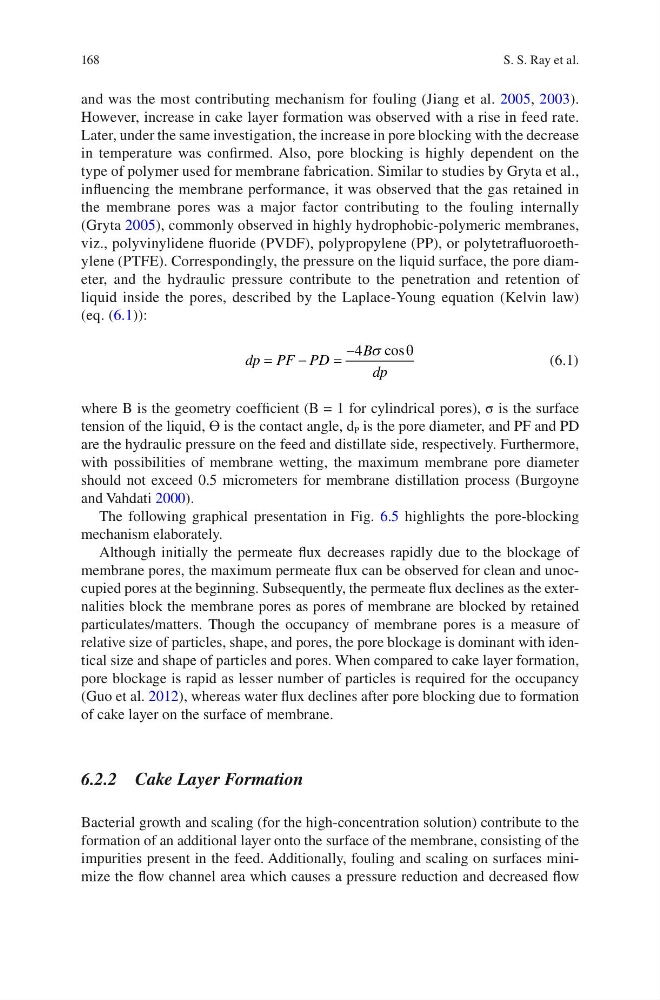
viz., polyvinylidene fluoride (PVDF), polypropylene (PP), or polytetrafluoroethylene (PTFE). Correspondingly, the pressure on the liquid surface, the pore diameter, and the hydraulic pressure contribute to the penetration and retention of
liquid inside the pores, described by the Laplace-Young equation (Kelvin law)
(eq. (6.1)):
dp PF PD
B
dp
=
−
=
−4 σ cos θ
(6.1)
where B is the geometry coefficient (B = 1 for cylindrical pores), σ is the surface
tension of the liquid, Ɵ is the contact angle, d P is the pore diameter, and PF and PD
are the hydraulic pressure on the feed and distillate side, respectively. Furthermore,
with possibilities of membrane wetting, the maximum membrane pore diameter
should not exceed 0.5 micrometers for membrane distillation process (Burgoyne
and Vahdati 2000).
The following graphical presentation in Fig. 6.5 highlights the pore-blocking
mechanism elaborately.
Although initially the permeate flux decreases rapidly due to the blockage of
membrane pores, the maximum permeate flux can be observed for clean and unoccupied pores at the beginning. Subsequently, the permeate flux declines as the externalities block the membrane pores as pores of membrane are blocked by retained
particulates/matters. Though the occupancy of membrane pores is a measure of
relative size of particles, shape, and pores, the pore blockage is dominant with identical size and shape of particles and pores. When compared to cake layer formation,
pore blockage is rapid as lesser number of particles is required for the occupancy
(Guo et al. 2012), whereas water flux declines after pore blocking due to formation
of cake layer on the surface of membrane.
6.2.2 Cake Layer Formation
Bacterial growth and scaling (for the high-concentration solution) contribute to the
formation of an additional layer onto the surface of the membrane, consisting of the
impurities present in the feed. Additionally, fouling and scaling on surfaces minimize the flow channel area which causes a pressure reduction and decreased flow
S. S. Ray et al.
and was the most contributing mechanism for fouling (Jiang et al. 2005, 2003).
However, increase in cake layer formation was observed with a rise in feed rate.
Later, under the same investigation, the increase in pore blocking with the decrease
in temperature was confirmed. Also, pore blocking is highly dependent on the
type of polymer used for membrane fabrication. Similar to studies by Gryta et al.,
influencing the membrane performance, it was observed that the gas retained in
the membrane pores was a major factor contributing to the fouling internally
(Gryta 2005), commonly observed in highly hydrophobic-polymeric membranes,
viz., polyvinylidene fluoride (PVDF), polypropylene (PP), or polytetrafluoroethylene (PTFE). Correspondingly, the pressure on the liquid surface, the pore diameter, and the hydraulic pressure contribute to the penetration and retention of
liquid inside the pores, described by the Laplace-Young equation (Kelvin law)
(eq. (6.1)):
dp PF PD
B
dp
=
−
=
−4 σ cos θ
(6.1)
where B is the geometry coefficient (B = 1 for cylindrical pores), σ is the surface
tension of the liquid, Ɵ is the contact angle, d P is the pore diameter, and PF and PD
are the hydraulic pressure on the feed and distillate side, respectively. Furthermore,
with possibilities of membrane wetting, the maximum membrane pore diameter
should not exceed 0.5 micrometers for membrane distillation process (Burgoyne
and Vahdati 2000).
The following graphical presentation in Fig. 6.5 highlights the pore-blocking
mechanism elaborately.
Although initially the permeate flux decreases rapidly due to the blockage of
membrane pores, the maximum permeate flux can be observed for clean and unoccupied pores at the beginning. Subsequently, the permeate flux declines as the externalities block the membrane pores as pores of membrane are blocked by retained
particulates/matters. Though the occupancy of membrane pores is a measure of
relative size of particles, shape, and pores, the pore blockage is dominant with identical size and shape of particles and pores. When compared to cake layer formation,
pore blockage is rapid as lesser number of particles is required for the occupancy
(Guo et al. 2012), whereas water flux declines after pore blocking due to formation
of cake layer on the surface of membrane.
6.2.2 Cake Layer Formation
Bacterial growth and scaling (for the high-concentration solution) contribute to the
formation of an additional layer onto the surface of the membrane, consisting of the
impurities present in the feed. Additionally, fouling and scaling on surfaces minimize the flow channel area which causes a pressure reduction and decreased flow
S. S. Ray et al.