

167
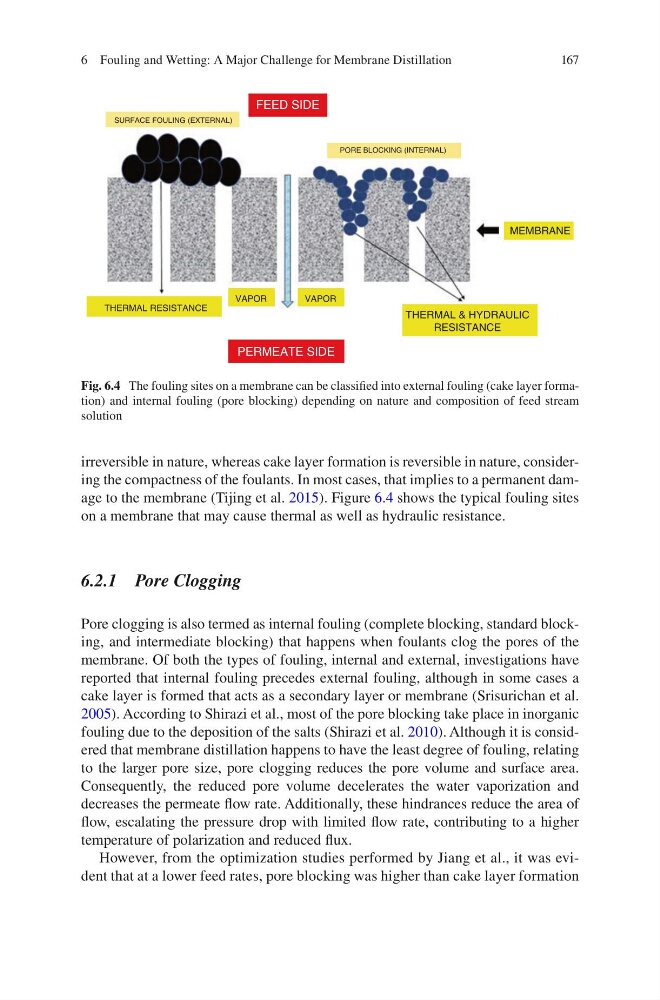
irreversible in nature, whereas cake layer formation is reversible in nature, considering the compactness of the foulants. In most cases, that implies to a permanent damage to the membrane (Tijing et al. 2015). Figure 6.4 shows the typical fouling sites
on a membrane that may cause thermal as well as hydraulic resistance.
6.2.1 Pore Clogging
Pore clogging is also termed as internal fouling (complete blocking, standard blocking, and intermediate blocking) that happens when foulants clog the pores of the
membrane. Of both the types of fouling, internal and external, investigations have
reported that internal fouling precedes external fouling, although in some cases a
cake layer is formed that acts as a secondary layer or membrane (Srisurichan et al.
2005). According to Shirazi et al., most of the pore blocking take place in inorganic
fouling due to the deposition of the salts (Shirazi et al. 2010). Although it is considered that membrane distillation happens to have the least degree of fouling, relating
to the larger pore size, pore clogging reduces the pore volume and surface area.
Consequently, the reduced pore volume decelerates the water vaporization and
decreases the permeate flow rate. Additionally, these hindrances reduce the area of
flow, escalating the pressure drop with limited flow rate, contributing to a higher
temperature of polarization and reduced flux.
However, from the optimization studies performed by Jiang et al., it was evident that at a lower feed rates, pore blocking was higher than cake layer formation
PORE BLOCKING (INTERNAL)
SURFACE FOULING (EXTERNAL)
THERMAL RESISTANCE
VAPOR
VAPOR
MEMBRANE
THERMAL & HYDRAULIC
RESISTANCE
PERMEATE SIDE
FEED SIDE
Fig. 6.4 The fouling sites on a membrane can be classified into external fouling (cake layer formation) and internal fouling (pore blocking) depending on nature and composition of feed stream
solution
6 Fouling and Wetting: A Major Challenge for Membrane Distillation
irreversible in nature, whereas cake layer formation is reversible in nature, considering the compactness of the foulants. In most cases, that implies to a permanent damage to the membrane (Tijing et al. 2015). Figure 6.4 shows the typical fouling sites
on a membrane that may cause thermal as well as hydraulic resistance.
6.2.1 Pore Clogging
Pore clogging is also termed as internal fouling (complete blocking, standard blocking, and intermediate blocking) that happens when foulants clog the pores of the
membrane. Of both the types of fouling, internal and external, investigations have
reported that internal fouling precedes external fouling, although in some cases a
cake layer is formed that acts as a secondary layer or membrane (Srisurichan et al.
2005). According to Shirazi et al., most of the pore blocking take place in inorganic
fouling due to the deposition of the salts (Shirazi et al. 2010). Although it is considered that membrane distillation happens to have the least degree of fouling, relating
to the larger pore size, pore clogging reduces the pore volume and surface area.
Consequently, the reduced pore volume decelerates the water vaporization and
decreases the permeate flow rate. Additionally, these hindrances reduce the area of
flow, escalating the pressure drop with limited flow rate, contributing to a higher
temperature of polarization and reduced flux.
However, from the optimization studies performed by Jiang et al., it was evident that at a lower feed rates, pore blocking was higher than cake layer formation
PORE BLOCKING (INTERNAL)
SURFACE FOULING (EXTERNAL)
THERMAL RESISTANCE
VAPOR
VAPOR
MEMBRANE
THERMAL & HYDRAULIC
RESISTANCE
PERMEATE SIDE
FEED SIDE
Fig. 6.4 The fouling sites on a membrane can be classified into external fouling (cake layer formation) and internal fouling (pore blocking) depending on nature and composition of feed stream
solution
6 Fouling and Wetting: A Major Challenge for Membrane Distillation