

166
contrary, whenever the membrane walls inside the pores are completely wet, it can
be classified as internal wetting (Gryta 2005; Lu et al. 2008).
Over the past decade, membrane distillation has gained much popularity, as a
result of increasing versatility in water treatment and desalination. Nevertheless,
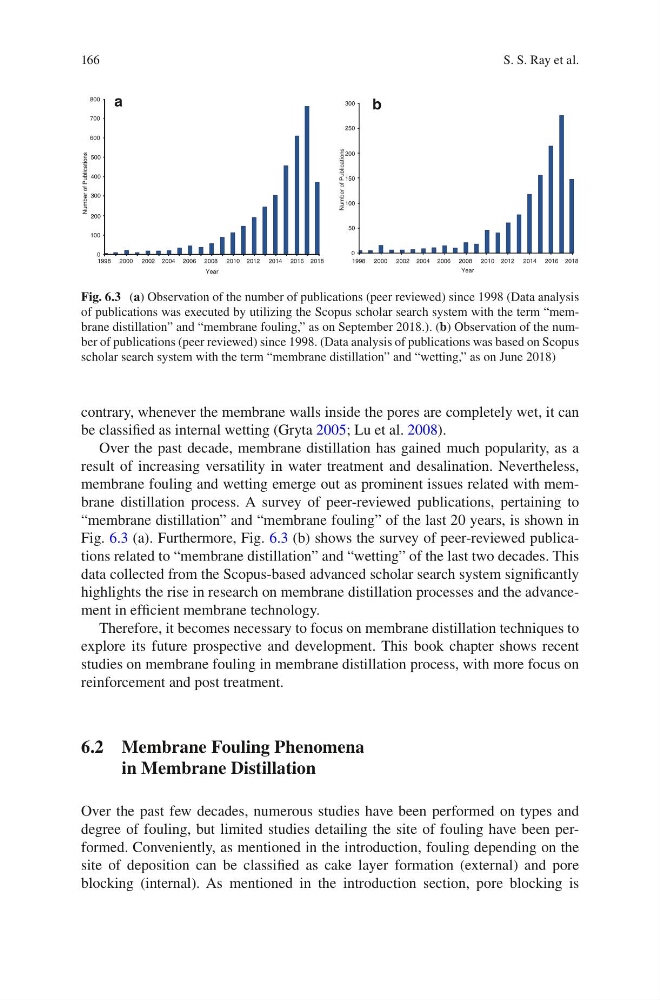
membrane fouling and wetting emerge out as prominent issues related with membrane distillation process. A survey of peer-reviewed publications, pertaining to
“membrane distillation” and “membrane fouling” of the last 20 years, is shown in
Fig. 6.3 (a). Furthermore, Fig. 6.3 (b) shows the survey of peer-reviewed publications related to “membrane distillation” and “wetting” of the last two decades. This
data collected from the Scopus-based advanced scholar search system significantly
highlights the rise in research on membrane distillation processes and the advancement in efficient membrane technology.
Therefore, it becomes necessary to focus on membrane distillation techniques to
explore its future prospective and development. This book chapter shows recent
studies on membrane fouling in membrane distillation process, with more focus on
reinforcement and post treatment.
6.2 Membrane Fouling Phenomena
in Membrane Distillation
Over the past few decades, numerous studies have been performed on types and
degree of fouling, but limited studies detailing the site of fouling have been performed. Conveniently, as mentioned in the introduction, fouling depending on the
site of deposition can be classified as cake layer formation (external) and pore
blocking (internal). As mentioned in the introduction section, pore blocking is
2016 2018
1998 2000 2002 2004 2006 2008 2010 2012 2014
2016 2018
1998
0
50
100
150
200
250
300
2000 2002 2004 2006 2008 2010 2012 2014
Year
Year
800
700
600
500
400
300
200
100
0
Number of Publications
Number of Publications
a
b
Fig. 6.3 (a) Observation of the number of publications (peer reviewed) since 1998 (Data analysis
of publications was executed by utilizing the Scopus scholar search system with the term “membrane distillation” and “membrane fouling,” as on September 2018.). (b) Observation of the number of publications (peer reviewed) since 1998. (Data analysis of publications was based on Scopus
scholar search system with the term “membrane distillation” and “wetting,” as on June 2018)
S. S. Ray et al.
contrary, whenever the membrane walls inside the pores are completely wet, it can
be classified as internal wetting (Gryta 2005; Lu et al. 2008).
Over the past decade, membrane distillation has gained much popularity, as a
result of increasing versatility in water treatment and desalination. Nevertheless,
membrane fouling and wetting emerge out as prominent issues related with membrane distillation process. A survey of peer-reviewed publications, pertaining to
“membrane distillation” and “membrane fouling” of the last 20 years, is shown in
Fig. 6.3 (a). Furthermore, Fig. 6.3 (b) shows the survey of peer-reviewed publications related to “membrane distillation” and “wetting” of the last two decades. This
data collected from the Scopus-based advanced scholar search system significantly
highlights the rise in research on membrane distillation processes and the advancement in efficient membrane technology.
Therefore, it becomes necessary to focus on membrane distillation techniques to
explore its future prospective and development. This book chapter shows recent
studies on membrane fouling in membrane distillation process, with more focus on
reinforcement and post treatment.
6.2 Membrane Fouling Phenomena
in Membrane Distillation
Over the past few decades, numerous studies have been performed on types and
degree of fouling, but limited studies detailing the site of fouling have been performed. Conveniently, as mentioned in the introduction, fouling depending on the
site of deposition can be classified as cake layer formation (external) and pore
blocking (internal). As mentioned in the introduction section, pore blocking is
2016 2018
1998 2000 2002 2004 2006 2008 2010 2012 2014
2016 2018
1998
0
50
100
150
200
250
300
2000 2002 2004 2006 2008 2010 2012 2014
Year
Year
800
700
600
500
400
300
200
100
0
Number of Publications
Number of Publications
a
b
Fig. 6.3 (a) Observation of the number of publications (peer reviewed) since 1998 (Data analysis
of publications was executed by utilizing the Scopus scholar search system with the term “membrane distillation” and “membrane fouling,” as on September 2018.). (b) Observation of the number of publications (peer reviewed) since 1998. (Data analysis of publications was based on Scopus
scholar search system with the term “membrane distillation” and “wetting,” as on June 2018)
S. S. Ray et al.