

165
As mentioned earlier, membrane distillation is a thermal separation technique,
wherein a hydrophobic microporous membrane isolates two aqueous streams at different temperatures. Correspondingly, an interface between gas and liquid is generated due to lack of mass transfer by virtue of its hydrophobic character (Ray et al.
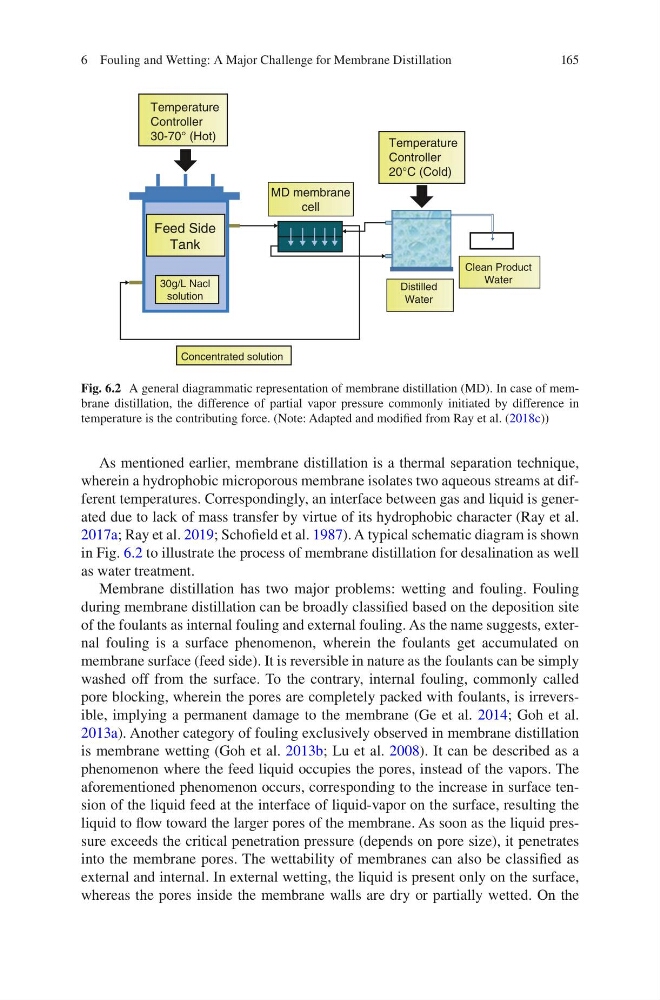
2017a; Ray et al. 2019; Schofield et al. 1987). A typical schematic diagram is shown
in Fig. 6.2 to illustrate the process of membrane distillation for desalination as well
as water treatment.
Membrane distillation has two major problems: wetting and fouling. Fouling
during membrane distillation can be broadly classified based on the deposition site
of the foulants as internal fouling and external fouling. As the name suggests, external fouling is a surface phenomenon, wherein the foulants get accumulated on
membrane surface (feed side). It is reversible in nature as the foulants can be simply
washed off from the surface. To the contrary, internal fouling, commonly called
pore blocking, wherein the pores are completely packed with foulants, is irreversible, implying a permanent damage to the membrane (Ge et al. 2014; Goh et al.
2013a). Another category of fouling exclusively observed in membrane distillation
is membrane wetting (Goh et al. 2013b; Lu et al. 2008). It can be described as a
phenomenon where the feed liquid occupies the pores, instead of the vapors. The
aforementioned phenomenon occurs, corresponding to the increase in surface tension of the liquid feed at the interface of liquid-vapor on the surface, resulting the
liquid to flow toward the larger pores of the membrane. As soon as the liquid pressure exceeds the critical penetration pressure (depends on pore size), it penetrates
into the membrane pores. The wettability of membranes can also be classified as
external and internal. In external wetting, the liquid is present only on the surface,
whereas the pores inside the membrane walls are dry or partially wetted. On the
Temperature
Controller
30-70° (Hot)
Feed Side
Tank
30g/L Nacl
solution
Concentrated solution
Distilled
Water
Clean Product
Water
Temperature
Controller
20°C (Cold)
MD membrane
cell
Fig. 6.2 A general diagrammatic representation of membrane distillation (MD). In case of membrane distillation, the difference of partial vapor pressure commonly initiated by difference in
temperature is the contributing force. (Note: Adapted and modified from Ray et al. (2018c))
6 Fouling and Wetting: A Major Challenge for Membrane Distillation
As mentioned earlier, membrane distillation is a thermal separation technique,
wherein a hydrophobic microporous membrane isolates two aqueous streams at different temperatures. Correspondingly, an interface between gas and liquid is generated due to lack of mass transfer by virtue of its hydrophobic character (Ray et al.
2017a; Ray et al. 2019; Schofield et al. 1987). A typical schematic diagram is shown
in Fig. 6.2 to illustrate the process of membrane distillation for desalination as well
as water treatment.
Membrane distillation has two major problems: wetting and fouling. Fouling
during membrane distillation can be broadly classified based on the deposition site
of the foulants as internal fouling and external fouling. As the name suggests, external fouling is a surface phenomenon, wherein the foulants get accumulated on
membrane surface (feed side). It is reversible in nature as the foulants can be simply
washed off from the surface. To the contrary, internal fouling, commonly called
pore blocking, wherein the pores are completely packed with foulants, is irreversible, implying a permanent damage to the membrane (Ge et al. 2014; Goh et al.
2013a). Another category of fouling exclusively observed in membrane distillation
is membrane wetting (Goh et al. 2013b; Lu et al. 2008). It can be described as a
phenomenon where the feed liquid occupies the pores, instead of the vapors. The
aforementioned phenomenon occurs, corresponding to the increase in surface tension of the liquid feed at the interface of liquid-vapor on the surface, resulting the
liquid to flow toward the larger pores of the membrane. As soon as the liquid pressure exceeds the critical penetration pressure (depends on pore size), it penetrates
into the membrane pores. The wettability of membranes can also be classified as
external and internal. In external wetting, the liquid is present only on the surface,
whereas the pores inside the membrane walls are dry or partially wetted. On the
Temperature
Controller
30-70° (Hot)
Feed Side
Tank
30g/L Nacl
solution
Concentrated solution
Distilled
Water
Clean Product
Water
Temperature
Controller
20°C (Cold)
MD membrane
cell
Fig. 6.2 A general diagrammatic representation of membrane distillation (MD). In case of membrane distillation, the difference of partial vapor pressure commonly initiated by difference in
temperature is the contributing force. (Note: Adapted and modified from Ray et al. (2018c))
6 Fouling and Wetting: A Major Challenge for Membrane Distillation