

164
characteristics, operational parameters, nature of feed, and prominently the pore
size of the membrane contribute to fouling. Typically, types of membrane, performance, hydrodynamic conditions, and operating conditions are prominent factors
that influence the performance (Al-Amoudi 2010; Bellona et al. 2004; Camacho
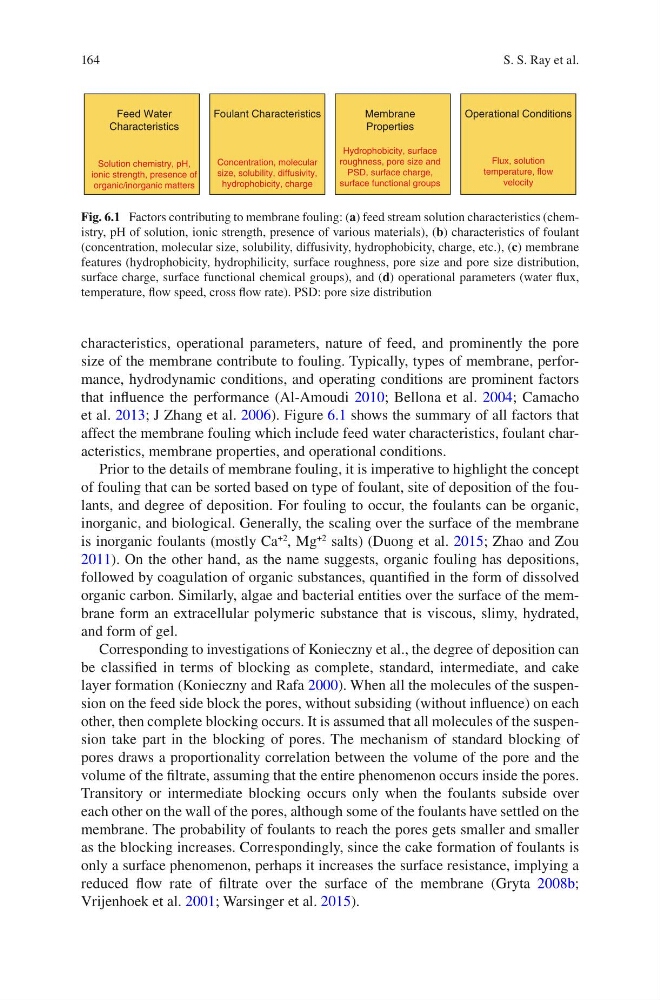
et al. 2013; J Zhang et al. 2006). Figure 6.1 shows the summary of all factors that
affect the membrane fouling which include feed water characteristics, foulant characteristics, membrane properties, and operational conditions.
Prior to the details of membrane fouling, it is imperative to highlight the concept
of fouling that can be sorted based on type of foulant, site of deposition of the foulants, and degree of deposition. For fouling to occur, the foulants can be organic,
inorganic, and biological. Generally, the scaling over the surface of the membrane
is inorganic foulants (mostly Ca
+2
, Mg
+2
salts) (Duong et al. 2015; Zhao and Zou
2011). On the other hand, as the name suggests, organic fouling has depositions,
followed by coagulation of organic substances, quantified in the form of dissolved
organic carbon. Similarly, algae and bacterial entities over the surface of the membrane form an extracellular polymeric substance that is viscous, slimy, hydrated,
and form of gel.
Corresponding to investigations of Konieczny et al., the degree of deposition can
be classified in terms of blocking as complete, standard, intermediate, and cake
layer formation (Konieczny and Rafa 2000). When all the molecules of the suspension on the feed side block the pores, without subsiding (without influence) on each
other, then complete blocking occurs. It is assumed that all molecules of the suspension take part in the blocking of pores. The mechanism of standard blocking of
pores draws a proportionality correlation between the volume of the pore and the
volume of the filtrate, assuming that the entire phenomenon occurs inside the pores.
Transitory or intermediate blocking occurs only when the foulants subside over
each other on the wall of the pores, although some of the foulants have settled on the
membrane. The probability of foulants to reach the pores gets smaller and smaller
as the blocking increases. Correspondingly, since the cake formation of foulants is
only a surface phenomenon, perhaps it increases the surface resistance, implying a
reduced flow rate of filtrate over the surface of the membrane (Gryta 2008b;
Vrijenhoek et al. 2001; Warsinger et al. 2015).
Feed Water
Characteristics
Foulant Characteristics
Membrane
Properties
Operational Conditions
Solution chemistry, pH,
ionic strength, presence of
organic/inorganic matters
Concentration, molecular
size, solubility, diffusivity,
hydrophobicity, charge
Hydrophobicity, surface
roughness, pore size and
PSD, surface charge,
surface functional groups
Flux, solution
temperature, flow
velocity
Fig. 6.1 Factors contributing to membrane fouling: (a) feed stream solution characteristics (chemistry, pH of solution, ionic strength, presence of various materials), (b) characteristics of foulant
(concentration, molecular size, solubility, diffusivity, hydrophobicity, charge, etc.), (c) membrane
features (hydrophobicity, hydrophilicity, surface roughness, pore size and pore size distribution,
surface charge, surface functional chemical groups), and (d) operational parameters (water flux,
temperature, flow speed, cross flow rate). PSD: pore size distribution
S. S. Ray et al.
characteristics, operational parameters, nature of feed, and prominently the pore
size of the membrane contribute to fouling. Typically, types of membrane, performance, hydrodynamic conditions, and operating conditions are prominent factors
that influence the performance (Al-Amoudi 2010; Bellona et al. 2004; Camacho
et al. 2013; J Zhang et al. 2006). Figure 6.1 shows the summary of all factors that
affect the membrane fouling which include feed water characteristics, foulant characteristics, membrane properties, and operational conditions.
Prior to the details of membrane fouling, it is imperative to highlight the concept
of fouling that can be sorted based on type of foulant, site of deposition of the foulants, and degree of deposition. For fouling to occur, the foulants can be organic,
inorganic, and biological. Generally, the scaling over the surface of the membrane
is inorganic foulants (mostly Ca
+2
, Mg
+2
salts) (Duong et al. 2015; Zhao and Zou
2011). On the other hand, as the name suggests, organic fouling has depositions,
followed by coagulation of organic substances, quantified in the form of dissolved
organic carbon. Similarly, algae and bacterial entities over the surface of the membrane form an extracellular polymeric substance that is viscous, slimy, hydrated,
and form of gel.
Corresponding to investigations of Konieczny et al., the degree of deposition can
be classified in terms of blocking as complete, standard, intermediate, and cake
layer formation (Konieczny and Rafa 2000). When all the molecules of the suspension on the feed side block the pores, without subsiding (without influence) on each
other, then complete blocking occurs. It is assumed that all molecules of the suspension take part in the blocking of pores. The mechanism of standard blocking of
pores draws a proportionality correlation between the volume of the pore and the
volume of the filtrate, assuming that the entire phenomenon occurs inside the pores.
Transitory or intermediate blocking occurs only when the foulants subside over
each other on the wall of the pores, although some of the foulants have settled on the
membrane. The probability of foulants to reach the pores gets smaller and smaller
as the blocking increases. Correspondingly, since the cake formation of foulants is
only a surface phenomenon, perhaps it increases the surface resistance, implying a
reduced flow rate of filtrate over the surface of the membrane (Gryta 2008b;
Vrijenhoek et al. 2001; Warsinger et al. 2015).
Feed Water
Characteristics
Foulant Characteristics
Membrane
Properties
Operational Conditions
Solution chemistry, pH,
ionic strength, presence of
organic/inorganic matters
Concentration, molecular
size, solubility, diffusivity,
hydrophobicity, charge
Hydrophobicity, surface
roughness, pore size and
PSD, surface charge,
surface functional groups
Flux, solution
temperature, flow
velocity
Fig. 6.1 Factors contributing to membrane fouling: (a) feed stream solution characteristics (chemistry, pH of solution, ionic strength, presence of various materials), (b) characteristics of foulant
(concentration, molecular size, solubility, diffusivity, hydrophobicity, charge, etc.), (c) membrane
features (hydrophobicity, hydrophilicity, surface roughness, pore size and pore size distribution,
surface charge, surface functional chemical groups), and (d) operational parameters (water flux,
temperature, flow speed, cross flow rate). PSD: pore size distribution
S. S. Ray et al.