

170
wherein d p is the mean particle diameter, c cake is the mean mass concentration of the
foulants forming the cake layer, and ρ p refers to the density of the particles. K* cake
is the specific cake layer resistance. From the Blake-Kozeny equation, the inverse
relation of the mean particle diameter and the specific resistance was confirmed.
Hereby, it can be easily stated that smaller particles contribute much toward the cake
layer formation as compared to larger foulants. Other than the size of the foulants,
the cross flow rate also has significance on the deposition of the foulants on the
membrane layer for cake layer formation. Recently, Mamun et al. projected the
aggravated initial growth rate of the secondary layer corresponding to the escalated
cross flow velocity (Chang et al. 2018).
According to the classic Derjaguin, Landau, Vervey, and Overbeek (DLVO) theory, the net foulant surface interaction additively depends on the van der Waals and
electrical forces between the double layers (Hoek et al. 2003). The surface and the
foulants with opposite charges will facilitate the cake layer formation, and correspondingly, similar charges destabilize the formation mechanism. From the aforementioned theory, it is very evident that particles with repulsive or lowered
interaction with surface constitute to less fouling. Other than the surface-particle
interaction, particle-particle interaction plays an acute role to enhance the cake layer
formation. According to Wilkinson et al., for particles with higher frequency of collision and attachment coefficient, more foulants agglomerate on the surface
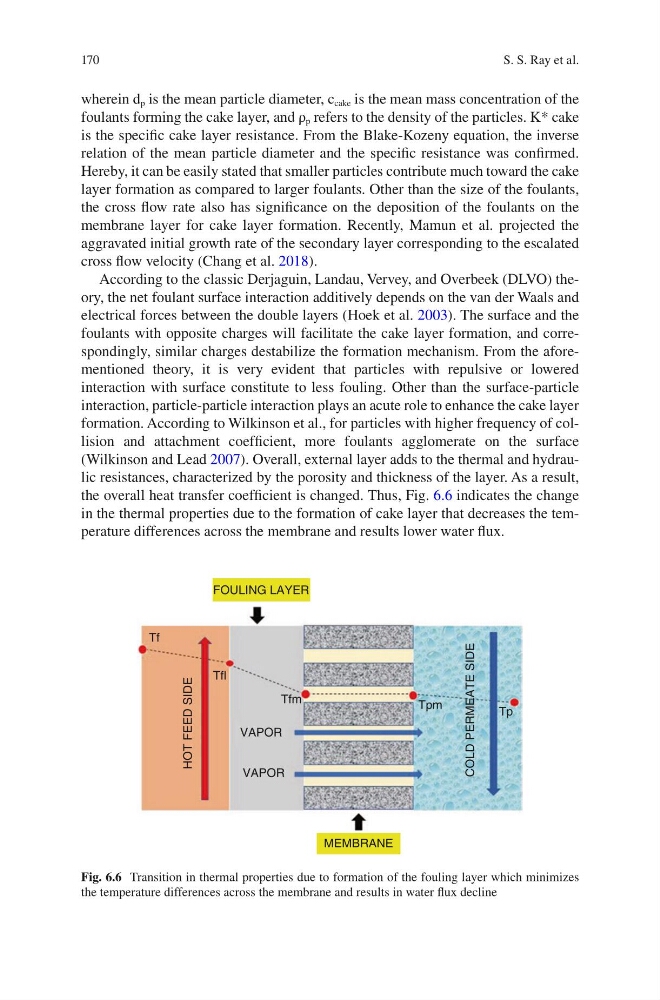
(Wilkinson and Lead 2007). Overall, external layer adds to the thermal and hydraulic resistances, characterized by the porosity and thickness of the layer. As a result,
the overall heat transfer coefficient is changed. Thus, Fig. 6.6 indicates the change
in the thermal properties due to the formation of cake layer that decreases the temperature differences across the membrane and results lower water flux.
VAPOR
VAPOR
HOT FEED SIDE
Tf
FOULING LAYER
MEMBRANE
Tfl
Tfm
Tpm
Tp
COLD PERMEATE SIDE
Fig. 6.6 Transition in thermal properties due to formation of the fouling layer which minimizes
the temperature differences across the membrane and results in water flux decline
S. S. Ray et al.
wherein d p is the mean particle diameter, c cake is the mean mass concentration of the
foulants forming the cake layer, and ρ p refers to the density of the particles. K* cake
is the specific cake layer resistance. From the Blake-Kozeny equation, the inverse
relation of the mean particle diameter and the specific resistance was confirmed.
Hereby, it can be easily stated that smaller particles contribute much toward the cake
layer formation as compared to larger foulants. Other than the size of the foulants,
the cross flow rate also has significance on the deposition of the foulants on the
membrane layer for cake layer formation. Recently, Mamun et al. projected the
aggravated initial growth rate of the secondary layer corresponding to the escalated
cross flow velocity (Chang et al. 2018).
According to the classic Derjaguin, Landau, Vervey, and Overbeek (DLVO) theory, the net foulant surface interaction additively depends on the van der Waals and
electrical forces between the double layers (Hoek et al. 2003). The surface and the
foulants with opposite charges will facilitate the cake layer formation, and correspondingly, similar charges destabilize the formation mechanism. From the aforementioned theory, it is very evident that particles with repulsive or lowered
interaction with surface constitute to less fouling. Other than the surface-particle
interaction, particle-particle interaction plays an acute role to enhance the cake layer
formation. According to Wilkinson et al., for particles with higher frequency of collision and attachment coefficient, more foulants agglomerate on the surface
(Wilkinson and Lead 2007). Overall, external layer adds to the thermal and hydraulic resistances, characterized by the porosity and thickness of the layer. As a result,
the overall heat transfer coefficient is changed. Thus, Fig. 6.6 indicates the change
in the thermal properties due to the formation of cake layer that decreases the temperature differences across the membrane and results lower water flux.
VAPOR
VAPOR
HOT FEED SIDE
Tf
FOULING LAYER
MEMBRANE
Tfl
Tfm
Tpm
Tp
COLD PERMEATE SIDE
Fig. 6.6 Transition in thermal properties due to formation of the fouling layer which minimizes
the temperature differences across the membrane and results in water flux decline
S. S. Ray et al.