

8.5 Process Parameters Affecting Anaerobic Digestion
The anaerobic digestion operation depends on the temperature which is one of the
primary factors which affects the production of biomethane. Other factors which are
important in the process are pH, alkalinity, and toxicity. At the temperatures range of
35–37
C Lettinga and Haandel (1993). Mesophilic organism’s growth will take
place. Anaerobic digestion occurs at three different kinds of temperature which are
psychrophilic (10–20
C) conditions, mesophilic (20–40
C) conditions, and thermophilic (50–60
C) conditions. Based on the growth rate of the bacteria at these
temperatures, retention time of the process differs. Since the growth of bacteria is
slower at lower temperatures, a longer retention time is required for psychrophilic
anaerobic digestion when compared to mesophilic or thermophilic digestion. The
local construction regulations of the place where the digester is being built has to be
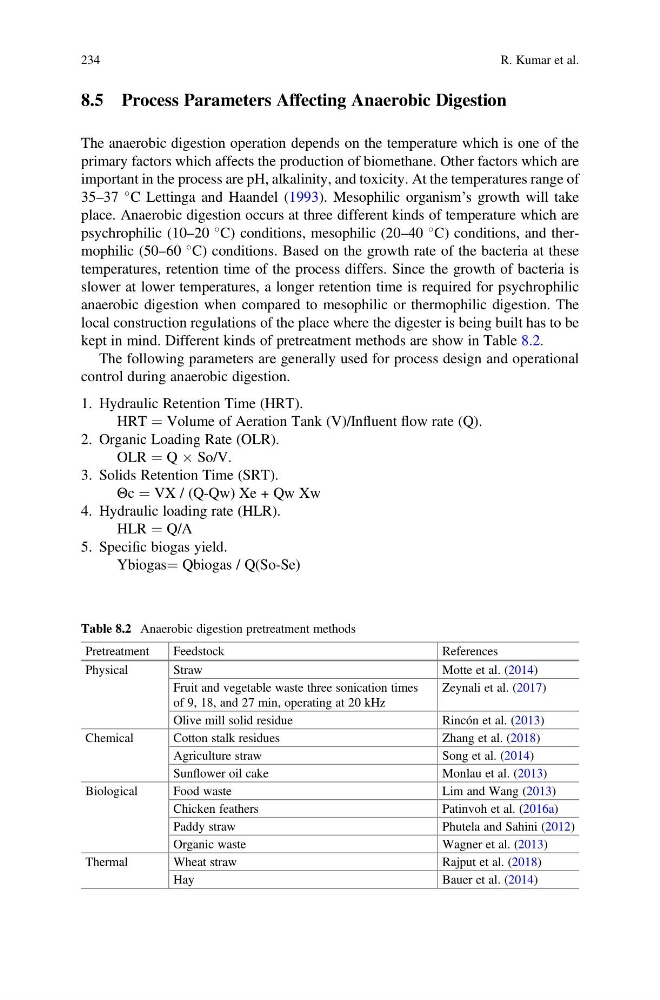
kept in mind. Different kinds of pretreatment methods are show in Table 8.2.
The following parameters are generally used for process design and operational
control during anaerobic digestion.
1. Hydraulic Retention Time (HRT).
HRT ¼ Volume of Aeration Tank (V)/Influent flow rate (Q).
2. Organic Loading Rate (OLR).
OLR ¼ Q Â So/V.
3. Solids Retention Time (SRT).
Θc ¼ VX / (Q-Qw) Xe + Qw Xw
4. Hydraulic loading rate (HLR).
HLR ¼ Q/A
5. Specific biogas yield.
Ybiogas¼ Qbiogas / Q(So-Se)
Table 8.2 Anaerobic digestion pretreatment methods
Pretreatment
Feedstock
References
Physical
Straw
Motte et al. (2014)
Fruit and vegetable waste three sonication times
of 9, 18, and 27 min, operating at 20 kHz
Zeynali et al. (2017)
Olive mill solid residue
Rincón et al. (2013)
Chemical
Cotton stalk residues
Zhang et al. (2018)
Agriculture straw
Song et al. (2014)
Sunflower oil cake
Monlau et al. (2013)
Biological
Food waste
Lim and Wang (2013)
Chicken feathers
Patinvoh et al. (2016a)
Paddy straw
Phutela and Sahini (2012)
Organic waste
Wagner et al. (2013)
Thermal
Wheat straw
Rajput et al. (2018)
Hay
Bauer et al. (2014)
234
R. Kumar et al.
The anaerobic digestion operation depends on the temperature which is one of the
primary factors which affects the production of biomethane. Other factors which are
important in the process are pH, alkalinity, and toxicity. At the temperatures range of
35–37
C Lettinga and Haandel (1993). Mesophilic organism’s growth will take
place. Anaerobic digestion occurs at three different kinds of temperature which are
psychrophilic (10–20
C) conditions, mesophilic (20–40
C) conditions, and thermophilic (50–60
C) conditions. Based on the growth rate of the bacteria at these
temperatures, retention time of the process differs. Since the growth of bacteria is
slower at lower temperatures, a longer retention time is required for psychrophilic
anaerobic digestion when compared to mesophilic or thermophilic digestion. The
local construction regulations of the place where the digester is being built has to be
kept in mind. Different kinds of pretreatment methods are show in Table 8.2.
The following parameters are generally used for process design and operational
control during anaerobic digestion.
1. Hydraulic Retention Time (HRT).
HRT ¼ Volume of Aeration Tank (V)/Influent flow rate (Q).
2. Organic Loading Rate (OLR).
OLR ¼ Q Â So/V.
3. Solids Retention Time (SRT).
Θc ¼ VX / (Q-Qw) Xe + Qw Xw
4. Hydraulic loading rate (HLR).
HLR ¼ Q/A
5. Specific biogas yield.
Ybiogas¼ Qbiogas / Q(So-Se)
Table 8.2 Anaerobic digestion pretreatment methods
Pretreatment
Feedstock
References
Physical
Straw
Motte et al. (2014)
Fruit and vegetable waste three sonication times
of 9, 18, and 27 min, operating at 20 kHz
Zeynali et al. (2017)
Olive mill solid residue
Rincón et al. (2013)
Chemical
Cotton stalk residues
Zhang et al. (2018)
Agriculture straw
Song et al. (2014)
Sunflower oil cake
Monlau et al. (2013)
Biological
Food waste
Lim and Wang (2013)
Chicken feathers
Patinvoh et al. (2016a)
Paddy straw
Phutela and Sahini (2012)
Organic waste
Wagner et al. (2013)
Thermal
Wheat straw
Rajput et al. (2018)
Hay
Bauer et al. (2014)
234
R. Kumar et al.