

enzymes included mainly belong to hydrolase group that are most engaged in
hydrolysis and regenerating glycosidic bonds. Herbinix hemicellulosilytica was
isolated from a thermophilic biogas reaction and was capable of breaking down
cellulose at higher temperatures (Koeck et al. 2015).
High-performance genomics and metagenomics sequences are used to investigate
the bacteria present in the biogas generation. In order to improve the biogas digestive
function, the presence of highly efficient microbial communities, hydrolyzing polymers varying from methane, is essential. Further understanding has limitations as a
large part of biodiversity is unaffected (Tian et al. 2016). Thus, the identification and
designation of microbial pathways of biogas production is an important function
(Stark et al. 2014). NSG strategies and “omics” have significantly reduced costs and
improved the reliability and consistency of the sequence data generated. These
benefits make it possible for tens of amplicon samples immediately after hundreds
of amplicon samples for a single operation without the need for the initiation and
cultivation of individual microorganisms (Vanwonterghem et al. 2014; Delmont
et al. 2012). Different metagenomics techniques, such as denaturing/Moche gradient
gel electrophoresis (Connaughton et al. 2006; Liu et al. 2009a, b), terminal restriction fragment length polymorphism (T-RFLP) (Carballa et al. 2011; Ziganshin et al.
2013), sequence (Dong et al. 2015), fluorescence in situ hybridization (FISH)
(Nettmann et al. 2010), and p4osequing (Li et al. 2013), were used for studying
microbial populations in biogas digestion. These studies have been done on large
microbial communities, lab small (Li et al. 2013), and small-scale reactors (Dong
et al. 2015; Tian et al. 2016). Hassa et al. (2020) have analyzed the genome sequence
of Methanothermobacter wolfeii SIV6 isolated from a thermophilic industrial-scale
biogas fermenter and reported an operon encoding different subunits of the enzyme
methyl-coenzyme M reductase which catalyzes the rate-limiting step during
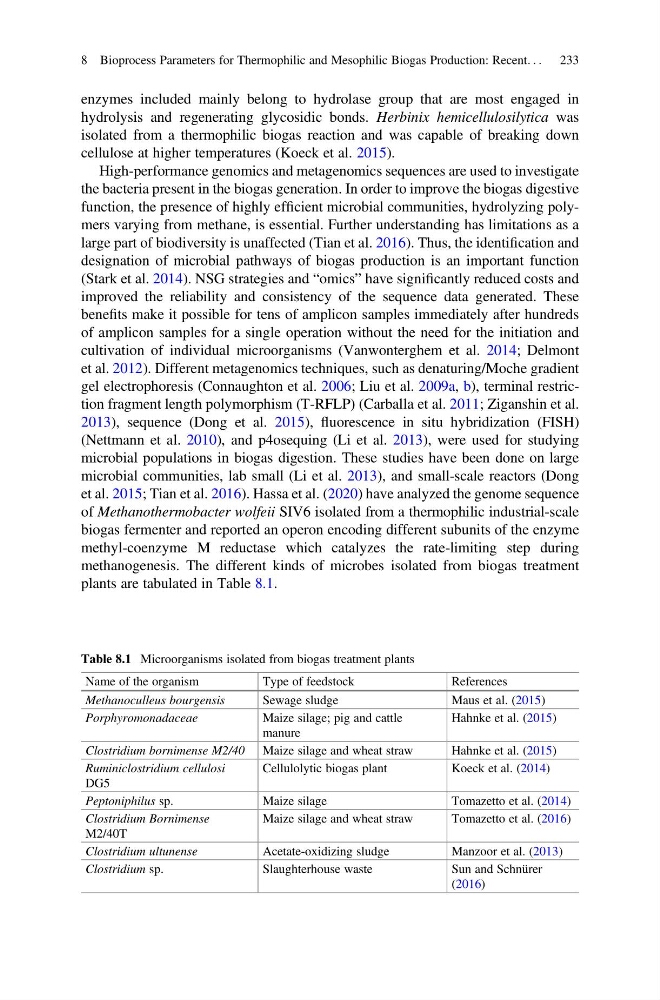
methanogenesis. The different kinds of microbes isolated from biogas treatment
plants are tabulated in Table 8.1.
Table 8.1 Microorganisms isolated from biogas treatment plants
Name of the organism
Type of feedstock
References
Methanoculleus bourgensis
Sewage sludge
Maus et al. (2015)
Porphyromonadaceae
Maize silage; pig and cattle
manure
Hahnke et al. (2015)
Clostridium bornimense M2/40 Maize silage and wheat straw
Hahnke et al. (2015)
Ruminiclostridium cellulosi
DG5
Cellulolytic biogas plant
Koeck et al. (2014)
Peptoniphilus sp.
Maize silage
Tomazetto et al. (2014)
Clostridium Bornimense
M2/40T
Maize silage and wheat straw
Tomazetto et al. (2016)
Clostridium ultunense
Acetate-oxidizing sludge
Manzoor et al. (2013)
Clostridium sp.
Slaughterhouse waste
Sun and Schnürer
(2016)
8 Bioprocess Parameters for Thermophilic and Mesophilic Biogas Production: Recent. . . 233
hydrolysis and regenerating glycosidic bonds. Herbinix hemicellulosilytica was
isolated from a thermophilic biogas reaction and was capable of breaking down
cellulose at higher temperatures (Koeck et al. 2015).
High-performance genomics and metagenomics sequences are used to investigate
the bacteria present in the biogas generation. In order to improve the biogas digestive
function, the presence of highly efficient microbial communities, hydrolyzing polymers varying from methane, is essential. Further understanding has limitations as a
large part of biodiversity is unaffected (Tian et al. 2016). Thus, the identification and
designation of microbial pathways of biogas production is an important function
(Stark et al. 2014). NSG strategies and “omics” have significantly reduced costs and
improved the reliability and consistency of the sequence data generated. These
benefits make it possible for tens of amplicon samples immediately after hundreds
of amplicon samples for a single operation without the need for the initiation and
cultivation of individual microorganisms (Vanwonterghem et al. 2014; Delmont
et al. 2012). Different metagenomics techniques, such as denaturing/Moche gradient
gel electrophoresis (Connaughton et al. 2006; Liu et al. 2009a, b), terminal restriction fragment length polymorphism (T-RFLP) (Carballa et al. 2011; Ziganshin et al.
2013), sequence (Dong et al. 2015), fluorescence in situ hybridization (FISH)
(Nettmann et al. 2010), and p4osequing (Li et al. 2013), were used for studying
microbial populations in biogas digestion. These studies have been done on large
microbial communities, lab small (Li et al. 2013), and small-scale reactors (Dong
et al. 2015; Tian et al. 2016). Hassa et al. (2020) have analyzed the genome sequence
of Methanothermobacter wolfeii SIV6 isolated from a thermophilic industrial-scale
biogas fermenter and reported an operon encoding different subunits of the enzyme
methyl-coenzyme M reductase which catalyzes the rate-limiting step during
methanogenesis. The different kinds of microbes isolated from biogas treatment
plants are tabulated in Table 8.1.
Table 8.1 Microorganisms isolated from biogas treatment plants
Name of the organism
Type of feedstock
References
Methanoculleus bourgensis
Sewage sludge
Maus et al. (2015)
Porphyromonadaceae
Maize silage; pig and cattle
manure
Hahnke et al. (2015)
Clostridium bornimense M2/40 Maize silage and wheat straw
Hahnke et al. (2015)
Ruminiclostridium cellulosi
DG5
Cellulolytic biogas plant
Koeck et al. (2014)
Peptoniphilus sp.
Maize silage
Tomazetto et al. (2014)
Clostridium Bornimense
M2/40T
Maize silage and wheat straw
Tomazetto et al. (2016)
Clostridium ultunense
Acetate-oxidizing sludge
Manzoor et al. (2013)
Clostridium sp.
Slaughterhouse waste
Sun and Schnürer
(2016)
8 Bioprocess Parameters for Thermophilic and Mesophilic Biogas Production: Recent. . . 233