

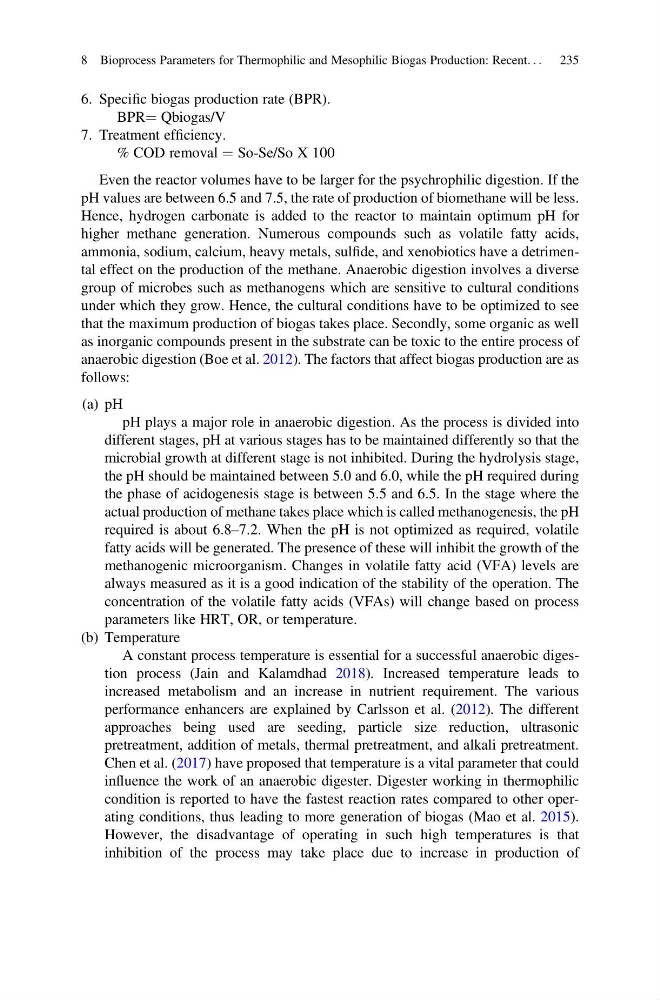
6. Specific biogas production rate (BPR).
BPR¼ Qbiogas/V
7. Treatment efficiency.
% COD removal ¼ So-Se/So X 100
Even the reactor volumes have to be larger for the psychrophilic digestion. If the
pH values are between 6.5 and 7.5, the rate of production of biomethane will be less.
Hence, hydrogen carbonate is added to the reactor to maintain optimum pH for
higher methane generation. Numerous compounds such as volatile fatty acids,
ammonia, sodium, calcium, heavy metals, sulfide, and xenobiotics have a detrimental effect on the production of the methane. Anaerobic digestion involves a diverse
group of microbes such as methanogens which are sensitive to cultural conditions
under which they grow. Hence, the cultural conditions have to be optimized to see
that the maximum production of biogas takes place. Secondly, some organic as well
as inorganic compounds present in the substrate can be toxic to the entire process of
anaerobic digestion (Boe et al. 2012). The factors that affect biogas production are as
follows:
(a) pH
pH plays a major role in anaerobic digestion. As the process is divided into
different stages, pH at various stages has to be maintained differently so that the
microbial growth at different stage is not inhibited. During the hydrolysis stage,
the pH should be maintained between 5.0 and 6.0, while the pH required during
the phase of acidogenesis stage is between 5.5 and 6.5. In the stage where the
actual production of methane takes place which is called methanogenesis, the pH
required is about 6.8–7.2. When the pH is not optimized as required, volatile
fatty acids will be generated. The presence of these will inhibit the growth of the
methanogenic microorganism. Changes in volatile fatty acid (VFA) levels are
always measured as it is a good indication of the stability of the operation. The
concentration of the volatile fatty acids (VFAs) will change based on process
parameters like HRT, OR, or temperature.
(b) Temperature
A constant process temperature is essential for a successful anaerobic digestion process (Jain and Kalamdhad 2018). Increased temperature leads to
increased metabolism and an increase in nutrient requirement. The various
performance enhancers are explained by Carlsson et al. (2012). The different
approaches being used are seeding, particle size reduction, ultrasonic
pretreatment, addition of metals, thermal pretreatment, and alkali pretreatment.
Chen et al. (2017) have proposed that temperature is a vital parameter that could
influence the work of an anaerobic digester. Digester working in thermophilic
condition is reported to have the fastest reaction rates compared to other operating conditions, thus leading to more generation of biogas (Mao et al. 2015).
However, the disadvantage of operating in such high temperatures is that
inhibition of the process may take place due to increase in production of
8 Bioprocess Parameters for Thermophilic and Mesophilic Biogas Production: Recent. . . 235
BPR¼ Qbiogas/V
7. Treatment efficiency.
% COD removal ¼ So-Se/So X 100
Even the reactor volumes have to be larger for the psychrophilic digestion. If the
pH values are between 6.5 and 7.5, the rate of production of biomethane will be less.
Hence, hydrogen carbonate is added to the reactor to maintain optimum pH for
higher methane generation. Numerous compounds such as volatile fatty acids,
ammonia, sodium, calcium, heavy metals, sulfide, and xenobiotics have a detrimental effect on the production of the methane. Anaerobic digestion involves a diverse
group of microbes such as methanogens which are sensitive to cultural conditions
under which they grow. Hence, the cultural conditions have to be optimized to see
that the maximum production of biogas takes place. Secondly, some organic as well
as inorganic compounds present in the substrate can be toxic to the entire process of
anaerobic digestion (Boe et al. 2012). The factors that affect biogas production are as
follows:
(a) pH
pH plays a major role in anaerobic digestion. As the process is divided into
different stages, pH at various stages has to be maintained differently so that the
microbial growth at different stage is not inhibited. During the hydrolysis stage,
the pH should be maintained between 5.0 and 6.0, while the pH required during
the phase of acidogenesis stage is between 5.5 and 6.5. In the stage where the
actual production of methane takes place which is called methanogenesis, the pH
required is about 6.8–7.2. When the pH is not optimized as required, volatile
fatty acids will be generated. The presence of these will inhibit the growth of the
methanogenic microorganism. Changes in volatile fatty acid (VFA) levels are
always measured as it is a good indication of the stability of the operation. The
concentration of the volatile fatty acids (VFAs) will change based on process
parameters like HRT, OR, or temperature.
(b) Temperature
A constant process temperature is essential for a successful anaerobic digestion process (Jain and Kalamdhad 2018). Increased temperature leads to
increased metabolism and an increase in nutrient requirement. The various
performance enhancers are explained by Carlsson et al. (2012). The different
approaches being used are seeding, particle size reduction, ultrasonic
pretreatment, addition of metals, thermal pretreatment, and alkali pretreatment.
Chen et al. (2017) have proposed that temperature is a vital parameter that could
influence the work of an anaerobic digester. Digester working in thermophilic
condition is reported to have the fastest reaction rates compared to other operating conditions, thus leading to more generation of biogas (Mao et al. 2015).
However, the disadvantage of operating in such high temperatures is that
inhibition of the process may take place due to increase in production of
8 Bioprocess Parameters for Thermophilic and Mesophilic Biogas Production: Recent. . . 235