

(1982). Pervaporation is a liquid mixture membrane separation process in which the
initial solution comes into contact with the inner surface of a membrane cell and
permeates the outer surface in the form of low partial pressure vapors. Therefore,
pervaporation is sometimes referred to as an extractive distillation process whereby
the membrane has the role of part third. However, to separate liquid mixtures in the
pervaporation phase process is not based on the vapor and liquid system equilibrium
as in the distillation process, but variations in the solubility coefficient and mixture
components diffusivity matter the most. Here, the equilibrium of the vapor-liquid
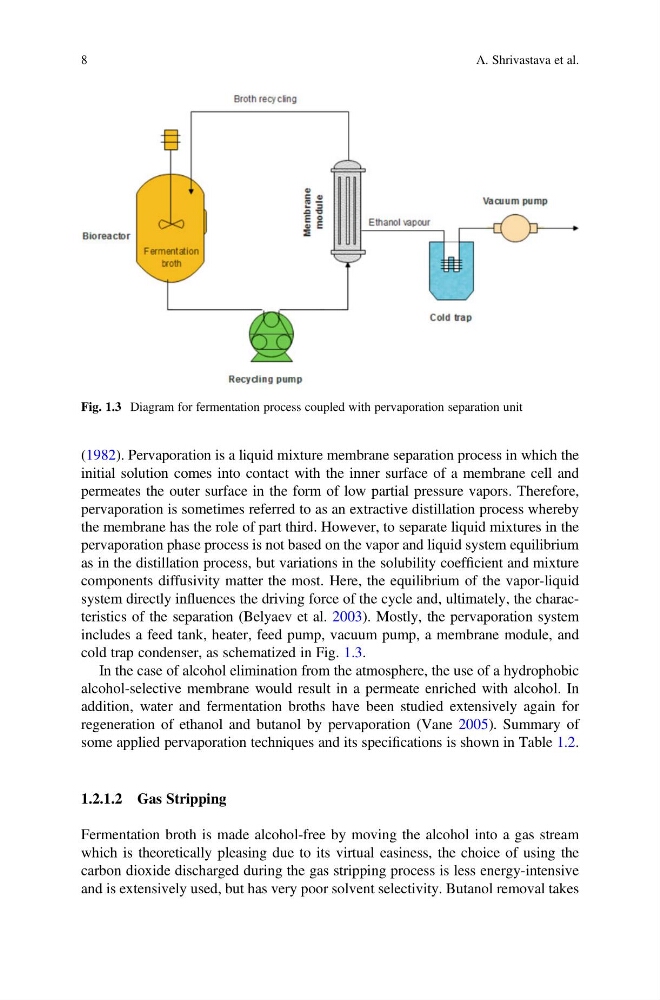
system directly influences the driving force of the cycle and, ultimately, the characteristics of the separation (Belyaev et al. 2003). Mostly, the pervaporation system
includes a feed tank, heater, feed pump, vacuum pump, a membrane module, and
cold trap condenser, as schematized in Fig. 1.3.
In the case of alcohol elimination from the atmosphere, the use of a hydrophobic
alcohol-selective membrane would result in a permeate enriched with alcohol. In
addition, water and fermentation broths have been studied extensively again for
regeneration of ethanol and butanol by pervaporation (Vane 2005). Summary of
some applied pervaporation techniques and its specifications is shown in Table 1.2.
1.2.1.2 Gas Stripping
Fermentation broth is made alcohol-free by moving the alcohol into a gas stream
which is theoretically pleasing due to its virtual easiness, the choice of using the
carbon dioxide discharged during the gas stripping process is less energy-intensive
and is extensively used, but has very poor solvent selectivity. Butanol removal takes
Fig. 1.3 Diagram for fermentation process coupled with pervaporation separation unit
8
A. Shrivastava et al.
initial solution comes into contact with the inner surface of a membrane cell and
permeates the outer surface in the form of low partial pressure vapors. Therefore,
pervaporation is sometimes referred to as an extractive distillation process whereby
the membrane has the role of part third. However, to separate liquid mixtures in the
pervaporation phase process is not based on the vapor and liquid system equilibrium
as in the distillation process, but variations in the solubility coefficient and mixture
components diffusivity matter the most. Here, the equilibrium of the vapor-liquid
system directly influences the driving force of the cycle and, ultimately, the characteristics of the separation (Belyaev et al. 2003). Mostly, the pervaporation system
includes a feed tank, heater, feed pump, vacuum pump, a membrane module, and
cold trap condenser, as schematized in Fig. 1.3.
In the case of alcohol elimination from the atmosphere, the use of a hydrophobic
alcohol-selective membrane would result in a permeate enriched with alcohol. In
addition, water and fermentation broths have been studied extensively again for
regeneration of ethanol and butanol by pervaporation (Vane 2005). Summary of
some applied pervaporation techniques and its specifications is shown in Table 1.2.
1.2.1.2 Gas Stripping
Fermentation broth is made alcohol-free by moving the alcohol into a gas stream
which is theoretically pleasing due to its virtual easiness, the choice of using the
carbon dioxide discharged during the gas stripping process is less energy-intensive
and is extensively used, but has very poor solvent selectivity. Butanol removal takes
Fig. 1.3 Diagram for fermentation process coupled with pervaporation separation unit
8
A. Shrivastava et al.