

place with other solvents and huge amounts of water, it is therefore important that the
liquid stream is condensed either by distillation or LLE before separating and
purifying individual solvents which should be purified by distillation. A typical
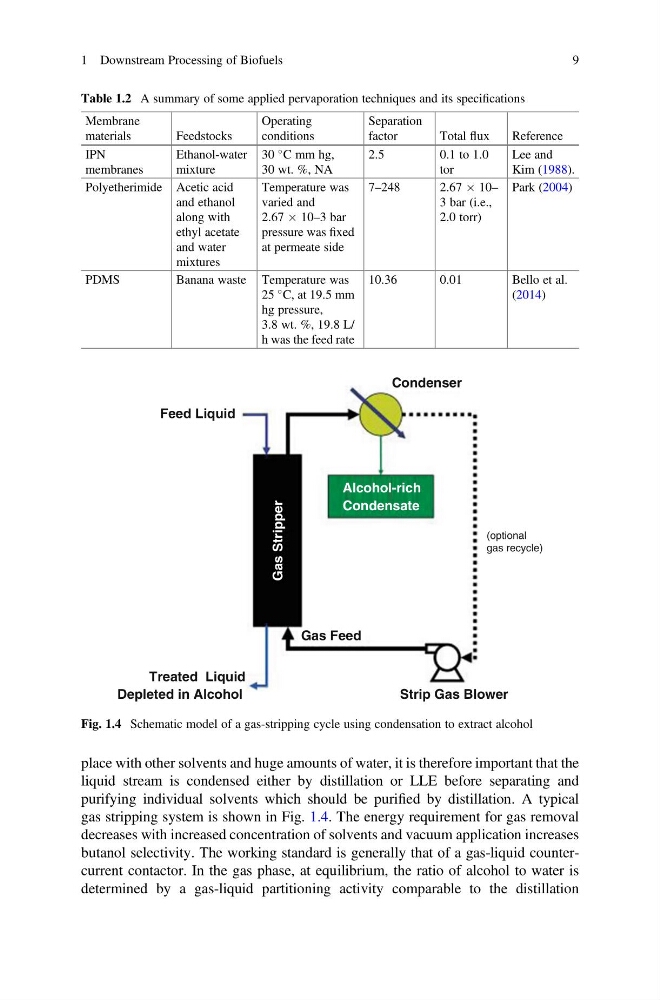
gas stripping system is shown in Fig. 1.4. The energy requirement for gas removal
decreases with increased concentration of solvents and vacuum application increases
butanol selectivity. The working standard is generally that of a gas-liquid countercurrent contactor. In the gas phase, at equilibrium, the ratio of alcohol to water is
determined by a gas-liquid partitioning activity comparable to the distillation
Table 1.2 A summary of some applied pervaporation techniques and its specifications
Membrane
materials
Feedstocks
Operating
conditions
Separation
factor
Total flux
Reference
IPN
membranes
Ethanol-water
mixture
30
C mm hg,
30 wt. %, NA
2.5
0.1 to 1.0
tor
Lee and
Kim (1988).
Polyetherimide Acetic acid
and ethanol
along with
ethyl acetate
and water
mixtures
Temperature was
varied and
2.67 Â 10–3 bar
pressure was fixed
at permeate side
7–248
2.67 Â 10–
3 bar (i.e.,
2.0 torr)
Park (2004)
PDMS
Banana waste Temperature was
25
C, at 19.5 mm
hg pressure,
3.8 wt. %, 19.8 L/
h was the feed rate
10.36
0.01
Bello et al.
(2014)
Condenser
Feed Liquid
Gas Feed
(optional
gas recycle)
Gas Stripper
Treated Liquid
Depleted in Alcohol
Strip Gas Blower
Alcohol-rich
Condensate
Fig. 1.4 Schematic model of a gas-stripping cycle using condensation to extract alcohol
1 Downstream Processing of Biofuels
9
liquid stream is condensed either by distillation or LLE before separating and
purifying individual solvents which should be purified by distillation. A typical
gas stripping system is shown in Fig. 1.4. The energy requirement for gas removal
decreases with increased concentration of solvents and vacuum application increases
butanol selectivity. The working standard is generally that of a gas-liquid countercurrent contactor. In the gas phase, at equilibrium, the ratio of alcohol to water is
determined by a gas-liquid partitioning activity comparable to the distillation
Table 1.2 A summary of some applied pervaporation techniques and its specifications
Membrane
materials
Feedstocks
Operating
conditions
Separation
factor
Total flux
Reference
IPN
membranes
Ethanol-water
mixture
30
C mm hg,
30 wt. %, NA
2.5
0.1 to 1.0
tor
Lee and
Kim (1988).
Polyetherimide Acetic acid
and ethanol
along with
ethyl acetate
and water
mixtures
Temperature was
varied and
2.67 Â 10–3 bar
pressure was fixed
at permeate side
7–248
2.67 Â 10–
3 bar (i.e.,
2.0 torr)
Park (2004)
PDMS
Banana waste Temperature was
25
C, at 19.5 mm
hg pressure,
3.8 wt. %, 19.8 L/
h was the feed rate
10.36
0.01
Bello et al.
(2014)
Condenser
Feed Liquid
Gas Feed
(optional
gas recycle)
Gas Stripper
Treated Liquid
Depleted in Alcohol
Strip Gas Blower
Alcohol-rich
Condensate
Fig. 1.4 Schematic model of a gas-stripping cycle using condensation to extract alcohol
1 Downstream Processing of Biofuels
9