

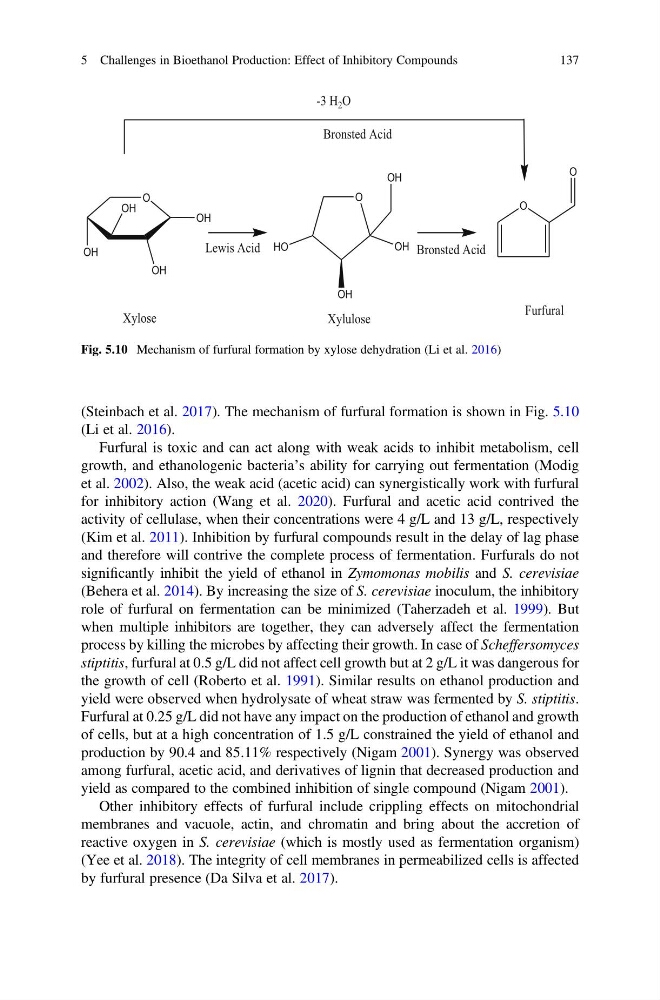
(Steinbach et al. 2017). The mechanism of furfural formation is shown in Fig. 5.10
(Li et al. 2016).
Furfural is toxic and can act along with weak acids to inhibit metabolism, cell
growth, and ethanologenic bacteria’s ability for carrying out fermentation (Modig
et al. 2002). Also, the weak acid (acetic acid) can synergistically work with furfural
for inhibitory action (Wang et al. 2020). Furfural and acetic acid contrived the
activity of cellulase, when their concentrations were 4 g/L and 13 g/L, respectively
(Kim et al. 2011). Inhibition by furfural compounds result in the delay of lag phase
and therefore will contrive the complete process of fermentation. Furfurals do not
significantly inhibit the yield of ethanol in Zymomonas mobilis and S. cerevisiae
(Behera et al. 2014). By increasing the size of S. cerevisiae inoculum, the inhibitory
role of furfural on fermentation can be minimized (Taherzadeh et al. 1999). But
when multiple inhibitors are together, they can adversely affect the fermentation
process by killing the microbes by affecting their growth. In case of Scheffersomyces
stiptitis, furfural at 0.5 g/L did not affect cell growth but at 2 g/L it was dangerous for
the growth of cell (Roberto et al. 1991). Similar results on ethanol production and
yield were observed when hydrolysate of wheat straw was fermented by S. stiptitis.
Furfural at 0.25 g/L did not have any impact on the production of ethanol and growth
of cells, but at a high concentration of 1.5 g/L constrained the yield of ethanol and
production by 90.4 and 85.11% respectively (Nigam 2001). Synergy was observed
among furfural, acetic acid, and derivatives of lignin that decreased production and
yield as compared to the combined inhibition of single compound (Nigam 2001).
Other inhibitory effects of furfural include crippling effects on mitochondrial
membranes and vacuole, actin, and chromatin and bring about the accretion of
reactive oxygen in S. cerevisiae (which is mostly used as fermentation organism)
(Yee et al. 2018). The integrity of cell membranes in permeabilized cells is affected
by furfural presence (Da Silva et al. 2017).
O
OH
OH
OH
OH
O
OH
OH
HO
OH
O
O
Xylose
Xylulose
Furfural
-3 H 2 O
Bronsted Acid
Lewis Acid
Bronsted Acid
Fig. 5.10 Mechanism of furfural formation by xylose dehydration (Li et al. 2016)
5 Challenges in Bioethanol Production: Effect of Inhibitory Compounds
137
(Li et al. 2016).
Furfural is toxic and can act along with weak acids to inhibit metabolism, cell
growth, and ethanologenic bacteria’s ability for carrying out fermentation (Modig
et al. 2002). Also, the weak acid (acetic acid) can synergistically work with furfural
for inhibitory action (Wang et al. 2020). Furfural and acetic acid contrived the
activity of cellulase, when their concentrations were 4 g/L and 13 g/L, respectively
(Kim et al. 2011). Inhibition by furfural compounds result in the delay of lag phase
and therefore will contrive the complete process of fermentation. Furfurals do not
significantly inhibit the yield of ethanol in Zymomonas mobilis and S. cerevisiae
(Behera et al. 2014). By increasing the size of S. cerevisiae inoculum, the inhibitory
role of furfural on fermentation can be minimized (Taherzadeh et al. 1999). But
when multiple inhibitors are together, they can adversely affect the fermentation
process by killing the microbes by affecting their growth. In case of Scheffersomyces
stiptitis, furfural at 0.5 g/L did not affect cell growth but at 2 g/L it was dangerous for
the growth of cell (Roberto et al. 1991). Similar results on ethanol production and
yield were observed when hydrolysate of wheat straw was fermented by S. stiptitis.
Furfural at 0.25 g/L did not have any impact on the production of ethanol and growth
of cells, but at a high concentration of 1.5 g/L constrained the yield of ethanol and
production by 90.4 and 85.11% respectively (Nigam 2001). Synergy was observed
among furfural, acetic acid, and derivatives of lignin that decreased production and
yield as compared to the combined inhibition of single compound (Nigam 2001).
Other inhibitory effects of furfural include crippling effects on mitochondrial
membranes and vacuole, actin, and chromatin and bring about the accretion of
reactive oxygen in S. cerevisiae (which is mostly used as fermentation organism)
(Yee et al. 2018). The integrity of cell membranes in permeabilized cells is affected
by furfural presence (Da Silva et al. 2017).
O
OH
OH
OH
OH
O
OH
OH
HO
OH
O
O
Xylose
Xylulose
Furfural
-3 H 2 O
Bronsted Acid
Lewis Acid
Bronsted Acid
Fig. 5.10 Mechanism of furfural formation by xylose dehydration (Li et al. 2016)
5 Challenges in Bioethanol Production: Effect of Inhibitory Compounds
137