

Furfural inhibits yeast but the mode of inhibition is not exactly understood.
However, it constrains the main enzymes of glycolysis, e.g., phosphofructokinase,
hexokinase, and triosephosphate dehydrogenase (Malav et al. 2017; Weil et al.
2002). Concluding the effects of furfurals on cells, it has been observed that furfurals
avert the energy levels of the cells by the reduction of inner cell’s ATP and NADPH
levels through inhibition of enzymes, by consuming the cofactors, damage of genetic
materials, membrane damage, and few proteins (Almeida et al. 2007). However,
cells have the ability to bear the low levels of furfurals and also can convert them into
furoic acids and furfuryl alcohols which are the less toxic forms of furfurals. Furoic
acid (is the oxidized form of furfural) is produced by the usage of ALDH (Wikandari
et al. 2019), while furfuryl alcohol (is the reduced form of furfural) is produced from
furfural by using ADH (Horváth et al. 2001).
5.5 Weak Acids
During the rehydration of HMF water is incorporated into the ring of furan at
position C2-C3 during the existence of acid acting to speed up the reaction as a
result LA (livulinic acid) and FA (formic acid) are formed (Kang et al. 2018; Mosier
et al. 2005). There is a limiting condition when there is a high amount of weak acid it
depletes bioethanol production from biomass hydrolysate; on the other hand, a low
amount of acid will have a positive impact. In the medium, if the concentration of
formic acid and acetic acid is low then it would increase the amount of ethanol and
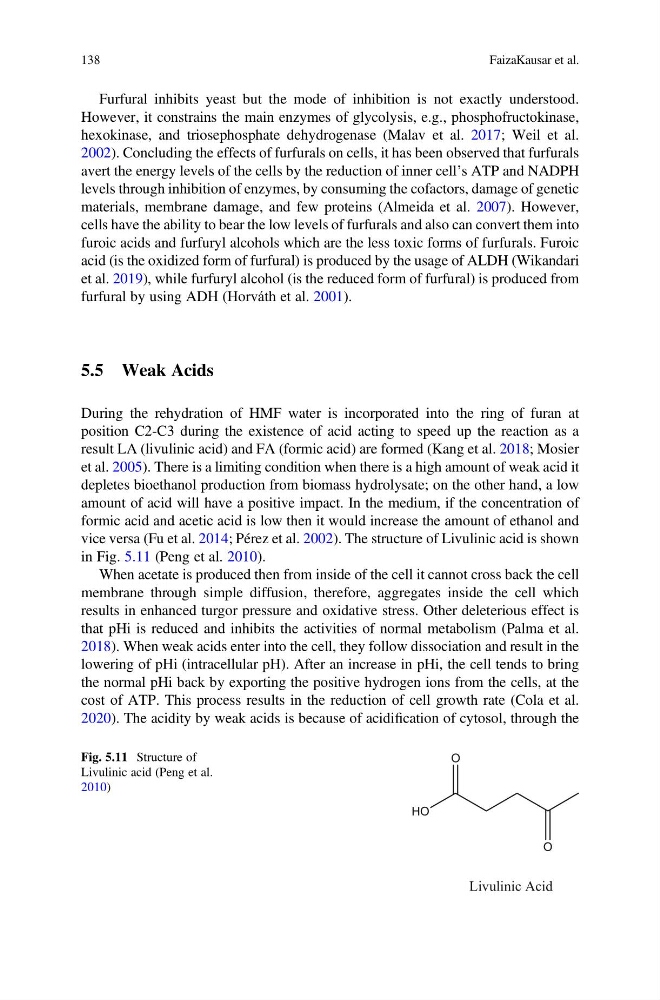
vice versa (Fu et al. 2014; Pérez et al. 2002). The structure of Livulinic acid is shown
in Fig. 5.11 (Peng et al. 2010).
When acetate is produced then from inside of the cell it cannot cross back the cell
membrane through simple diffusion, therefore, aggregates inside the cell which
results in enhanced turgor pressure and oxidative stress. Other deleterious effect is
that pHi is reduced and inhibits the activities of normal metabolism (Palma et al.
2018). When weak acids enter into the cell, they follow dissociation and result in the
lowering of pHi (intracellular pH). After an increase in pHi, the cell tends to bring
the normal pHi back by exporting the positive hydrogen ions from the cells, at the
cost of ATP. This process results in the reduction of cell growth rate (Cola et al.
2020). The acidity by weak acids is because of acidification of cytosol, through the
HO
O
O
Livulinic Acid
Fig. 5.11 Structure of
Livulinic acid (Peng et al.
2010)
138
FaizaKausar et al.
However, it constrains the main enzymes of glycolysis, e.g., phosphofructokinase,
hexokinase, and triosephosphate dehydrogenase (Malav et al. 2017; Weil et al.
2002). Concluding the effects of furfurals on cells, it has been observed that furfurals
avert the energy levels of the cells by the reduction of inner cell’s ATP and NADPH
levels through inhibition of enzymes, by consuming the cofactors, damage of genetic
materials, membrane damage, and few proteins (Almeida et al. 2007). However,
cells have the ability to bear the low levels of furfurals and also can convert them into
furoic acids and furfuryl alcohols which are the less toxic forms of furfurals. Furoic
acid (is the oxidized form of furfural) is produced by the usage of ALDH (Wikandari
et al. 2019), while furfuryl alcohol (is the reduced form of furfural) is produced from
furfural by using ADH (Horváth et al. 2001).
5.5 Weak Acids
During the rehydration of HMF water is incorporated into the ring of furan at
position C2-C3 during the existence of acid acting to speed up the reaction as a
result LA (livulinic acid) and FA (formic acid) are formed (Kang et al. 2018; Mosier
et al. 2005). There is a limiting condition when there is a high amount of weak acid it
depletes bioethanol production from biomass hydrolysate; on the other hand, a low
amount of acid will have a positive impact. In the medium, if the concentration of
formic acid and acetic acid is low then it would increase the amount of ethanol and
vice versa (Fu et al. 2014; Pérez et al. 2002). The structure of Livulinic acid is shown
in Fig. 5.11 (Peng et al. 2010).
When acetate is produced then from inside of the cell it cannot cross back the cell
membrane through simple diffusion, therefore, aggregates inside the cell which
results in enhanced turgor pressure and oxidative stress. Other deleterious effect is
that pHi is reduced and inhibits the activities of normal metabolism (Palma et al.
2018). When weak acids enter into the cell, they follow dissociation and result in the
lowering of pHi (intracellular pH). After an increase in pHi, the cell tends to bring
the normal pHi back by exporting the positive hydrogen ions from the cells, at the
cost of ATP. This process results in the reduction of cell growth rate (Cola et al.
2020). The acidity by weak acids is because of acidification of cytosol, through the
HO
O
O
Livulinic Acid
Fig. 5.11 Structure of
Livulinic acid (Peng et al.
2010)
138
FaizaKausar et al.