

2017; Kumar et al. 2009)
The process of pretreatment affects the structure and chemical makeup of LC
biomass by making changes to its macrostructure and microstructure. Also, it makes
changes to LC structure by making it more representable to microbes (An et al.
2015). During this change in structure process, cellulose surrounded by lignin and
hemicellulose, these two polymers are broken down, the structure of cellulose is
altered to make cellulose available to enzymes. Similarly, lignin and hemicellulose
are removed and degraded respectively. This process makes interaction of enzyme
substrate better which improves the hydrolysis of sugar and makes the process
efficient (Chandra et al. 2015; Michalska et al. 2012; Palmqvist and Hahn-Hägerdal
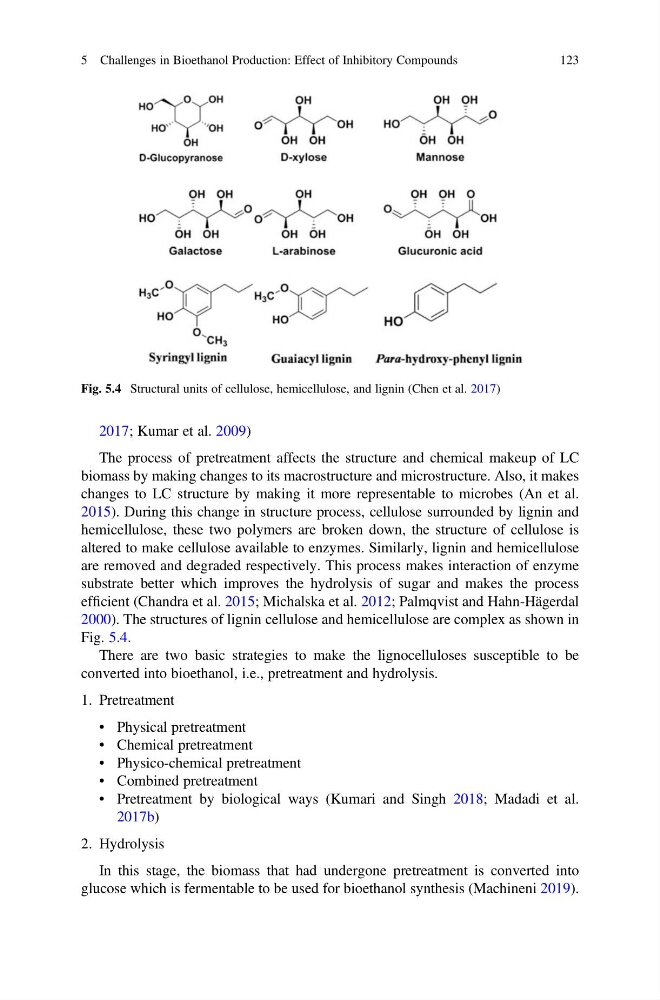
2000). The structures of lignin cellulose and hemicellulose are complex as shown in
Fig. 5.4.
There are two basic strategies to make the lignocelluloses susceptible to be
converted into bioethanol, i.e., pretreatment and hydrolysis.
1. Pretreatment
• Physical pretreatment
• Chemical pretreatment
• Physico-chemical pretreatment
• Combined pretreatment
• Pretreatment by biological ways (Kumari and Singh 2018; Madadi et al.
2017b)
2. Hydrolysis
In this stage, the biomass that had undergone pretreatment is converted into
glucose which is fermentable to be used for bioethanol synthesis (Machineni 2019).
Fig. 5.4 Structural units of cellulose, hemicellulose, and lignin (Chen et al. 2017)
5 Challenges in Bioethanol Production: Effect of Inhibitory Compounds
123
The process of pretreatment affects the structure and chemical makeup of LC
biomass by making changes to its macrostructure and microstructure. Also, it makes
changes to LC structure by making it more representable to microbes (An et al.
2015). During this change in structure process, cellulose surrounded by lignin and
hemicellulose, these two polymers are broken down, the structure of cellulose is
altered to make cellulose available to enzymes. Similarly, lignin and hemicellulose
are removed and degraded respectively. This process makes interaction of enzyme
substrate better which improves the hydrolysis of sugar and makes the process
efficient (Chandra et al. 2015; Michalska et al. 2012; Palmqvist and Hahn-Hägerdal
2000). The structures of lignin cellulose and hemicellulose are complex as shown in
Fig. 5.4.
There are two basic strategies to make the lignocelluloses susceptible to be
converted into bioethanol, i.e., pretreatment and hydrolysis.
1. Pretreatment
• Physical pretreatment
• Chemical pretreatment
• Physico-chemical pretreatment
• Combined pretreatment
• Pretreatment by biological ways (Kumari and Singh 2018; Madadi et al.
2017b)
2. Hydrolysis
In this stage, the biomass that had undergone pretreatment is converted into
glucose which is fermentable to be used for bioethanol synthesis (Machineni 2019).
Fig. 5.4 Structural units of cellulose, hemicellulose, and lignin (Chen et al. 2017)
5 Challenges in Bioethanol Production: Effect of Inhibitory Compounds
123