

5.1.1 Pretreatment Explained
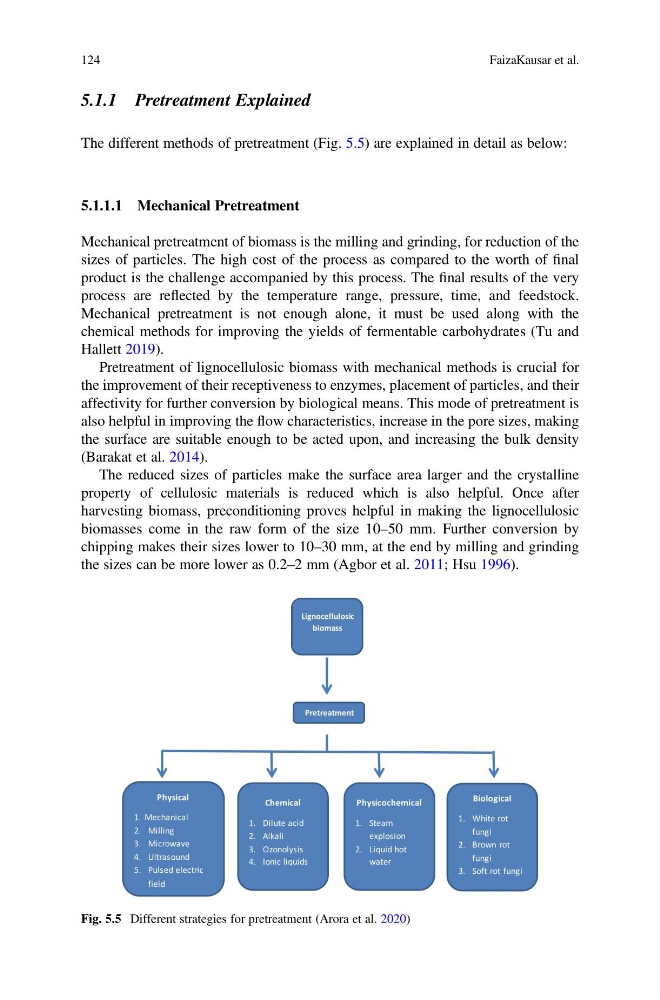
The different methods of pretreatment (Fig. 5.5) are explained in detail as below:
5.1.1.1 Mechanical Pretreatment
Mechanical pretreatment of biomass is the milling and grinding, for reduction of the
sizes of particles. The high cost of the process as compared to the worth of final
product is the challenge accompanied by this process. The final results of the very
process are reflected by the temperature range, pressure, time, and feedstock.
Mechanical pretreatment is not enough alone, it must be used along with the
chemical methods for improving the yields of fermentable carbohydrates (Tu and
Hallett 2019).
Pretreatment of lignocellulosic biomass with mechanical methods is crucial for
the improvement of their receptiveness to enzymes, placement of particles, and their
affectivity for further conversion by biological means. This mode of pretreatment is
also helpful in improving the flow characteristics, increase in the pore sizes, making
the surface are suitable enough to be acted upon, and increasing the bulk density
(Barakat et al. 2014).
The reduced sizes of particles make the surface area larger and the crystalline
property of cellulosic materials is reduced which is also helpful. Once after
harvesting biomass, preconditioning proves helpful in making the lignocellulosic
biomasses come in the raw form of the size 10–50 mm. Further conversion by
chipping makes their sizes lower to 10–30 mm, at the end by milling and grinding
the sizes can be more lower as 0.2–2 mm (Agbor et al. 2011; Hsu 1996).
Physical
1. Mechanical
2. Milling
3. Microwave
4. Ultrasound
5. Pulsed electric
field
Chemical
1. Dilute acid
2. Alkali
3. Ozonolysis
4. Ionic liquids
Physicochemical
1. Steam
explosion
2. Liquid hot
water
Biological
1. White rot
fungi
2. Brown rot
fungi
3. Soft rot fungi
Lignocellulosic
biomass
Pretreatment
Fig. 5.5 Different strategies for pretreatment (Arora et al. 2020)
124
FaizaKausar et al.
The different methods of pretreatment (Fig. 5.5) are explained in detail as below:
5.1.1.1 Mechanical Pretreatment
Mechanical pretreatment of biomass is the milling and grinding, for reduction of the
sizes of particles. The high cost of the process as compared to the worth of final
product is the challenge accompanied by this process. The final results of the very
process are reflected by the temperature range, pressure, time, and feedstock.
Mechanical pretreatment is not enough alone, it must be used along with the
chemical methods for improving the yields of fermentable carbohydrates (Tu and
Hallett 2019).
Pretreatment of lignocellulosic biomass with mechanical methods is crucial for
the improvement of their receptiveness to enzymes, placement of particles, and their
affectivity for further conversion by biological means. This mode of pretreatment is
also helpful in improving the flow characteristics, increase in the pore sizes, making
the surface are suitable enough to be acted upon, and increasing the bulk density
(Barakat et al. 2014).
The reduced sizes of particles make the surface area larger and the crystalline
property of cellulosic materials is reduced which is also helpful. Once after
harvesting biomass, preconditioning proves helpful in making the lignocellulosic
biomasses come in the raw form of the size 10–50 mm. Further conversion by
chipping makes their sizes lower to 10–30 mm, at the end by milling and grinding
the sizes can be more lower as 0.2–2 mm (Agbor et al. 2011; Hsu 1996).
Physical
1. Mechanical
2. Milling
3. Microwave
4. Ultrasound
5. Pulsed electric
field
Chemical
1. Dilute acid
2. Alkali
3. Ozonolysis
4. Ionic liquids
Physicochemical
1. Steam
explosion
2. Liquid hot
water
Biological
1. White rot
fungi
2. Brown rot
fungi
3. Soft rot fungi
Lignocellulosic
biomass
Pretreatment
Fig. 5.5 Different strategies for pretreatment (Arora et al. 2020)
124
FaizaKausar et al.