

The reason why pretreatment should be carried out lies in the structure and
composition of LB. Cell walls of plants are resistant to degradation by
micro-organisms because of the strength and robustness provided by the defensive
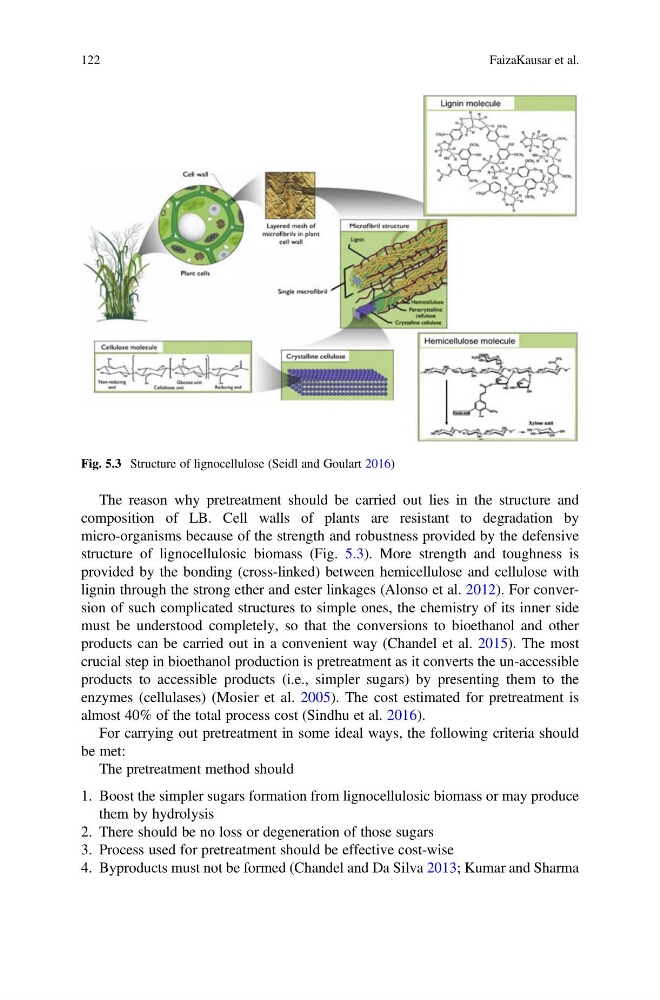
structure of lignocellulosic biomass (Fig. 5.3). More strength and toughness is
provided by the bonding (cross-linked) between hemicellulose and cellulose with
lignin through the strong ether and ester linkages (Alonso et al. 2012). For conversion of such complicated structures to simple ones, the chemistry of its inner side
must be understood completely, so that the conversions to bioethanol and other
products can be carried out in a convenient way (Chandel et al. 2015). The most
crucial step in bioethanol production is pretreatment as it converts the un-accessible
products to accessible products (i.e., simpler sugars) by presenting them to the
enzymes (cellulases) (Mosier et al. 2005). The cost estimated for pretreatment is
almost 40% of the total process cost (Sindhu et al. 2016).
For carrying out pretreatment in some ideal ways, the following criteria should
be met:
The pretreatment method should
1. Boost the simpler sugars formation from lignocellulosic biomass or may produce
them by hydrolysis
2. There should be no loss or degeneration of those sugars
3. Process used for pretreatment should be effective cost-wise
4. Byproducts must not be formed (Chandel and Da Silva 2013; Kumar and Sharma
Fig. 5.3 Structure of lignocellulose (Seidl and Goulart 2016)
122
FaizaKausar et al.
composition of LB. Cell walls of plants are resistant to degradation by
micro-organisms because of the strength and robustness provided by the defensive
structure of lignocellulosic biomass (Fig. 5.3). More strength and toughness is
provided by the bonding (cross-linked) between hemicellulose and cellulose with
lignin through the strong ether and ester linkages (Alonso et al. 2012). For conversion of such complicated structures to simple ones, the chemistry of its inner side
must be understood completely, so that the conversions to bioethanol and other
products can be carried out in a convenient way (Chandel et al. 2015). The most
crucial step in bioethanol production is pretreatment as it converts the un-accessible
products to accessible products (i.e., simpler sugars) by presenting them to the
enzymes (cellulases) (Mosier et al. 2005). The cost estimated for pretreatment is
almost 40% of the total process cost (Sindhu et al. 2016).
For carrying out pretreatment in some ideal ways, the following criteria should
be met:
The pretreatment method should
1. Boost the simpler sugars formation from lignocellulosic biomass or may produce
them by hydrolysis
2. There should be no loss or degeneration of those sugars
3. Process used for pretreatment should be effective cost-wise
4. Byproducts must not be formed (Chandel and Da Silva 2013; Kumar and Sharma
Fig. 5.3 Structure of lignocellulose (Seidl and Goulart 2016)
122
FaizaKausar et al.