

ciliatus, and Phanerochaete sordid were also observed at this concentration. In the
same level concentration, γ-HCH reduced 60% of the growth of P. sordida,
P. radiata, and decreased 40% growth of mycelia Bjerkandera adusta and
P. ciliatus. Among these fungal species, P. chrysosporium and B. adusta were the
most tolerant of HCH isomers (Quintero et al. 2008). Incubation of the WRF
basidiomycete—P. chrysosporium inoculated into sterile-soil mixed with lindane
(γ-HCH) at 0.8 μg/g
À1 yielded biomass of 110 mg (Mougin et al. 1997).
4.2.4 Influence of Lindane
Growth of fungal cultures of P. sordid and C. bulleri in the liquid medium was not
influenced by the treatment of 8 ppm concentration-level lindane (Singh and Kuhad
2000).
4.2.5 Effect of Diuron
Phenyl urea herbicide diuron is used extensively in a variety of field crops, especially
the sugarcane cultivation area. Diuron compound mode of action is the inhibition of
photosynthesis by blocking of photosystem II electron transportation mechanism in
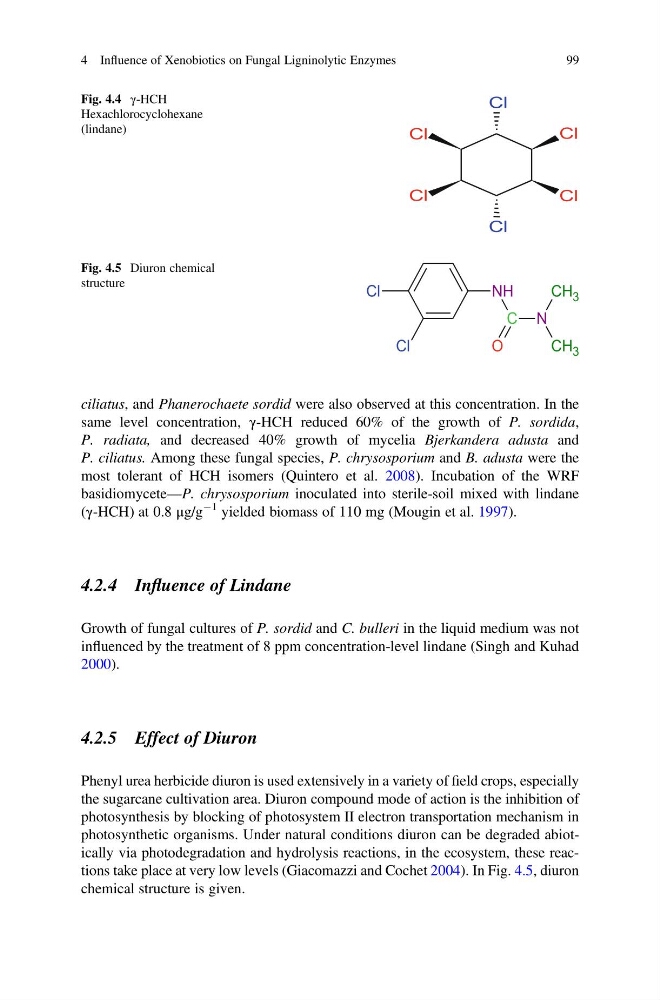
photosynthetic organisms. Under natural conditions diuron can be degraded abiotically via photodegradation and hydrolysis reactions, in the ecosystem, these reactions take place at very low levels (Giacomazzi and Cochet 2004). In Fig. 4.5, diuron
chemical structure is given.
Cl
Cl
Cl
Cl
Cl
Cl
Fig. 4.4 γ-HCH
Hexachlorocyclohexane
(lindane)
Cl
Cl
NH
C N
O
CH 3
CH 3
Fig. 4.5 Diuron chemical
structure
4 Influence of Xenobiotics on Fungal Ligninolytic Enzymes
99
same level concentration, γ-HCH reduced 60% of the growth of P. sordida,
P. radiata, and decreased 40% growth of mycelia Bjerkandera adusta and
P. ciliatus. Among these fungal species, P. chrysosporium and B. adusta were the
most tolerant of HCH isomers (Quintero et al. 2008). Incubation of the WRF
basidiomycete—P. chrysosporium inoculated into sterile-soil mixed with lindane
(γ-HCH) at 0.8 μg/g
À1 yielded biomass of 110 mg (Mougin et al. 1997).
4.2.4 Influence of Lindane
Growth of fungal cultures of P. sordid and C. bulleri in the liquid medium was not
influenced by the treatment of 8 ppm concentration-level lindane (Singh and Kuhad
2000).
4.2.5 Effect of Diuron
Phenyl urea herbicide diuron is used extensively in a variety of field crops, especially
the sugarcane cultivation area. Diuron compound mode of action is the inhibition of
photosynthesis by blocking of photosystem II electron transportation mechanism in
photosynthetic organisms. Under natural conditions diuron can be degraded abiotically via photodegradation and hydrolysis reactions, in the ecosystem, these reactions take place at very low levels (Giacomazzi and Cochet 2004). In Fig. 4.5, diuron
chemical structure is given.
Cl
Cl
Cl
Cl
Cl
Cl
Fig. 4.4 γ-HCH
Hexachlorocyclohexane
(lindane)
Cl
Cl
NH
C N
O
CH 3
CH 3
Fig. 4.5 Diuron chemical
structure
4 Influence of Xenobiotics on Fungal Ligninolytic Enzymes
99