

4.2.1 Effect of Insecticide: Malathion
Malathion is an organophosphorus insecticide that is widely used in agriculture,
forestry system, and housing landscaping. Malathion is extensively used in pest
control programs such as to control sucking insects and chewing insects in various
field crops and also broadly used as a substitute for DTT compound to control insects
of household, parasites of animals, mosquitoes, flies, and head body lice (Chambers
1992; Barlas 1996). Singh et al. (2012) studied the toxicity effect of malathion on
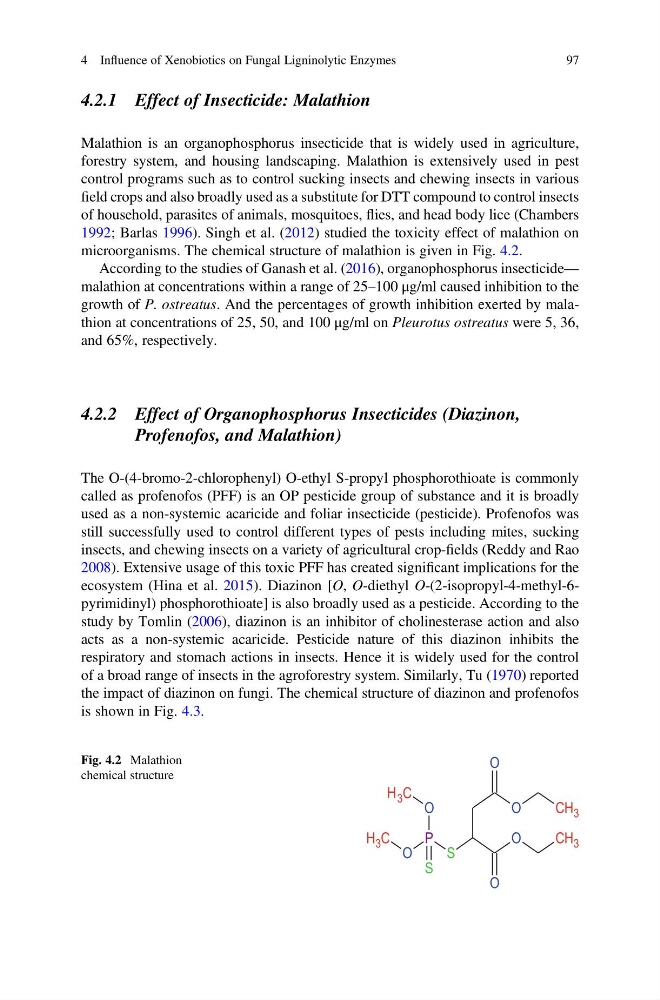
microorganisms. The chemical structure of malathion is given in Fig. 4.2.
According to the studies of Ganash et al. (2016), organophosphorus insecticide—
malathion at concentrations within a range of 25–100 μg/ml caused inhibition to the
growth of P. ostreatus. And the percentages of growth inhibition exerted by malathion at concentrations of 25, 50, and 100 μg/ml on Pleurotus ostreatus were 5, 36,
and 65%, respectively.
4.2.2 Effect of Organophosphorus Insecticides (Diazinon,
Profenofos, and Malathion)
The O-(4-bromo-2-chlorophenyl) O-ethyl S-propyl phosphorothioate is commonly
called as profenofos (PFF) is an OP pesticide group of substance and it is broadly
used as a non-systemic acaricide and foliar insecticide (pesticide). Profenofos was
still successfully used to control different types of pests including mites, sucking
insects, and chewing insects on a variety of agricultural crop-fields (Reddy and Rao
2008). Extensive usage of this toxic PFF has created significant implications for the
ecosystem (Hina et al. 2015). Diazinon [O, O-diethyl O-(2-isopropyl-4-methyl-6pyrimidinyl) phosphorothioate] is also broadly used as a pesticide. According to the
study by Tomlin (2006), diazinon is an inhibitor of cholinesterase action and also
acts as a non-systemic acaricide. Pesticide nature of this diazinon inhibits the
respiratory and stomach actions in insects. Hence it is widely used for the control
of a broad range of insects in the agroforestry system. Similarly, Tu (1970) reported
the impact of diazinon on fungi. The chemical structure of diazinon and profenofos
is shown in Fig. 4.3.
O
O
CH 3
CH 3
O
S
P
C
H 3
O
C
H 3
O
O
S
Fig. 4.2 Malathion
chemical structure
4 Influence of Xenobiotics on Fungal Ligninolytic Enzymes
97
Malathion is an organophosphorus insecticide that is widely used in agriculture,
forestry system, and housing landscaping. Malathion is extensively used in pest
control programs such as to control sucking insects and chewing insects in various
field crops and also broadly used as a substitute for DTT compound to control insects
of household, parasites of animals, mosquitoes, flies, and head body lice (Chambers
1992; Barlas 1996). Singh et al. (2012) studied the toxicity effect of malathion on
microorganisms. The chemical structure of malathion is given in Fig. 4.2.
According to the studies of Ganash et al. (2016), organophosphorus insecticide—
malathion at concentrations within a range of 25–100 μg/ml caused inhibition to the
growth of P. ostreatus. And the percentages of growth inhibition exerted by malathion at concentrations of 25, 50, and 100 μg/ml on Pleurotus ostreatus were 5, 36,
and 65%, respectively.
4.2.2 Effect of Organophosphorus Insecticides (Diazinon,
Profenofos, and Malathion)
The O-(4-bromo-2-chlorophenyl) O-ethyl S-propyl phosphorothioate is commonly
called as profenofos (PFF) is an OP pesticide group of substance and it is broadly
used as a non-systemic acaricide and foliar insecticide (pesticide). Profenofos was
still successfully used to control different types of pests including mites, sucking
insects, and chewing insects on a variety of agricultural crop-fields (Reddy and Rao
2008). Extensive usage of this toxic PFF has created significant implications for the
ecosystem (Hina et al. 2015). Diazinon [O, O-diethyl O-(2-isopropyl-4-methyl-6pyrimidinyl) phosphorothioate] is also broadly used as a pesticide. According to the
study by Tomlin (2006), diazinon is an inhibitor of cholinesterase action and also
acts as a non-systemic acaricide. Pesticide nature of this diazinon inhibits the
respiratory and stomach actions in insects. Hence it is widely used for the control
of a broad range of insects in the agroforestry system. Similarly, Tu (1970) reported
the impact of diazinon on fungi. The chemical structure of diazinon and profenofos
is shown in Fig. 4.3.
O
O
CH 3
CH 3
O
S
P
C
H 3
O
C
H 3
O
O
S
Fig. 4.2 Malathion
chemical structure
4 Influence of Xenobiotics on Fungal Ligninolytic Enzymes
97