

The white rot fungi (WRF) produces the laccases, and extracellular peroxidases
have been recognized as key enzymes taking part in the oxidation of toxic aromatic
polymers (Mester and Tien 2000; Zahmatkesh et al. 2010; Mendonça Maciel et al.
2010). Some of the organic compounds have been degraded by the participation of
cytochrome P450 (CYP) enzymes in WRF (Ning and Wang 2012; Kelly and Kelly
2013; Zhang et al. 2015; Zahmatkesh et al. 2016). The catalytic property CYPs such
as oxidation/hydroxylation/epoxidation reactions which are directly involved in the
bioremediation of pollutants and these CYPs are recognized as hemo-membranebound proteins (Neve and Ingelman-Sundberg 2008; Aranda 2016).
However, the interaction between xenobiotics and the WRF on the secretion of
LMEs has not been evaluated and information is virtually lacking on the impact of
pollutants on growth and production of LE by the WRF. Hence the present book
chapter mainly focused on the effect of xenobiotics/pesticides on the growth (biomass) and secretions of LMEs by WRF and also explained the intern reaction of
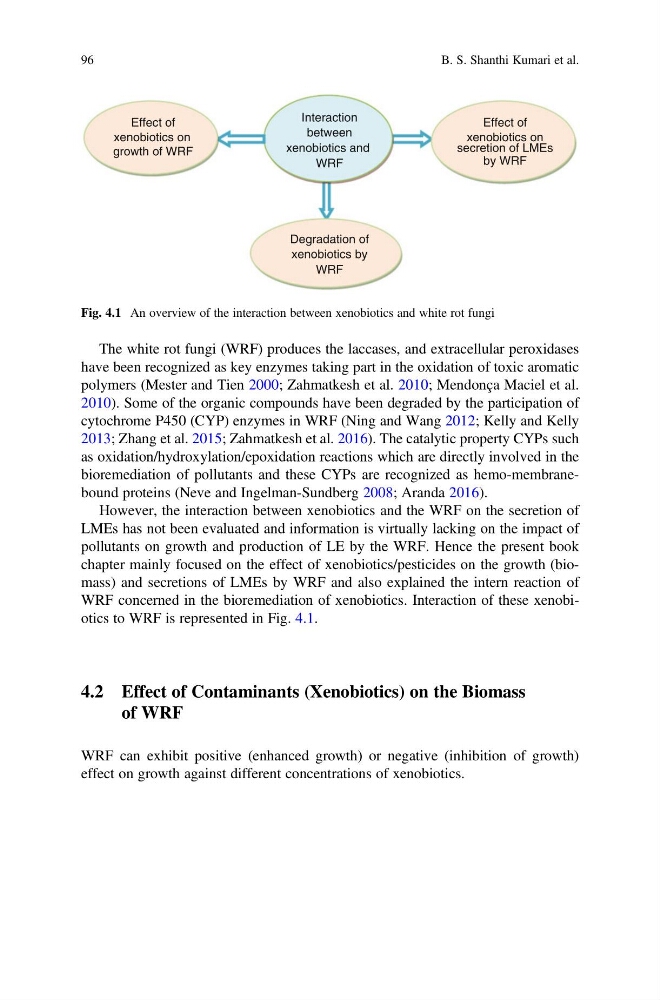
WRF concerned in the bioremediation of xenobiotics. Interaction of these xenobiotics to WRF is represented in Fig. 4.1.
4.2 Effect of Contaminants (Xenobiotics) on the Biomass
of WRF
WRF can exhibit positive (enhanced growth) or negative (inhibition of growth)
effect on growth against different concentrations of xenobiotics.
Effect of
xenobiotics on
growth of WRF
Interaction
between
xenobiotics and
WRF
Degradation of
xenobiotics by
WRF
Effect of
xenobiotics on
secretion of LMEs
by WRF
Fig. 4.1 An overview of the interaction between xenobiotics and white rot fungi
96
B. S. Shanthi Kumari et al.
have been recognized as key enzymes taking part in the oxidation of toxic aromatic
polymers (Mester and Tien 2000; Zahmatkesh et al. 2010; Mendonça Maciel et al.
2010). Some of the organic compounds have been degraded by the participation of
cytochrome P450 (CYP) enzymes in WRF (Ning and Wang 2012; Kelly and Kelly
2013; Zhang et al. 2015; Zahmatkesh et al. 2016). The catalytic property CYPs such
as oxidation/hydroxylation/epoxidation reactions which are directly involved in the
bioremediation of pollutants and these CYPs are recognized as hemo-membranebound proteins (Neve and Ingelman-Sundberg 2008; Aranda 2016).
However, the interaction between xenobiotics and the WRF on the secretion of
LMEs has not been evaluated and information is virtually lacking on the impact of
pollutants on growth and production of LE by the WRF. Hence the present book
chapter mainly focused on the effect of xenobiotics/pesticides on the growth (biomass) and secretions of LMEs by WRF and also explained the intern reaction of
WRF concerned in the bioremediation of xenobiotics. Interaction of these xenobiotics to WRF is represented in Fig. 4.1.
4.2 Effect of Contaminants (Xenobiotics) on the Biomass
of WRF
WRF can exhibit positive (enhanced growth) or negative (inhibition of growth)
effect on growth against different concentrations of xenobiotics.
Effect of
xenobiotics on
growth of WRF
Interaction
between
xenobiotics and
WRF
Degradation of
xenobiotics by
WRF
Effect of
xenobiotics on
secretion of LMEs
by WRF
Fig. 4.1 An overview of the interaction between xenobiotics and white rot fungi
96
B. S. Shanthi Kumari et al.