

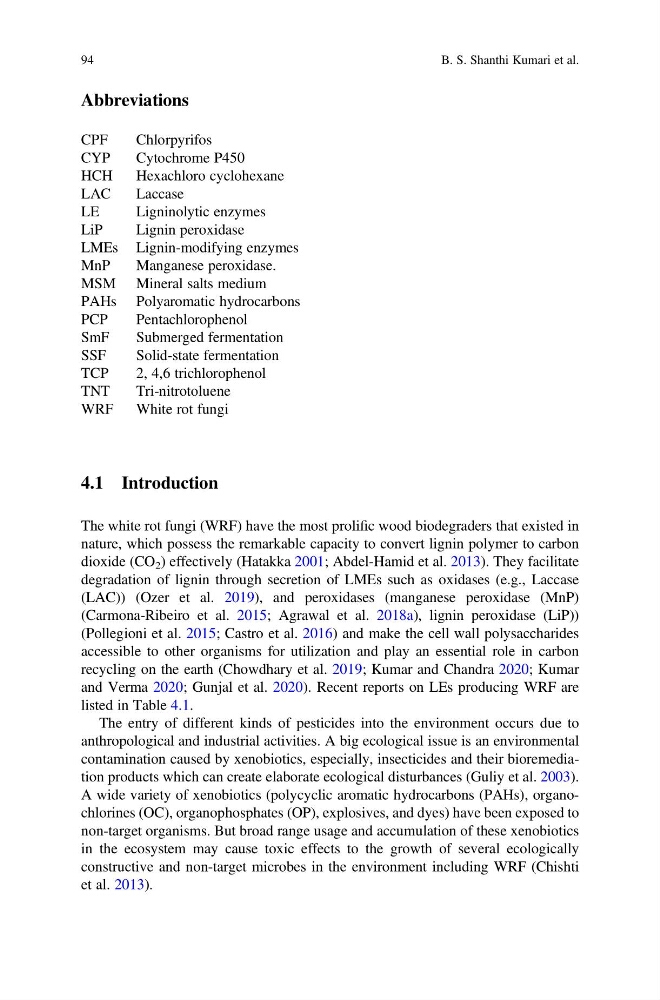
Abbreviations
CPF
Chlorpyrifos
CYP
Cytochrome P450
HCH
Hexachloro cyclohexane
LAC
Laccase
LE
Ligninolytic enzymes
LiP
Lignin peroxidase
LMEs Lignin-modifying enzymes
MnP
Manganese peroxidase.
MSM Mineral salts medium
PAHs Polyaromatic hydrocarbons
PCP
Pentachlorophenol
SmF
Submerged fermentation
SSF
Solid-state fermentation
TCP
2, 4,6 trichlorophenol
TNT
Tri-nitrotoluene
WRF
White rot fungi
4.1 Introduction
The white rot fungi (WRF) have the most prolific wood biodegraders that existed in
nature, which possess the remarkable capacity to convert lignin polymer to carbon
dioxide (CO 2 ) effectively (Hatakka 2001; Abdel-Hamid et al. 2013). They facilitate
degradation of lignin through secretion of LMEs such as oxidases (e.g., Laccase
(LAC)) (Ozer et al. 2019), and peroxidases (manganese peroxidase (MnP)
(Carmona-Ribeiro et al. 2015; Agrawal et al. 2018a), lignin peroxidase (LiP))
(Pollegioni et al. 2015; Castro et al. 2016) and make the cell wall polysaccharides
accessible to other organisms for utilization and play an essential role in carbon
recycling on the earth (Chowdhary et al. 2019; Kumar and Chandra 2020; Kumar
and Verma 2020; Gunjal et al. 2020). Recent reports on LEs producing WRF are
listed in Table 4.1.
The entry of different kinds of pesticides into the environment occurs due to
anthropological and industrial activities. A big ecological issue is an environmental
contamination caused by xenobiotics, especially, insecticides and their bioremediation products which can create elaborate ecological disturbances (Guliy et al. 2003).
A wide variety of xenobiotics (polycyclic aromatic hydrocarbons (PAHs), organochlorines (OC), organophosphates (OP), explosives, and dyes) have been exposed to
non-target organisms. But broad range usage and accumulation of these xenobiotics
in the ecosystem may cause toxic effects to the growth of several ecologically
constructive and non-target microbes in the environment including WRF (Chishti
et al. 2013).
94
B. S. Shanthi Kumari et al.
CPF
Chlorpyrifos
CYP
Cytochrome P450
HCH
Hexachloro cyclohexane
LAC
Laccase
LE
Ligninolytic enzymes
LiP
Lignin peroxidase
LMEs Lignin-modifying enzymes
MnP
Manganese peroxidase.
MSM Mineral salts medium
PAHs Polyaromatic hydrocarbons
PCP
Pentachlorophenol
SmF
Submerged fermentation
SSF
Solid-state fermentation
TCP
2, 4,6 trichlorophenol
TNT
Tri-nitrotoluene
WRF
White rot fungi
4.1 Introduction
The white rot fungi (WRF) have the most prolific wood biodegraders that existed in
nature, which possess the remarkable capacity to convert lignin polymer to carbon
dioxide (CO 2 ) effectively (Hatakka 2001; Abdel-Hamid et al. 2013). They facilitate
degradation of lignin through secretion of LMEs such as oxidases (e.g., Laccase
(LAC)) (Ozer et al. 2019), and peroxidases (manganese peroxidase (MnP)
(Carmona-Ribeiro et al. 2015; Agrawal et al. 2018a), lignin peroxidase (LiP))
(Pollegioni et al. 2015; Castro et al. 2016) and make the cell wall polysaccharides
accessible to other organisms for utilization and play an essential role in carbon
recycling on the earth (Chowdhary et al. 2019; Kumar and Chandra 2020; Kumar
and Verma 2020; Gunjal et al. 2020). Recent reports on LEs producing WRF are
listed in Table 4.1.
The entry of different kinds of pesticides into the environment occurs due to
anthropological and industrial activities. A big ecological issue is an environmental
contamination caused by xenobiotics, especially, insecticides and their bioremediation products which can create elaborate ecological disturbances (Guliy et al. 2003).
A wide variety of xenobiotics (polycyclic aromatic hydrocarbons (PAHs), organochlorines (OC), organophosphates (OP), explosives, and dyes) have been exposed to
non-target organisms. But broad range usage and accumulation of these xenobiotics
in the ecosystem may cause toxic effects to the growth of several ecologically
constructive and non-target microbes in the environment including WRF (Chishti
et al. 2013).
94
B. S. Shanthi Kumari et al.