

dose irrespective of the regime of its administration. The reciprocity principle holds
only in rare cases when multiple conditions are met:
• The material contains only one compound that is affected by light, and there is
only one pathway of its photodegradation.
• By-products of the photochemical reaction do not accumulate and interfere with
any subsequent photochemical reactions and do not participate in any secondary
reactions with other compounds present in the material.
• There are no reactions of any kind that are independent of light (especially
oxidation).
• There are no dark-time reactions.
As illustrated in [156], where microfading tests were performed for several
lightfastness reference materials and silk samples dyed with turmeric, pomegranate,
and cochineal, the reciprocity low cannot be used to obtain color change predictions
for samples highly susceptible to fading as consistent results were obtained only for
the most stable colors from the tested set. For the BWStd 1, authors established that
the light dose required to reach color change equal to 5 (DE* ab calculated with the
CIE 1976 formula) depends strongly on the illumination intensity used—for 1Mlx
illumination, the dose required was 1.7 Mlx h, for 4Mlx—only 0.4 Mlx h.
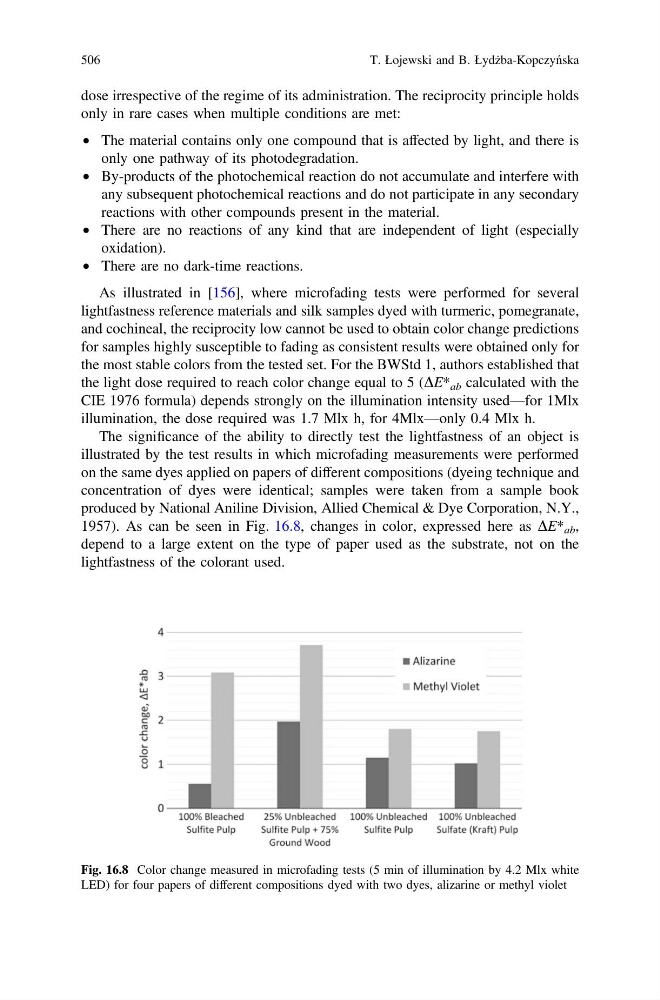
The significance of the ability to directly test the lightfastness of an object is
illustrated by the test results in which microfading measurements were performed
on the same dyes applied on papers of different compositions (dyeing technique and
concentration of dyes were identical; samples were taken from a sample book
produced by National Aniline Division, Allied Chemical & Dye Corporation, N.Y.,
1957). As can be seen in Fig. 16.8, changes in color, expressed here as DE* ab ,
depend to a large extent on the type of paper used as the substrate, not on the
lightfastness of the colorant used.
Fig. 16.8 Color change measured in microfading tests (5 min of illumination by 4.2 Mlx white
LED) for four papers of different compositions dyed with two dyes, alizarine or methyl violet
506
T. Łojewski and B. Łydżba-Kopczyńska
only in rare cases when multiple conditions are met:
• The material contains only one compound that is affected by light, and there is
only one pathway of its photodegradation.
• By-products of the photochemical reaction do not accumulate and interfere with
any subsequent photochemical reactions and do not participate in any secondary
reactions with other compounds present in the material.
• There are no reactions of any kind that are independent of light (especially
oxidation).
• There are no dark-time reactions.
As illustrated in [156], where microfading tests were performed for several
lightfastness reference materials and silk samples dyed with turmeric, pomegranate,
and cochineal, the reciprocity low cannot be used to obtain color change predictions
for samples highly susceptible to fading as consistent results were obtained only for
the most stable colors from the tested set. For the BWStd 1, authors established that
the light dose required to reach color change equal to 5 (DE* ab calculated with the
CIE 1976 formula) depends strongly on the illumination intensity used—for 1Mlx
illumination, the dose required was 1.7 Mlx h, for 4Mlx—only 0.4 Mlx h.
The significance of the ability to directly test the lightfastness of an object is
illustrated by the test results in which microfading measurements were performed
on the same dyes applied on papers of different compositions (dyeing technique and
concentration of dyes were identical; samples were taken from a sample book
produced by National Aniline Division, Allied Chemical & Dye Corporation, N.Y.,
1957). As can be seen in Fig. 16.8, changes in color, expressed here as DE* ab ,
depend to a large extent on the type of paper used as the substrate, not on the
lightfastness of the colorant used.
Fig. 16.8 Color change measured in microfading tests (5 min of illumination by 4.2 Mlx white
LED) for four papers of different compositions dyed with two dyes, alizarine or methyl violet
506
T. Łojewski and B. Łydżba-Kopczyńska