

equivalent to more than 1 year of exposure under a typical museum illumination
(i.e., 100 lx per 10 h/day). The outcomes of MFT experiments allow pointing out
the most fragile objects or elements within a given object as well as compare
lightfastness of materials evaluated for their possible application in conservation
work. Analysis of test results can be carried out directly upon finishing a measurement series, and conclusions are immediate and usually do not require any
interpretive measures and skills. Such a simplicity of transition from measurements
to practical conclusions makes the MFT method particularly useful for laboratories
and conservation workshops operating within cultural institutions, where the
microfader next to the pH meter, microscope, and digital camera might become a
standard piece of equipment used for everyday investigation of artifacts.
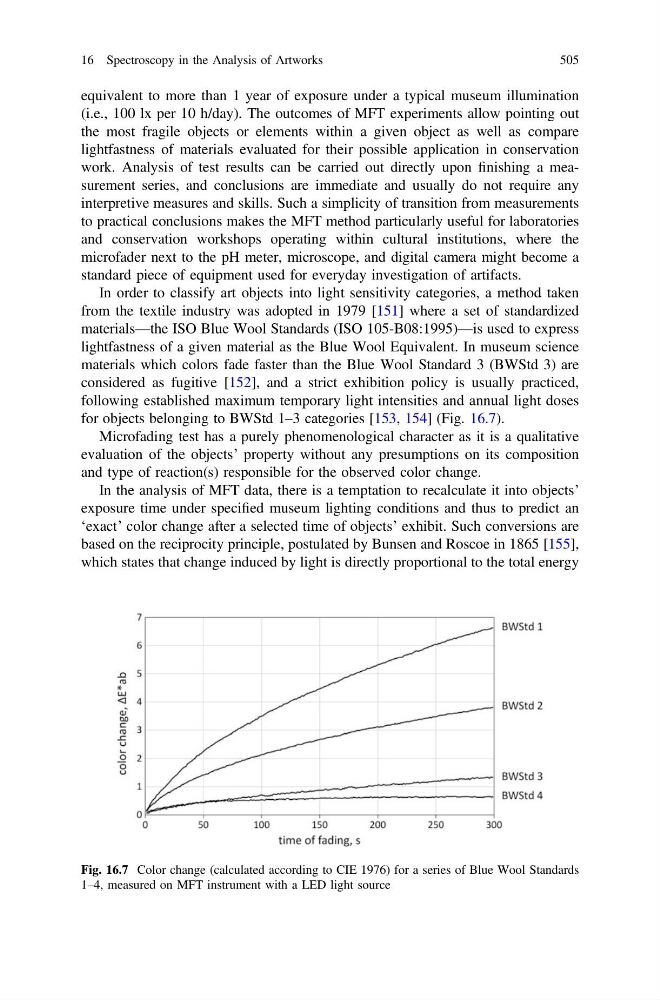
In order to classify art objects into light sensitivity categories, a method taken
from the textile industry was adopted in 1979 [151] where a set of standardized
materials—the ISO Blue Wool Standards (ISO 105-B08:1995)—is used to express
lightfastness of a given material as the Blue Wool Equivalent. In museum science
materials which colors fade faster than the Blue Wool Standard 3 (BWStd 3) are
considered as fugitive [152], and a strict exhibition policy is usually practiced,
following established maximum temporary light intensities and annual light doses
for objects belonging to BWStd 1–3 categories [153, 154] (Fig. 16.7).
Microfading test has a purely phenomenological character as it is a qualitative
evaluation of the objects’ property without any presumptions on its composition
and type of reaction(s) responsible for the observed color change.
In the analysis of MFT data, there is a temptation to recalculate it into objects’
exposure time under specified museum lighting conditions and thus to predict an
‘exact’ color change after a selected time of objects’ exhibit. Such conversions are
based on the reciprocity principle, postulated by Bunsen and Roscoe in 1865 [155],
which states that change induced by light is directly proportional to the total energy
Fig. 16.7 Color change (calculated according to CIE 1976) for a series of Blue Wool Standards
1–4, measured on MFT instrument with a LED light source
16 Spectroscopy in the Analysis of Artworks
505
(i.e., 100 lx per 10 h/day). The outcomes of MFT experiments allow pointing out
the most fragile objects or elements within a given object as well as compare
lightfastness of materials evaluated for their possible application in conservation
work. Analysis of test results can be carried out directly upon finishing a measurement series, and conclusions are immediate and usually do not require any
interpretive measures and skills. Such a simplicity of transition from measurements
to practical conclusions makes the MFT method particularly useful for laboratories
and conservation workshops operating within cultural institutions, where the
microfader next to the pH meter, microscope, and digital camera might become a
standard piece of equipment used for everyday investigation of artifacts.
In order to classify art objects into light sensitivity categories, a method taken
from the textile industry was adopted in 1979 [151] where a set of standardized
materials—the ISO Blue Wool Standards (ISO 105-B08:1995)—is used to express
lightfastness of a given material as the Blue Wool Equivalent. In museum science
materials which colors fade faster than the Blue Wool Standard 3 (BWStd 3) are
considered as fugitive [152], and a strict exhibition policy is usually practiced,
following established maximum temporary light intensities and annual light doses
for objects belonging to BWStd 1–3 categories [153, 154] (Fig. 16.7).
Microfading test has a purely phenomenological character as it is a qualitative
evaluation of the objects’ property without any presumptions on its composition
and type of reaction(s) responsible for the observed color change.
In the analysis of MFT data, there is a temptation to recalculate it into objects’
exposure time under specified museum lighting conditions and thus to predict an
‘exact’ color change after a selected time of objects’ exhibit. Such conversions are
based on the reciprocity principle, postulated by Bunsen and Roscoe in 1865 [155],
which states that change induced by light is directly proportional to the total energy
Fig. 16.7 Color change (calculated according to CIE 1976) for a series of Blue Wool Standards
1–4, measured on MFT instrument with a LED light source
16 Spectroscopy in the Analysis of Artworks
505