

use of a carbon black. Also, the analysis of gray area indicated unusual approach by
the artist to the creation of various hues of colors. The specific gray tonality was
achieved by the combination of such pigments like lapis lazuli, lead white, and
carbon black. Unfortunately, strong fluorescence obscuring Raman spectra collected on the greenish and reddish illuminated area of the Hebrew Bible suggested
the application of organic dye used quite frequently in manuscripts [107].
The comparative Raman analysis of the pigments used in the Breviarium
Romanum revealed the presence of the pigments popular in the medieval minerals,
like azurite (2CuCO 3 ÁCu(OH) 2 ) present in the blue areas, lead white (found in a
carnation), yellow ocher (the yellow earth mineral composed of goethite (FeO(OH)
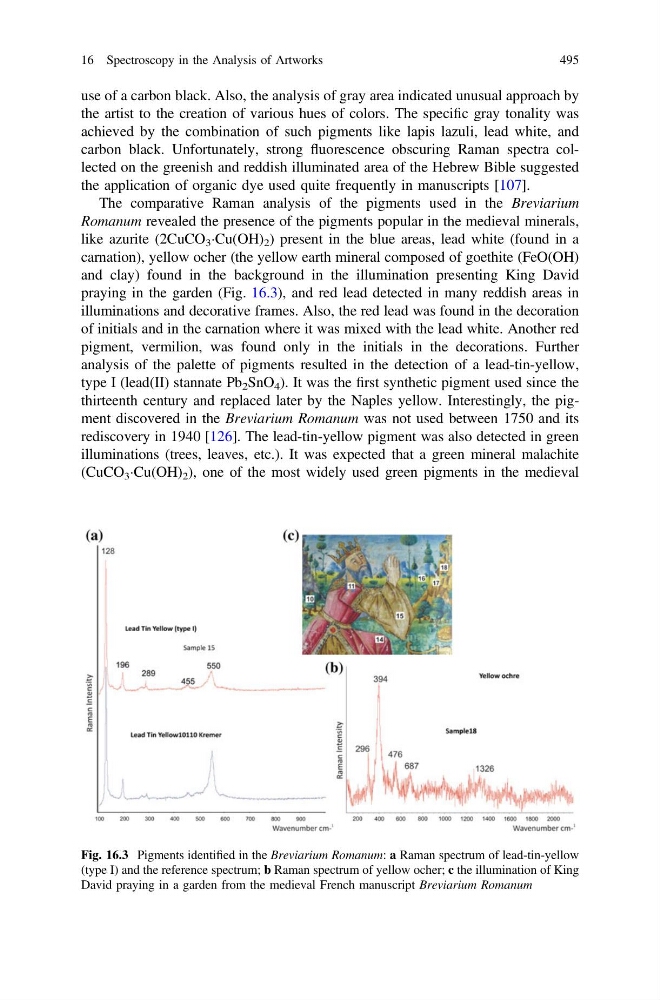
and clay) found in the background in the illumination presenting King David
praying in the garden (Fig. 16.3), and red lead detected in many reddish areas in
illuminations and decorative frames. Also, the red lead was found in the decoration
of initials and in the carnation where it was mixed with the lead white. Another red
pigment, vermilion, was found only in the initials in the decorations. Further
analysis of the palette of pigments resulted in the detection of a lead-tin-yellow,
type I (lead(II) stannate Pb 2 SnO 4 ). It was the first synthetic pigment used since the
thirteenth century and replaced later by the Naples yellow. Interestingly, the pigment discovered in the Breviarium Romanum was not used between 1750 and its
rediscovery in 1940 [126]. The lead-tin-yellow pigment was also detected in green
illuminations (trees, leaves, etc.). It was expected that a green mineral malachite
(CuCO 3 ÁCu(OH) 2 ), one of the most widely used green pigments in the medieval
Fig. 16.3 Pigments identified in the Breviarium Romanum: a Raman spectrum of lead-tin-yellow
(type I) and the reference spectrum; b Raman spectrum of yellow ocher; c the illumination of King
David praying in a garden from the medieval French manuscript Breviarium Romanum
16 Spectroscopy in the Analysis of Artworks
495
the artist to the creation of various hues of colors. The specific gray tonality was
achieved by the combination of such pigments like lapis lazuli, lead white, and
carbon black. Unfortunately, strong fluorescence obscuring Raman spectra collected on the greenish and reddish illuminated area of the Hebrew Bible suggested
the application of organic dye used quite frequently in manuscripts [107].
The comparative Raman analysis of the pigments used in the Breviarium
Romanum revealed the presence of the pigments popular in the medieval minerals,
like azurite (2CuCO 3 ÁCu(OH) 2 ) present in the blue areas, lead white (found in a
carnation), yellow ocher (the yellow earth mineral composed of goethite (FeO(OH)
and clay) found in the background in the illumination presenting King David
praying in the garden (Fig. 16.3), and red lead detected in many reddish areas in
illuminations and decorative frames. Also, the red lead was found in the decoration
of initials and in the carnation where it was mixed with the lead white. Another red
pigment, vermilion, was found only in the initials in the decorations. Further
analysis of the palette of pigments resulted in the detection of a lead-tin-yellow,
type I (lead(II) stannate Pb 2 SnO 4 ). It was the first synthetic pigment used since the
thirteenth century and replaced later by the Naples yellow. Interestingly, the pigment discovered in the Breviarium Romanum was not used between 1750 and its
rediscovery in 1940 [126]. The lead-tin-yellow pigment was also detected in green
illuminations (trees, leaves, etc.). It was expected that a green mineral malachite
(CuCO 3 ÁCu(OH) 2 ), one of the most widely used green pigments in the medieval
Fig. 16.3 Pigments identified in the Breviarium Romanum: a Raman spectrum of lead-tin-yellow
(type I) and the reference spectrum; b Raman spectrum of yellow ocher; c the illumination of King
David praying in a garden from the medieval French manuscript Breviarium Romanum
16 Spectroscopy in the Analysis of Artworks
495