

The Hebrew Bible contains 20 extraordinary illuminations presenting the
impressive range of colors. In all of the investigated illuminations, the parts presenting golden characters were prepared using pure lapis lazuli, the pigment made
from the mineral identified due to the presence of the Raman bands at 258, 548,
822, and 1096 cm
−1 . Various blue tonalities from light blue to navy blue were
achieved by mixing blue pigment with lead white or with carbon black. The Raman
spectra recorded on several white ornaments and on many other white details within
the decoration displayed the Raman band at 1055 cm
−1 , characteristic for the
presence of the lead white (2PbCO 3 ÁPb(OH) 2 ). Lead white was quite commonly
used in carnations, while application of red lead (118, 149, 220, 390, 480, and
548 cm
−1 ) instead of vermilion or red ocher (the clay containing the mineral
hematite Fe 2 O 3 ) in order to create the warm tonality of the carnation as well in
creating other details like red lips or reddish cheeks was less common. Analysis of
the red orange elements revealed the presence of the pure red lead. The Raman
spectra recorded on the red details have shown that in many illuminations the red
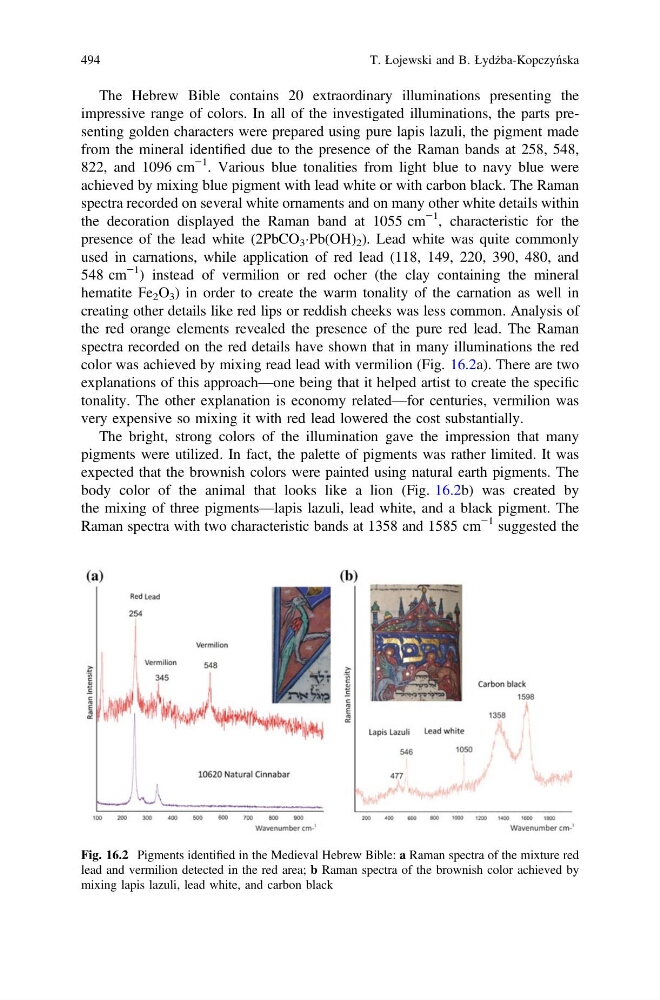
color was achieved by mixing read lead with vermilion (Fig. 16.2a). There are two
explanations of this approach—one being that it helped artist to create the specific
tonality. The other explanation is economy related—for centuries, vermilion was
very expensive so mixing it with red lead lowered the cost substantially.
The bright, strong colors of the illumination gave the impression that many
pigments were utilized. In fact, the palette of pigments was rather limited. It was
expected that the brownish colors were painted using natural earth pigments. The
body color of the animal that looks like a lion (Fig. 16.2b) was created by
the mixing of three pigments—lapis lazuli, lead white, and a black pigment. The
Raman spectra with two characteristic bands at 1358 and 1585 cm
−1 suggested the
Fig. 16.2 Pigments identified in the Medieval Hebrew Bible: a Raman spectra of the mixture red
lead and vermilion detected in the red area; b Raman spectra of the brownish color achieved by
mixing lapis lazuli, lead white, and carbon black
494
T. Łojewski and B. Łydżba-Kopczyńska
impressive range of colors. In all of the investigated illuminations, the parts presenting golden characters were prepared using pure lapis lazuli, the pigment made
from the mineral identified due to the presence of the Raman bands at 258, 548,
822, and 1096 cm
−1 . Various blue tonalities from light blue to navy blue were
achieved by mixing blue pigment with lead white or with carbon black. The Raman
spectra recorded on several white ornaments and on many other white details within
the decoration displayed the Raman band at 1055 cm
−1 , characteristic for the
presence of the lead white (2PbCO 3 ÁPb(OH) 2 ). Lead white was quite commonly
used in carnations, while application of red lead (118, 149, 220, 390, 480, and
548 cm
−1 ) instead of vermilion or red ocher (the clay containing the mineral
hematite Fe 2 O 3 ) in order to create the warm tonality of the carnation as well in
creating other details like red lips or reddish cheeks was less common. Analysis of
the red orange elements revealed the presence of the pure red lead. The Raman
spectra recorded on the red details have shown that in many illuminations the red
color was achieved by mixing read lead with vermilion (Fig. 16.2a). There are two
explanations of this approach—one being that it helped artist to create the specific
tonality. The other explanation is economy related—for centuries, vermilion was
very expensive so mixing it with red lead lowered the cost substantially.
The bright, strong colors of the illumination gave the impression that many
pigments were utilized. In fact, the palette of pigments was rather limited. It was
expected that the brownish colors were painted using natural earth pigments. The
body color of the animal that looks like a lion (Fig. 16.2b) was created by
the mixing of three pigments—lapis lazuli, lead white, and a black pigment. The
Raman spectra with two characteristic bands at 1358 and 1585 cm
−1 suggested the
Fig. 16.2 Pigments identified in the Medieval Hebrew Bible: a Raman spectra of the mixture red
lead and vermilion detected in the red area; b Raman spectra of the brownish color achieved by
mixing lapis lazuli, lead white, and carbon black
494
T. Łojewski and B. Łydżba-Kopczyńska