

carried out with the 647 nm laser; the 514 nm laser was used for other colors. There
were two reasons leading to utilization of the red laser: first, to overcome
the possible fluorescence, especially during analysis of inks; second, to avoid the
decomposition of red lead (minium). Clark et al. [124] have shown that the
application of the laser line 514 nm or the energy at the exit bigger than 2.3 mW for
the line 647 nm caused decomposition of the red lead. Degradation of the pigment
is displayed by the change of the Raman intensity of bands at 125, 485, 555 cm
−1
and by the presence of the additional band at 1095 cm
−1 . Due to this fact, the
application of the adequate laser line and power was of the utmost importance.
The Raman spectra database created on-site for the historical pigments produced
according to the original recipes by Kremer manufacture [125] was used for the
comparative study of both investigated manuscripts. In order to perform the most
efficient comparative analysis, Raman spectra from the database and spectra of
analyzed pigments were collected under the same parameters and equipment.
Additionally, reference samples were prepared for all inks present in the Bible.
Carbon-based and iron gall inks were prepared according to old recipes.
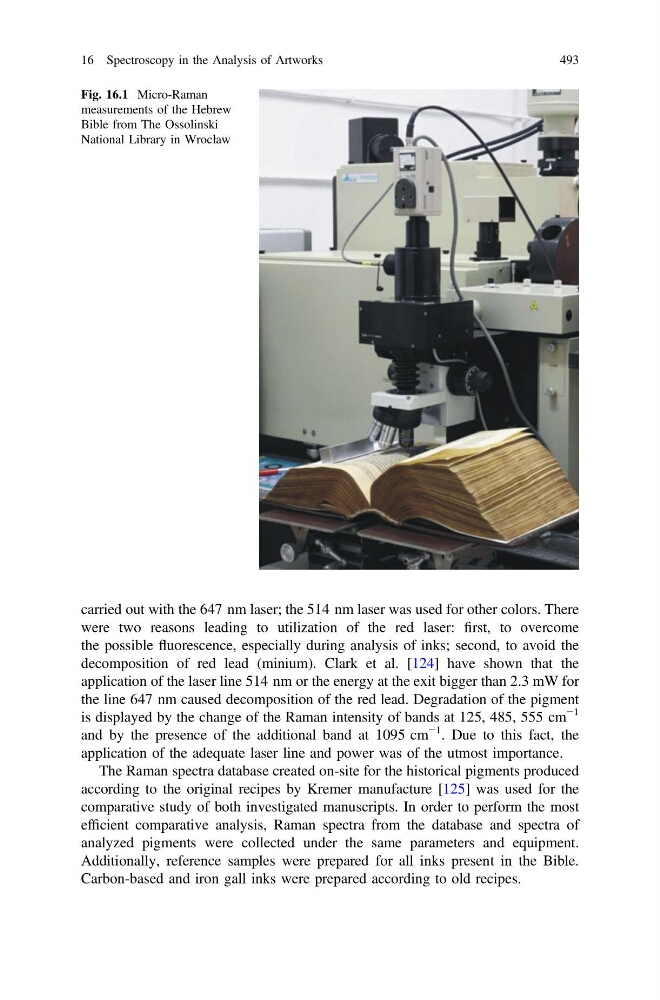
Fig. 16.1 Micro-Raman
measurements of the Hebrew
Bible from The Ossolinski
National Library in Wrocław
16 Spectroscopy in the Analysis of Artworks
493
were two reasons leading to utilization of the red laser: first, to overcome
the possible fluorescence, especially during analysis of inks; second, to avoid the
decomposition of red lead (minium). Clark et al. [124] have shown that the
application of the laser line 514 nm or the energy at the exit bigger than 2.3 mW for
the line 647 nm caused decomposition of the red lead. Degradation of the pigment
is displayed by the change of the Raman intensity of bands at 125, 485, 555 cm
−1
and by the presence of the additional band at 1095 cm
−1 . Due to this fact, the
application of the adequate laser line and power was of the utmost importance.
The Raman spectra database created on-site for the historical pigments produced
according to the original recipes by Kremer manufacture [125] was used for the
comparative study of both investigated manuscripts. In order to perform the most
efficient comparative analysis, Raman spectra from the database and spectra of
analyzed pigments were collected under the same parameters and equipment.
Additionally, reference samples were prepared for all inks present in the Bible.
Carbon-based and iron gall inks were prepared according to old recipes.
Fig. 16.1 Micro-Raman
measurements of the Hebrew
Bible from The Ossolinski
National Library in Wrocław
16 Spectroscopy in the Analysis of Artworks
493