

illuminations and paintings, was used in the green areas. However, the analysis
indicated that the green color was achieved by mixing lead-tin-yellow and azurite.
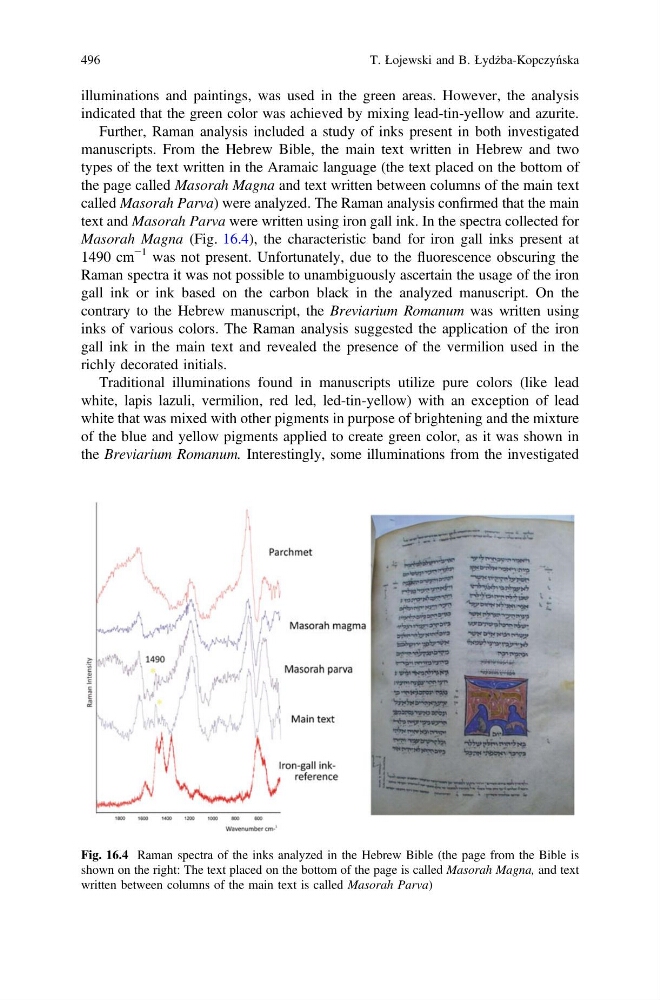
Further, Raman analysis included a study of inks present in both investigated
manuscripts. From the Hebrew Bible, the main text written in Hebrew and two
types of the text written in the Aramaic language (the text placed on the bottom of
the page called Masorah Magna and text written between columns of the main text
called Masorah Parva) were analyzed. The Raman analysis confirmed that the main
text and Masorah Parva were written using iron gall ink. In the spectra collected for
Masorah Magna (Fig. 16.4), the characteristic band for iron gall inks present at
1490 cm
−1 was not present. Unfortunately, due to the fluorescence obscuring the
Raman spectra it was not possible to unambiguously ascertain the usage of the iron
gall ink or ink based on the carbon black in the analyzed manuscript. On the
contrary to the Hebrew manuscript, the Breviarium Romanum was written using
inks of various colors. The Raman analysis suggested the application of the iron
gall ink in the main text and revealed the presence of the vermilion used in the
richly decorated initials.
Traditional illuminations found in manuscripts utilize pure colors (like lead
white, lapis lazuli, vermilion, red led, led-tin-yellow) with an exception of lead
white that was mixed with other pigments in purpose of brightening and the mixture
of the blue and yellow pigments applied to create green color, as it was shown in
the Breviarium Romanum. Interestingly, some illuminations from the investigated
Fig. 16.4 Raman spectra of the inks analyzed in the Hebrew Bible (the page from the Bible is
shown on the right: The text placed on the bottom of the page is called Masorah Magna, and text
written between columns of the main text is called Masorah Parva)
496
T. Łojewski and B. Łydżba-Kopczyńska
indicated that the green color was achieved by mixing lead-tin-yellow and azurite.
Further, Raman analysis included a study of inks present in both investigated
manuscripts. From the Hebrew Bible, the main text written in Hebrew and two
types of the text written in the Aramaic language (the text placed on the bottom of
the page called Masorah Magna and text written between columns of the main text
called Masorah Parva) were analyzed. The Raman analysis confirmed that the main
text and Masorah Parva were written using iron gall ink. In the spectra collected for
Masorah Magna (Fig. 16.4), the characteristic band for iron gall inks present at
1490 cm
−1 was not present. Unfortunately, due to the fluorescence obscuring the
Raman spectra it was not possible to unambiguously ascertain the usage of the iron
gall ink or ink based on the carbon black in the analyzed manuscript. On the
contrary to the Hebrew manuscript, the Breviarium Romanum was written using
inks of various colors. The Raman analysis suggested the application of the iron
gall ink in the main text and revealed the presence of the vermilion used in the
richly decorated initials.
Traditional illuminations found in manuscripts utilize pure colors (like lead
white, lapis lazuli, vermilion, red led, led-tin-yellow) with an exception of lead
white that was mixed with other pigments in purpose of brightening and the mixture
of the blue and yellow pigments applied to create green color, as it was shown in
the Breviarium Romanum. Interestingly, some illuminations from the investigated
Fig. 16.4 Raman spectra of the inks analyzed in the Hebrew Bible (the page from the Bible is
shown on the right: The text placed on the bottom of the page is called Masorah Magna, and text
written between columns of the main text is called Masorah Parva)
496
T. Łojewski and B. Łydżba-Kopczyńska