

15.3 Glass Structure in the Light of Spectroscopic Studies
15.3.1 Model Silica Glass
Silicate glass (m-SiO 2 ) is a typical representative of amorphous bodies. It is recognized as the most important, even model example of a solid with a disordered
structure. Thus, the m-SiO 2 structure often constitutes the starting point for studies
on glasses with more complex compositions.
As previously mentioned, it is assumed that, within the short and intermediaterange order, glass structure corresponds to the order of respective crystalline forms.
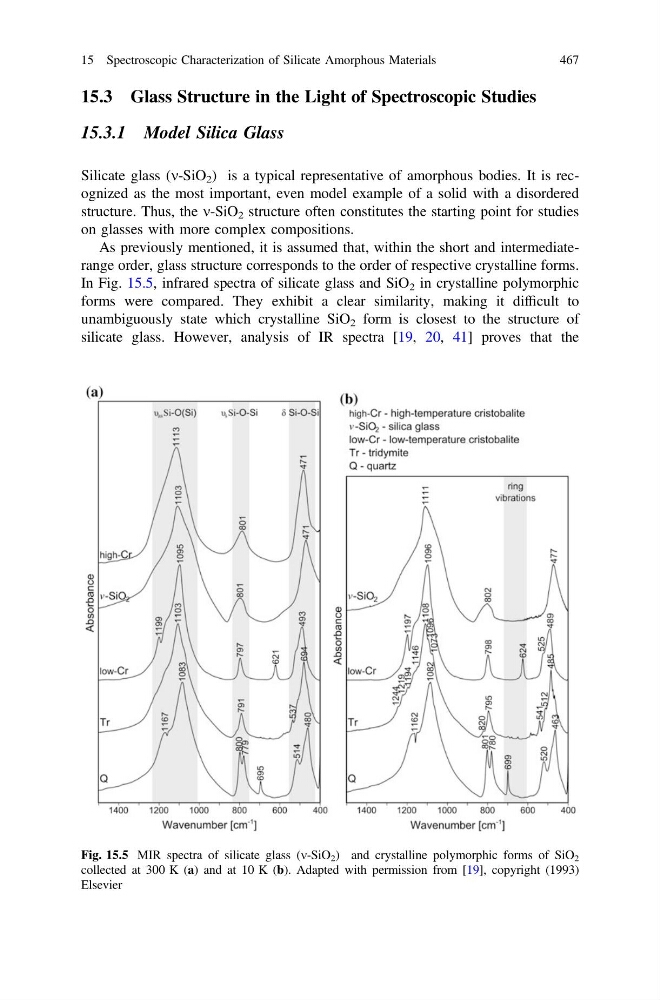
In Fig. 15.5, infrared spectra of silicate glass and SiO 2 in crystalline polymorphic
forms were compared. They exhibit a clear similarity, making it difficult to
unambiguously state which crystalline SiO 2 form is closest to the structure of
silicate glass. However, analysis of IR spectra [19, 20, 41] proves that the
Fig. 15.5 MIR spectra of silicate glass (m-SiO 2 ) and crystalline polymorphic forms of SiO 2
collected at 300 K (a) and at 10 K (b). Adapted with permission from [19], copyright (1993)
Elsevier
15 Spectroscopic Characterization of Silicate Amorphous Materials
467
15.3.1 Model Silica Glass
Silicate glass (m-SiO 2 ) is a typical representative of amorphous bodies. It is recognized as the most important, even model example of a solid with a disordered
structure. Thus, the m-SiO 2 structure often constitutes the starting point for studies
on glasses with more complex compositions.
As previously mentioned, it is assumed that, within the short and intermediaterange order, glass structure corresponds to the order of respective crystalline forms.
In Fig. 15.5, infrared spectra of silicate glass and SiO 2 in crystalline polymorphic
forms were compared. They exhibit a clear similarity, making it difficult to
unambiguously state which crystalline SiO 2 form is closest to the structure of
silicate glass. However, analysis of IR spectra [19, 20, 41] proves that the
Fig. 15.5 MIR spectra of silicate glass (m-SiO 2 ) and crystalline polymorphic forms of SiO 2
collected at 300 K (a) and at 10 K (b). Adapted with permission from [19], copyright (1993)
Elsevier
15 Spectroscopic Characterization of Silicate Amorphous Materials
467