

F
0 x
ð Þ ¼ F x
ð Þ exp 2pc
0 x
ð
Þ¼0:5A
0
i c i Á cos 2pm
0 x
À
Á Á
exp À2p k i À c
0
ð
Þx
½
Rc i
ð15:2Þ
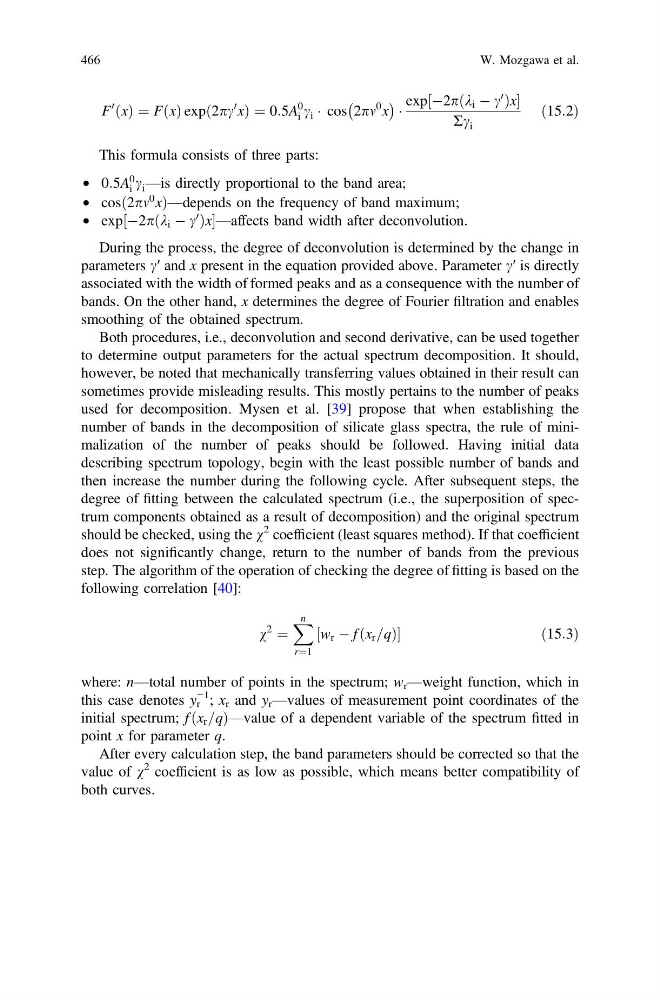
This formula consists of three parts:
• 0:5A
0
i c i —is directly proportional to the band area;
• cos 2pm
0 x
ð
Þ—depends on the frequency of band maximum;
• exp À2p k i À c
0
ð
Þx
½
—affects band width after deconvolution.
During the process, the degree of deconvolution is determined by the change in
parameters c′ and x present in the equation provided above. Parameter c′ is directly
associated with the width of formed peaks and as a consequence with the number of
bands. On the other hand, x determines the degree of Fourier filtration and enables
smoothing of the obtained spectrum.
Both procedures, i.e., deconvolution and second derivative, can be used together
to determine output parameters for the actual spectrum decomposition. It should,
however, be noted that mechanically transferring values obtained in their result can
sometimes provide misleading results. This mostly pertains to the number of peaks
used for decomposition. Mysen et al. [39] propose that when establishing the
number of bands in the decomposition of silicate glass spectra, the rule of minimalization of the number of peaks should be followed. Having initial data
describing spectrum topology, begin with the least possible number of bands and
then increase the number during the following cycle. After subsequent steps, the
degree of fitting between the calculated spectrum (i.e., the superposition of spectrum components obtained as a result of decomposition) and the original spectrum
should be checked, using the v
2 coefficient (least squares method). If that coefficient
does not significantly change, return to the number of bands from the previous
step. The algorithm of the operation of checking the degree of fitting is based on the
following correlation [40]:
v
2
¼
X n
r¼1
w r À f ðx r =qÞ
½
ð 15:3Þ
where: n—total number of points in the spectrum; w r —weight function, which in
this case denotes y r
−1 ; x r and y r —values of measurement point coordinates of the
initial spectrum; f x r =q
ð
Þ—value of a dependent variable of the spectrum fitted in
point x for parameter q.
After every calculation step, the band parameters should be corrected so that the
value of v
2 coefficient is as low as possible, which means better compatibility of
both curves.
466
W. Mozgawa et al.
0 x
ð Þ ¼ F x
ð Þ exp 2pc
0 x
ð
Þ¼0:5A
0
i c i Á cos 2pm
0 x
À
Á Á
exp À2p k i À c
0
ð
Þx
½
Rc i
ð15:2Þ
This formula consists of three parts:
• 0:5A
0
i c i —is directly proportional to the band area;
• cos 2pm
0 x
ð
Þ—depends on the frequency of band maximum;
• exp À2p k i À c
0
ð
Þx
½
—affects band width after deconvolution.
During the process, the degree of deconvolution is determined by the change in
parameters c′ and x present in the equation provided above. Parameter c′ is directly
associated with the width of formed peaks and as a consequence with the number of
bands. On the other hand, x determines the degree of Fourier filtration and enables
smoothing of the obtained spectrum.
Both procedures, i.e., deconvolution and second derivative, can be used together
to determine output parameters for the actual spectrum decomposition. It should,
however, be noted that mechanically transferring values obtained in their result can
sometimes provide misleading results. This mostly pertains to the number of peaks
used for decomposition. Mysen et al. [39] propose that when establishing the
number of bands in the decomposition of silicate glass spectra, the rule of minimalization of the number of peaks should be followed. Having initial data
describing spectrum topology, begin with the least possible number of bands and
then increase the number during the following cycle. After subsequent steps, the
degree of fitting between the calculated spectrum (i.e., the superposition of spectrum components obtained as a result of decomposition) and the original spectrum
should be checked, using the v
2 coefficient (least squares method). If that coefficient
does not significantly change, return to the number of bands from the previous
step. The algorithm of the operation of checking the degree of fitting is based on the
following correlation [40]:
v
2
¼
X n
r¼1
w r À f ðx r =qÞ
½
ð 15:3Þ
where: n—total number of points in the spectrum; w r —weight function, which in
this case denotes y r
−1 ; x r and y r —values of measurement point coordinates of the
initial spectrum; f x r =q
ð
Þ—value of a dependent variable of the spectrum fitted in
point x for parameter q.
After every calculation step, the band parameters should be corrected so that the
value of v
2 coefficient is as low as possible, which means better compatibility of
both curves.
466
W. Mozgawa et al.