

achievement in comparison to known tellurite or fluorogermanate optical fibers. In
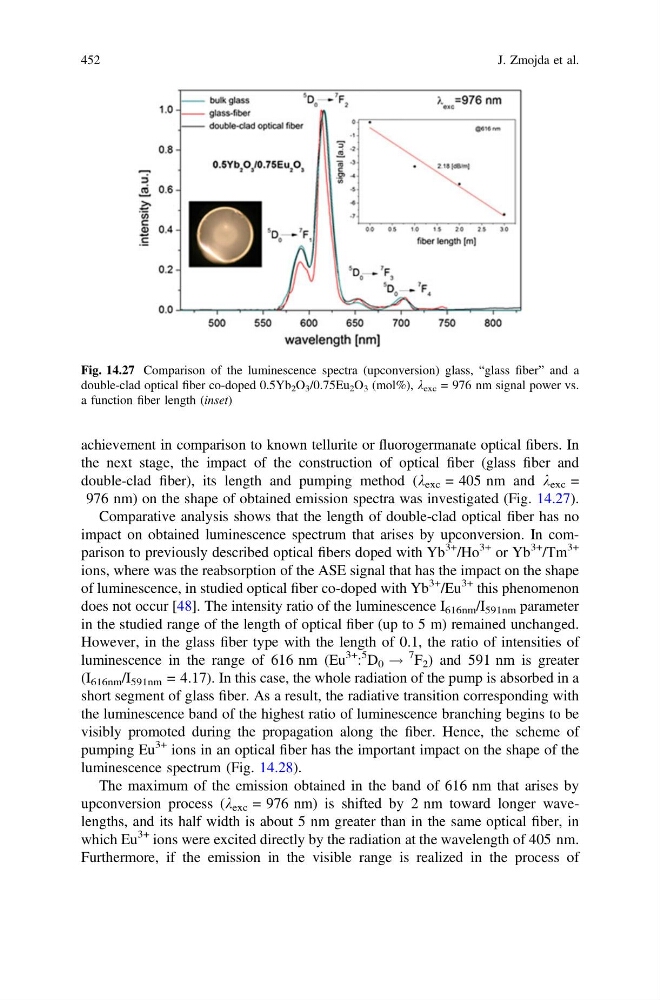
the next stage, the impact of the construction of optical fiber (glass fiber and
double-clad fiber), its length and pumping method (k exc = 405 nm and k exc =
976 nm) on the shape of obtained emission spectra was investigated (Fig. 14.27).
Comparative analysis shows that the length of double-clad optical fiber has no
impact on obtained luminescence spectrum that arises by upconversion. In comparison to previously described optical fibers doped with Yb
3+ /Ho
3+ or Yb
3+ /Tm
3+
ions, where was the reabsorption of the ASE signal that has the impact on the shape
of luminescence, in studied optical fiber co-doped with Yb
3+ /Eu
3+ this phenomenon
does not occur [48]. The intensity ratio of the luminescence I 616nm /I 591nm parameter
in the studied range of the length of optical fiber (up to 5 m) remained unchanged.
However, in the glass fiber type with the length of 0.1, the ratio of intensities of
luminescence in the range of 616 nm (Eu
3+ :
5 D 0 !
7 F 2 ) and 591 nm is greater
(I 616nm /I 591nm = 4.17). In this case, the whole radiation of the pump is absorbed in a
short segment of glass fiber. As a result, the radiative transition corresponding with
the luminescence band of the highest ratio of luminescence branching begins to be
visibly promoted during the propagation along the fiber. Hence, the scheme of
pumping Eu
3+ ions in an optical fiber has the important impact on the shape of the
luminescence spectrum (Fig. 14.28).
The maximum of the emission obtained in the band of 616 nm that arises by
upconversion process (k exc = 976 nm) is shifted by 2 nm toward longer wavelengths, and its half width is about 5 nm greater than in the same optical fiber, in
which Eu
3+ ions were excited directly by the radiation at the wavelength of 405 nm.
Furthermore, if the emission in the visible range is realized in the process of
Fig. 14.27 Comparison of the luminescence spectra (upconversion) glass, “glass fiber” and a
double-clad optical fiber co-doped 0.5Yb 2 O 3 /0.75Eu 2 O 3 (mol%), k exc = 976 nm signal power vs.
a function fiber length (inset)
452
J. Zmojda et al.
the next stage, the impact of the construction of optical fiber (glass fiber and
double-clad fiber), its length and pumping method (k exc = 405 nm and k exc =
976 nm) on the shape of obtained emission spectra was investigated (Fig. 14.27).
Comparative analysis shows that the length of double-clad optical fiber has no
impact on obtained luminescence spectrum that arises by upconversion. In comparison to previously described optical fibers doped with Yb
3+ /Ho
3+ or Yb
3+ /Tm
3+
ions, where was the reabsorption of the ASE signal that has the impact on the shape
of luminescence, in studied optical fiber co-doped with Yb
3+ /Eu
3+ this phenomenon
does not occur [48]. The intensity ratio of the luminescence I 616nm /I 591nm parameter
in the studied range of the length of optical fiber (up to 5 m) remained unchanged.
However, in the glass fiber type with the length of 0.1, the ratio of intensities of
luminescence in the range of 616 nm (Eu
3+ :
5 D 0 !
7 F 2 ) and 591 nm is greater
(I 616nm /I 591nm = 4.17). In this case, the whole radiation of the pump is absorbed in a
short segment of glass fiber. As a result, the radiative transition corresponding with
the luminescence band of the highest ratio of luminescence branching begins to be
visibly promoted during the propagation along the fiber. Hence, the scheme of
pumping Eu
3+ ions in an optical fiber has the important impact on the shape of the
luminescence spectrum (Fig. 14.28).
The maximum of the emission obtained in the band of 616 nm that arises by
upconversion process (k exc = 976 nm) is shifted by 2 nm toward longer wavelengths, and its half width is about 5 nm greater than in the same optical fiber, in
which Eu
3+ ions were excited directly by the radiation at the wavelength of 405 nm.
Furthermore, if the emission in the visible range is realized in the process of
Fig. 14.27 Comparison of the luminescence spectra (upconversion) glass, “glass fiber” and a
double-clad optical fiber co-doped 0.5Yb 2 O 3 /0.75Eu 2 O 3 (mol%), k exc = 976 nm signal power vs.
a function fiber length (inset)
452
J. Zmojda et al.