

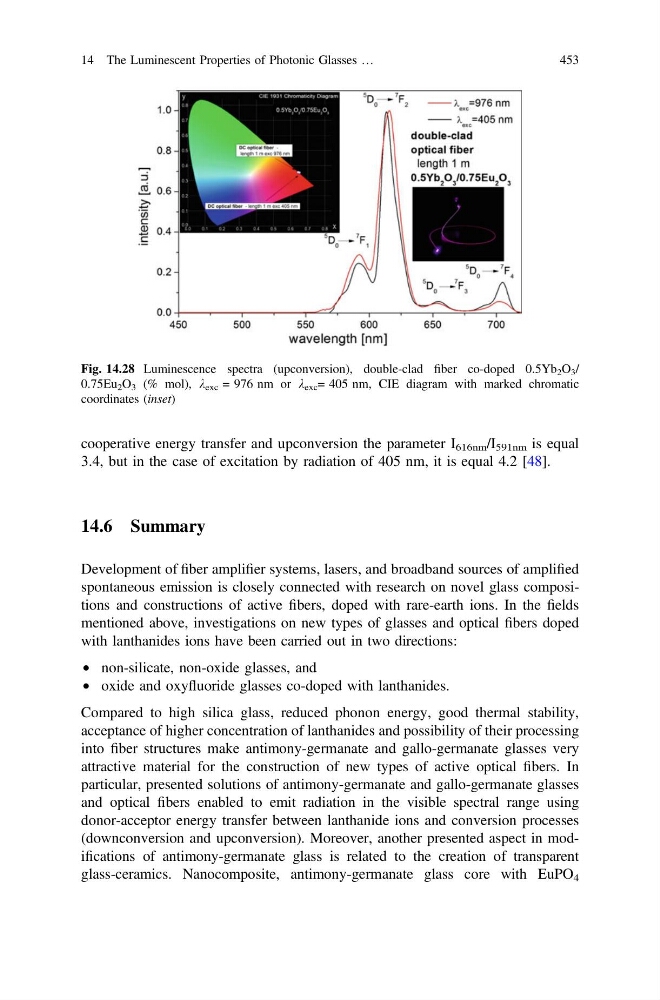
cooperative energy transfer and upconversion the parameter I 616nm /I 591nm is equal
3.4, but in the case of excitation by radiation of 405 nm, it is equal 4.2 [48].
14.6 Summary
Development of fiber amplifier systems, lasers, and broadband sources of amplified
spontaneous emission is closely connected with research on novel glass compositions and constructions of active fibers, doped with rare-earth ions. In the fields
mentioned above, investigations on new types of glasses and optical fibers doped
with lanthanides ions have been carried out in two directions:
• non-silicate, non-oxide glasses, and
• oxide and oxyfluoride glasses co-doped with lanthanides.
Compared to high silica glass, reduced phonon energy, good thermal stability,
acceptance of higher concentration of lanthanides and possibility of their processing
into fiber structures make antimony-germanate and gallo-germanate glasses very
attractive material for the construction of new types of active optical fibers. In
particular, presented solutions of antimony-germanate and gallo-germanate glasses
and optical fibers enabled to emit radiation in the visible spectral range using
donor-acceptor energy transfer between lanthanide ions and conversion processes
(downconversion and upconversion). Moreover, another presented aspect in modifications of antimony-germanate glass is related to the creation of transparent
glass-ceramics. Nanocomposite, antimony-germanate glass core with EuPO 4
Fig. 14.28 Luminescence spectra (upconversion), double-clad fiber co-doped 0.5Yb 2 O 3 /
0.75Eu 2 O 3 (% mol), k exc = 976 nm or k exc = 405 nm, CIE diagram with marked chromatic
coordinates (inset)
14 The Luminescent Properties of Photonic Glasses …
453
3.4, but in the case of excitation by radiation of 405 nm, it is equal 4.2 [48].
14.6 Summary
Development of fiber amplifier systems, lasers, and broadband sources of amplified
spontaneous emission is closely connected with research on novel glass compositions and constructions of active fibers, doped with rare-earth ions. In the fields
mentioned above, investigations on new types of glasses and optical fibers doped
with lanthanides ions have been carried out in two directions:
• non-silicate, non-oxide glasses, and
• oxide and oxyfluoride glasses co-doped with lanthanides.
Compared to high silica glass, reduced phonon energy, good thermal stability,
acceptance of higher concentration of lanthanides and possibility of their processing
into fiber structures make antimony-germanate and gallo-germanate glasses very
attractive material for the construction of new types of active optical fibers. In
particular, presented solutions of antimony-germanate and gallo-germanate glasses
and optical fibers enabled to emit radiation in the visible spectral range using
donor-acceptor energy transfer between lanthanide ions and conversion processes
(downconversion and upconversion). Moreover, another presented aspect in modifications of antimony-germanate glass is related to the creation of transparent
glass-ceramics. Nanocomposite, antimony-germanate glass core with EuPO 4
Fig. 14.28 Luminescence spectra (upconversion), double-clad fiber co-doped 0.5Yb 2 O 3 /
0.75Eu 2 O 3 (% mol), k exc = 976 nm or k exc = 405 nm, CIE diagram with marked chromatic
coordinates (inset)
14 The Luminescent Properties of Photonic Glasses …
453