

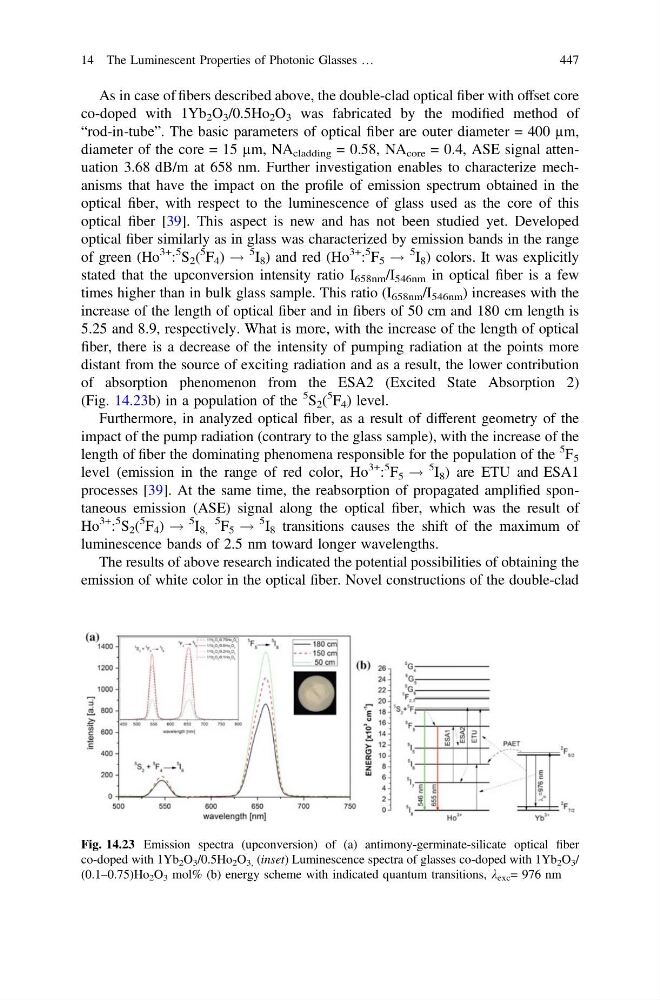
As in case of fibers described above, the double-clad optical fiber with offset core
co-doped with 1Yb 2 O 3 /0.5Ho 2 O 3 was fabricated by the modified method of
“rod-in-tube”. The basic parameters of optical fiber are outer diameter = 400 µm,
diameter of the core = 15 µm, NA cladding = 0.58, NA core = 0.4, ASE signal attenuation 3.68 dB/m at 658 nm. Further investigation enables to characterize mechanisms that have the impact on the profile of emission spectrum obtained in the
optical fiber, with respect to the luminescence of glass used as the core of this
optical fiber [39]. This aspect is new and has not been studied yet. Developed
optical fiber similarly as in glass was characterized by emission bands in the range
of green (Ho
3+ :
5 S 2 (
5 F 4 ) !
5 I 8 ) and red (Ho
3+ :
5 F 5 !
5 I 8 ) colors. It was explicitly
stated that the upconversion intensity ratio I 658nm /I 546nm in optical fiber is a few
times higher than in bulk glass sample. This ratio (I 658nm /I 546nm ) increases with the
increase of the length of optical fiber and in fibers of 50 cm and 180 cm length is
5.25 and 8.9, respectively. What is more, with the increase of the length of optical
fiber, there is a decrease of the intensity of pumping radiation at the points more
distant from the source of exciting radiation and as a result, the lower contribution
of absorption phenomenon from the ESA2 (Excited State Absorption 2)
(Fig. 14.23b) in a population of the
5 S 2 (
5 F 4 ) level.
Furthermore, in analyzed optical fiber, as a result of different geometry of the
impact of the pump radiation (contrary to the glass sample), with the increase of the
length of fiber the dominating phenomena responsible for the population of the
5 F 5
level (emission in the range of red color, Ho
3+ :
5 F 5 !
5 I 8 ) are ETU and ESA1
processes [39]. At the same time, the reabsorption of propagated amplified spontaneous emission (ASE) signal along the optical fiber, which was the result of
Ho
3+ :
5 S 2 (
5 F 4 ) !
5 I 8,
5 F 5 !
5 I 8 transitions causes the shift of the maximum of
luminescence bands of 2.5 nm toward longer wavelengths.
The results of above research indicated the potential possibilities of obtaining the
emission of white color in the optical fiber. Novel constructions of the double-clad
Fig. 14.23 Emission spectra (upconversion) of (a) antimony-germinate-silicate optical fiber
co-doped with 1Yb 2 O 3 /0.5Ho 2 O 3, (inset) Luminescence spectra of glasses co-doped with 1Yb 2 O 3 /
(0.1–0.75)Ho 2 O 3 mol% (b) energy scheme with indicated quantum transitions, k exc = 976 nm
14 The Luminescent Properties of Photonic Glasses …
447
co-doped with 1Yb 2 O 3 /0.5Ho 2 O 3 was fabricated by the modified method of
“rod-in-tube”. The basic parameters of optical fiber are outer diameter = 400 µm,
diameter of the core = 15 µm, NA cladding = 0.58, NA core = 0.4, ASE signal attenuation 3.68 dB/m at 658 nm. Further investigation enables to characterize mechanisms that have the impact on the profile of emission spectrum obtained in the
optical fiber, with respect to the luminescence of glass used as the core of this
optical fiber [39]. This aspect is new and has not been studied yet. Developed
optical fiber similarly as in glass was characterized by emission bands in the range
of green (Ho
3+ :
5 S 2 (
5 F 4 ) !
5 I 8 ) and red (Ho
3+ :
5 F 5 !
5 I 8 ) colors. It was explicitly
stated that the upconversion intensity ratio I 658nm /I 546nm in optical fiber is a few
times higher than in bulk glass sample. This ratio (I 658nm /I 546nm ) increases with the
increase of the length of optical fiber and in fibers of 50 cm and 180 cm length is
5.25 and 8.9, respectively. What is more, with the increase of the length of optical
fiber, there is a decrease of the intensity of pumping radiation at the points more
distant from the source of exciting radiation and as a result, the lower contribution
of absorption phenomenon from the ESA2 (Excited State Absorption 2)
(Fig. 14.23b) in a population of the
5 S 2 (
5 F 4 ) level.
Furthermore, in analyzed optical fiber, as a result of different geometry of the
impact of the pump radiation (contrary to the glass sample), with the increase of the
length of fiber the dominating phenomena responsible for the population of the
5 F 5
level (emission in the range of red color, Ho
3+ :
5 F 5 !
5 I 8 ) are ETU and ESA1
processes [39]. At the same time, the reabsorption of propagated amplified spontaneous emission (ASE) signal along the optical fiber, which was the result of
Ho
3+ :
5 S 2 (
5 F 4 ) !
5 I 8,
5 F 5 !
5 I 8 transitions causes the shift of the maximum of
luminescence bands of 2.5 nm toward longer wavelengths.
The results of above research indicated the potential possibilities of obtaining the
emission of white color in the optical fiber. Novel constructions of the double-clad
Fig. 14.23 Emission spectra (upconversion) of (a) antimony-germinate-silicate optical fiber
co-doped with 1Yb 2 O 3 /0.5Ho 2 O 3, (inset) Luminescence spectra of glasses co-doped with 1Yb 2 O 3 /
(0.1–0.75)Ho 2 O 3 mol% (b) energy scheme with indicated quantum transitions, k exc = 976 nm
14 The Luminescent Properties of Photonic Glasses …
447