

two cores optical fiber (with offset) made of antimony-germanate-silicate glass, in
which the first one was co-doped with 1Yb 2 O 3 /0.1Tm 2 O 3, and the second one was
co-doped with 1Yb 2 O 3 /0.5Ho 2 O 3 was proposed [40, 41]. The aim of the carried out
research was the analysis of possibilities of obtaining the emission of white color in
optical fiber, resulting in the superposition of luminescence bands, which resulted in
radiative transitions in Tm
3+ and Ho
3+ ions. Also, the studies were focused on the
impact of the length of optical fiber and the pumping power on the possibility of
profiling the emission signal of optical fiber indicating their impact on obtained
colorimetric parameters. The basic parameters of fabricated double-core optical
fiber were as follows: outer diameter = 350 µm, diameters of cores = 10 µm,
distance between the cores = 30 µm, offset of the cores = 60 µm,
NA cladding = 0.58, NA core = 0.29, ASE signal attenuation = 3 dB/m (at 481 nm).
Applying the same offset of the cores provides equal pumping of the two cores.
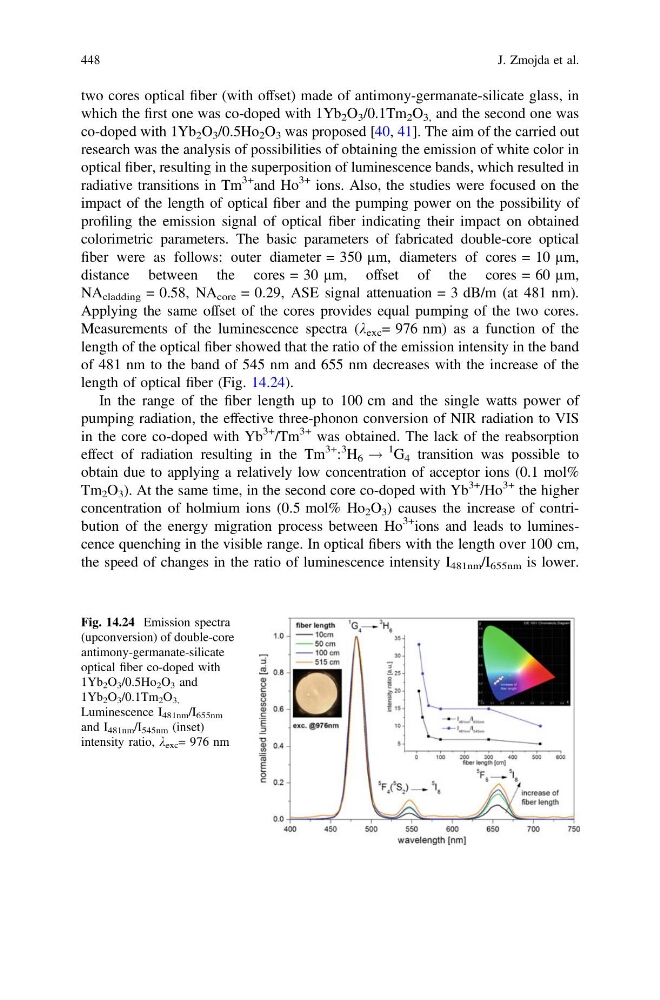
Measurements of the luminescence spectra (k exc = 976 nm) as a function of the
length of the optical fiber showed that the ratio of the emission intensity in the band
of 481 nm to the band of 545 nm and 655 nm decreases with the increase of the
length of optical fiber (Fig. 14.24).
In the range of the fiber length up to 100 cm and the single watts power of
pumping radiation, the effective three-phonon conversion of NIR radiation to VIS
in the core co-doped with Yb
3+ /Tm
3+ was obtained. The lack of the reabsorption
effect of radiation resulting in the Tm
3+ :
3 H 6 !
1 G 4 transition was possible to
obtain due to applying a relatively low concentration of acceptor ions (0.1 mol%
Tm 2 O 3 ). At the same time, in the second core co-doped with Yb
3+ /Ho
3+ the higher
concentration of holmium ions (0.5 mol% Ho 2 O 3 ) causes the increase of contribution of the energy migration process between Ho
3+ ions and leads to luminescence quenching in the visible range. In optical fibers with the length over 100 cm,
the speed of changes in the ratio of luminescence intensity I 481nm /I 655nm is lower.
Fig. 14.24 Emission spectra
(upconversion) of double-core
antimony-germanate-silicate
optical fiber co-doped with
1Yb 2 O 3 /0.5Ho 2 O 3 and
1Yb 2 O 3 /0.1Tm 2 O 3,
Luminescence I 481nm /I 655nm
and I 481nm /I 545nm (inset)
intensity ratio, k exc = 976 nm
448
J. Zmojda et al.
which the first one was co-doped with 1Yb 2 O 3 /0.1Tm 2 O 3, and the second one was
co-doped with 1Yb 2 O 3 /0.5Ho 2 O 3 was proposed [40, 41]. The aim of the carried out
research was the analysis of possibilities of obtaining the emission of white color in
optical fiber, resulting in the superposition of luminescence bands, which resulted in
radiative transitions in Tm
3+ and Ho
3+ ions. Also, the studies were focused on the
impact of the length of optical fiber and the pumping power on the possibility of
profiling the emission signal of optical fiber indicating their impact on obtained
colorimetric parameters. The basic parameters of fabricated double-core optical
fiber were as follows: outer diameter = 350 µm, diameters of cores = 10 µm,
distance between the cores = 30 µm, offset of the cores = 60 µm,
NA cladding = 0.58, NA core = 0.29, ASE signal attenuation = 3 dB/m (at 481 nm).
Applying the same offset of the cores provides equal pumping of the two cores.
Measurements of the luminescence spectra (k exc = 976 nm) as a function of the
length of the optical fiber showed that the ratio of the emission intensity in the band
of 481 nm to the band of 545 nm and 655 nm decreases with the increase of the
length of optical fiber (Fig. 14.24).
In the range of the fiber length up to 100 cm and the single watts power of
pumping radiation, the effective three-phonon conversion of NIR radiation to VIS
in the core co-doped with Yb
3+ /Tm
3+ was obtained. The lack of the reabsorption
effect of radiation resulting in the Tm
3+ :
3 H 6 !
1 G 4 transition was possible to
obtain due to applying a relatively low concentration of acceptor ions (0.1 mol%
Tm 2 O 3 ). At the same time, in the second core co-doped with Yb
3+ /Ho
3+ the higher
concentration of holmium ions (0.5 mol% Ho 2 O 3 ) causes the increase of contribution of the energy migration process between Ho
3+ ions and leads to luminescence quenching in the visible range. In optical fibers with the length over 100 cm,
the speed of changes in the ratio of luminescence intensity I 481nm /I 655nm is lower.
Fig. 14.24 Emission spectra
(upconversion) of double-core
antimony-germanate-silicate
optical fiber co-doped with
1Yb 2 O 3 /0.5Ho 2 O 3 and
1Yb 2 O 3 /0.1Tm 2 O 3,
Luminescence I 481nm /I 655nm
and I 481nm /I 545nm (inset)
intensity ratio, k exc = 976 nm
448
J. Zmojda et al.