

Moreover, another important effect which is decreasing of the luminescence
intensity ratio I 481mn /I 653nm with the increase of the length of optical fiber was
observed. In fabricated optical fiber with a length of 1 m, this value I 481mn /I 653nm is
17.9 and it decreases to 13.8 with the increase of the length optical fiber to 2.5 m.
Such a big change of the intensity of luminescence band I 481mn /I 653nm as a function
of optical fiber length results from the three-level quantum scheme for the emission
band in the range of blue color and simultaneously quasi four-level quantum
scheme in the case of red emission band. Due to the fact that the
3 F 4 level is
separated from the ground level of
3 H 6 , the luminescence in the band of 653 nm
(
1 G 4 !
3 F 4 ) is not reabsorbed in the optical fiber in a process of excitation from the
ground state absorption (GSA) in Tm
3+ ions.
Analogously, antimony-germanate-silicate glass co-doped with Yb
3+ /Ho
3+ ions
was investigated to obtain luminescence in the visible range [39]. Holmium ions do
not absorb radiation in the range of commercially available semiconductor laser
diodes of high power operating in the range of 976 nm. The process of their
excitation results in the Yb
3+
! Ho
3+ energy transfer with the participation of
phonons. Carried out optimization of the concentration of rare-earth has shown that
the maximum concentration of luminescence, obtained in the process of two-photon
upconversion (at 546 nm, (Ho
3+ :
5 S 2 (
5 F 4 ) !
5 I 8 ) and 655.5 nm (Ho
3+ :
5 F 5
5 I 8 ), in
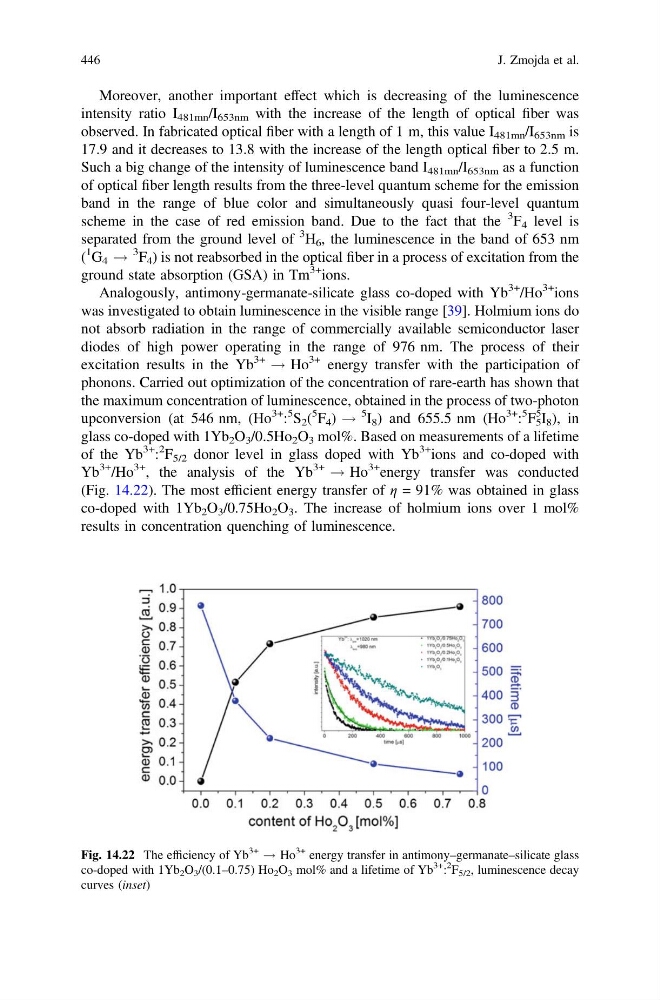
glass co-doped with 1Yb 2 O 3 /0.5Ho 2 O 3 mol%. Based on measurements of a lifetime
of the Yb
3+ :
2 F 5/2 donor level in glass doped with Yb
3+ ions and co-doped with
Yb
3+ /Ho
3+ , the analysis of the Yb
3+
! Ho
3+ energy transfer was conducted
(Fig. 14.22). The most efficient energy transfer of η = 91% was obtained in glass
co-doped with 1Yb 2 O 3 /0.75Ho 2 O 3 . The increase of holmium ions over 1 mol%
results in concentration quenching of luminescence.
Fig. 14.22 The efficiency of Yb
3+ ! Ho
3+ energy transfer in antimony–germanate–silicate glass
co-doped with 1Yb 2 O 3 /(0.1–0.75) Ho 2 O 3 mol% and a lifetime of Yb
3+ :
2
F 5/2 , luminescence decay
curves (inset)
446
J. Zmojda et al.
intensity ratio I 481mn /I 653nm with the increase of the length of optical fiber was
observed. In fabricated optical fiber with a length of 1 m, this value I 481mn /I 653nm is
17.9 and it decreases to 13.8 with the increase of the length optical fiber to 2.5 m.
Such a big change of the intensity of luminescence band I 481mn /I 653nm as a function
of optical fiber length results from the three-level quantum scheme for the emission
band in the range of blue color and simultaneously quasi four-level quantum
scheme in the case of red emission band. Due to the fact that the
3 F 4 level is
separated from the ground level of
3 H 6 , the luminescence in the band of 653 nm
(
1 G 4 !
3 F 4 ) is not reabsorbed in the optical fiber in a process of excitation from the
ground state absorption (GSA) in Tm
3+ ions.
Analogously, antimony-germanate-silicate glass co-doped with Yb
3+ /Ho
3+ ions
was investigated to obtain luminescence in the visible range [39]. Holmium ions do
not absorb radiation in the range of commercially available semiconductor laser
diodes of high power operating in the range of 976 nm. The process of their
excitation results in the Yb
3+
! Ho
3+ energy transfer with the participation of
phonons. Carried out optimization of the concentration of rare-earth has shown that
the maximum concentration of luminescence, obtained in the process of two-photon
upconversion (at 546 nm, (Ho
3+ :
5 S 2 (
5 F 4 ) !
5 I 8 ) and 655.5 nm (Ho
3+ :
5 F 5
5 I 8 ), in
glass co-doped with 1Yb 2 O 3 /0.5Ho 2 O 3 mol%. Based on measurements of a lifetime
of the Yb
3+ :
2 F 5/2 donor level in glass doped with Yb
3+ ions and co-doped with
Yb
3+ /Ho
3+ , the analysis of the Yb
3+
! Ho
3+ energy transfer was conducted
(Fig. 14.22). The most efficient energy transfer of η = 91% was obtained in glass
co-doped with 1Yb 2 O 3 /0.75Ho 2 O 3 . The increase of holmium ions over 1 mol%
results in concentration quenching of luminescence.
Fig. 14.22 The efficiency of Yb
3+ ! Ho
3+ energy transfer in antimony–germanate–silicate glass
co-doped with 1Yb 2 O 3 /(0.1–0.75) Ho 2 O 3 mol% and a lifetime of Yb
3+ :
2
F 5/2 , luminescence decay
curves (inset)
446
J. Zmojda et al.