

As part of the study on luminescence, an increase in the content of Na 2 O
compounds led to increasing the degree of disorder of the local active dopant field,
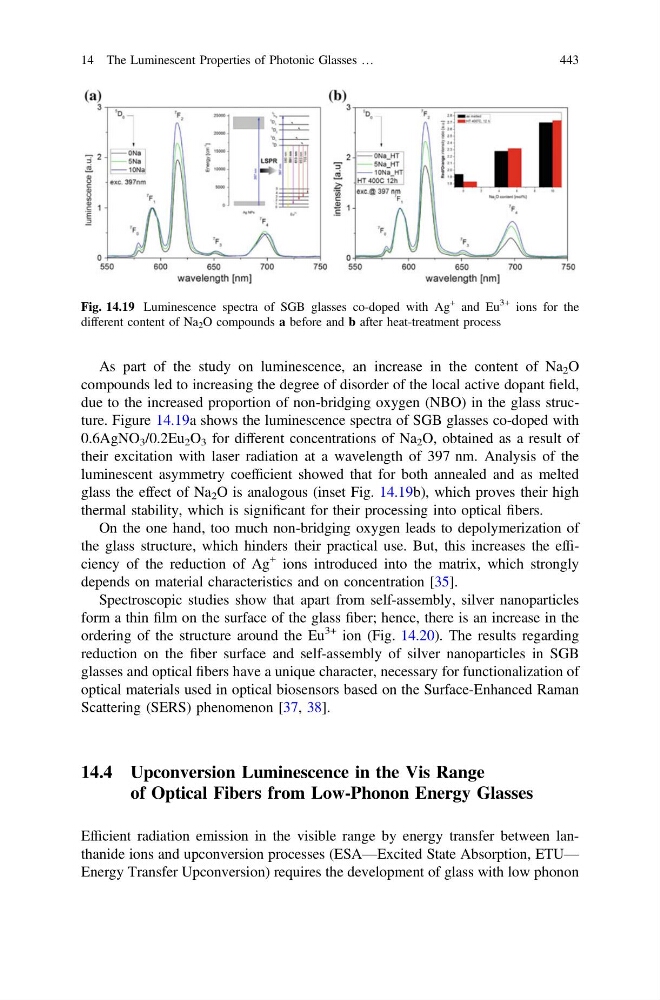
due to the increased proportion of non-bridging oxygen (NBO) in the glass structure. Figure 14.19a shows the luminescence spectra of SGB glasses co-doped with
0.6AgNO 3 /0.2Eu 2 O 3 for different concentrations of Na 2 O, obtained as a result of
their excitation with laser radiation at a wavelength of 397 nm. Analysis of the
luminescent asymmetry coefficient showed that for both annealed and as melted
glass the effect of Na 2 O is analogous (inset Fig. 14.19b), which proves their high
thermal stability, which is significant for their processing into optical fibers.
On the one hand, too much non-bridging oxygen leads to depolymerization of
the glass structure, which hinders their practical use. But, this increases the efficiency of the reduction of Ag
+ ions introduced into the matrix, which strongly
depends on material characteristics and on concentration [35].
Spectroscopic studies show that apart from self-assembly, silver nanoparticles
form a thin film on the surface of the glass fiber; hence, there is an increase in the
ordering of the structure around the Eu
3+ ion (Fig. 14.20). The results regarding
reduction on the fiber surface and self-assembly of silver nanoparticles in SGB
glasses and optical fibers have a unique character, necessary for functionalization of
optical materials used in optical biosensors based on the Surface-Enhanced Raman
Scattering (SERS) phenomenon [37, 38].
14.4 Upconversion Luminescence in the Vis Range
of Optical Fibers from Low-Phonon Energy Glasses
Efficient radiation emission in the visible range by energy transfer between lanthanide ions and upconversion processes (ESA—Excited State Absorption, ETU—
Energy Transfer Upconversion) requires the development of glass with low phonon
Fig. 14.19 Luminescence spectra of SGB glasses co-doped with Ag
+ and Eu
3+ ions for the
different content of Na 2 O compounds a before and b after heat-treatment process
14 The Luminescent Properties of Photonic Glasses …
443
compounds led to increasing the degree of disorder of the local active dopant field,
due to the increased proportion of non-bridging oxygen (NBO) in the glass structure. Figure 14.19a shows the luminescence spectra of SGB glasses co-doped with
0.6AgNO 3 /0.2Eu 2 O 3 for different concentrations of Na 2 O, obtained as a result of
their excitation with laser radiation at a wavelength of 397 nm. Analysis of the
luminescent asymmetry coefficient showed that for both annealed and as melted
glass the effect of Na 2 O is analogous (inset Fig. 14.19b), which proves their high
thermal stability, which is significant for their processing into optical fibers.
On the one hand, too much non-bridging oxygen leads to depolymerization of
the glass structure, which hinders their practical use. But, this increases the efficiency of the reduction of Ag
+ ions introduced into the matrix, which strongly
depends on material characteristics and on concentration [35].
Spectroscopic studies show that apart from self-assembly, silver nanoparticles
form a thin film on the surface of the glass fiber; hence, there is an increase in the
ordering of the structure around the Eu
3+ ion (Fig. 14.20). The results regarding
reduction on the fiber surface and self-assembly of silver nanoparticles in SGB
glasses and optical fibers have a unique character, necessary for functionalization of
optical materials used in optical biosensors based on the Surface-Enhanced Raman
Scattering (SERS) phenomenon [37, 38].
14.4 Upconversion Luminescence in the Vis Range
of Optical Fibers from Low-Phonon Energy Glasses
Efficient radiation emission in the visible range by energy transfer between lanthanide ions and upconversion processes (ESA—Excited State Absorption, ETU—
Energy Transfer Upconversion) requires the development of glass with low phonon
Fig. 14.19 Luminescence spectra of SGB glasses co-doped with Ag
+ and Eu
3+ ions for the
different content of Na 2 O compounds a before and b after heat-treatment process
14 The Luminescent Properties of Photonic Glasses …
443